Unified State / Job 137 / Method and evidence
A place for the next connection.
The previous model's strongest aggregate score hid two weak skills. This release tests those skills directly: the choice of a new parent, and a decision close to a geometric boundary.
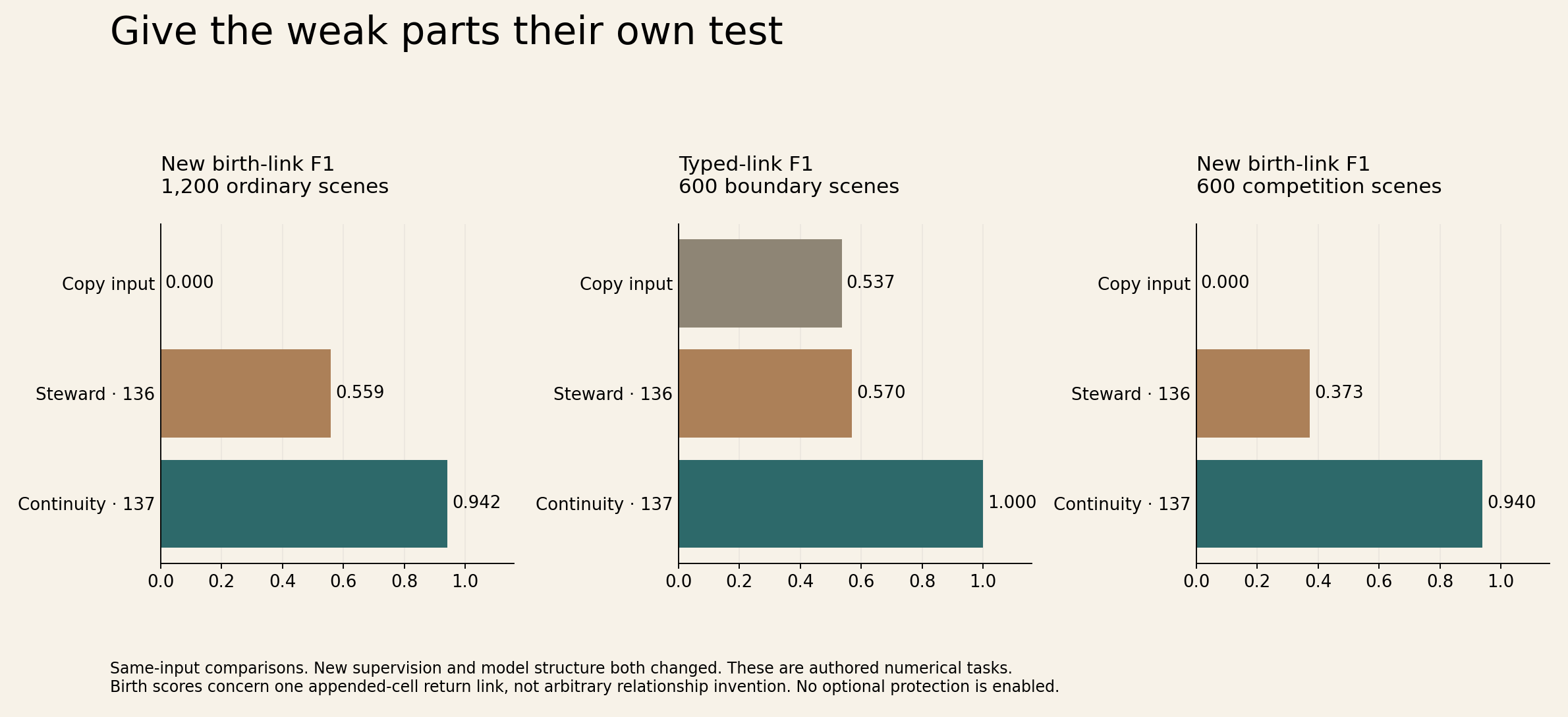
What improved
On 1,200 fresh ordinary fields, actual new-cell link F1 rises from 0.5588 to 0.9420. Whole-graph typed-link F1 changes from 0.9924 to 0.9996. On 600 focused boundary fields, link F1 changes from 0.5700 to 1.0000. On 600 candidate-competition fields, birth-link F1 changes from 0.3731 to 0.9403.
These comparisons run the previous Job136 specialist and the new specialist on the same inputs and the same unchanged field backbone. A fresh copy baseline is included. They are not a comparison between scores from different test sets.
| Scenes | Method | Link F1 | Birth F1 | Persistent recall | Exact graphs |
|---|---|---|---|---|---|
| Ordinary · 1,200 | Copy | 0.9019 | 0.0000 | 100.0% | 28.1% |
| Ordinary · 1,200 | Steward 136 | 0.9924 | 0.5588 | 99.6% | 78.6% |
| Ordinary · 1,200 | Continuity · deployed | 0.9996 | 0.9420 | 100.0% | 97.9% |
| Ordinary · 1,200 | Continuity · replicate 2 | 0.9996 | 0.9420 | 100.0% | 97.9% |
| Ordinary · 1,200 | Continuity · replicate 3 | 0.9995 | 0.9244 | 100.0% | 97.2% |
| Ordinary · 1,200 | Continuity · no additions | 0.9966 | 0.0000 | 100.0% | 81.8% |
| Boundary · 600 | Copy | 0.5367 | — | 100.0% | 53.7% |
| Boundary · 600 | Steward 136 | 0.5700 | — | 19.9% | 57.0% |
| Boundary · 600 | Continuity · deployed | 1.0000 | — | 100.0% | 100.0% |
| Boundary · 600 | Continuity · replicate 2 | 1.0000 | — | 100.0% | 100.0% |
| Boundary · 600 | Continuity · replicate 3 | 1.0000 | — | 100.0% | 100.0% |
| Boundary · 600 | Continuity · no additions | 1.0000 | — | 100.0% | 100.0% |
| Competition · 600 | Copy | 0.8999 | 0.0000 | 100.0% | 22.2% |
| Competition · 600 | Steward 136 | 0.9757 | 0.3731 | 99.5% | 48.0% |
| Competition · 600 | Continuity · deployed | 0.9990 | 0.9403 | 100.0% | 94.5% |
| Competition · 600 | Continuity · replicate 2 | 0.9990 | 0.9403 | 100.0% | 94.5% |
| Competition · 600 | Continuity · replicate 3 | 0.9990 | 0.9389 | 100.0% | 94.2% |
| Competition · 600 | Continuity · no additions | 0.9915 | 0.0000 | 100.0% | 52.5% |
“Birth” here means a connection involving a newly appended cell. A replacement relation type on an existing pair is not counted as a new birth. A dash means no target or predicted births; the archived metric convention gives such empty sets F1=1, but that is not evidence of growth skill. Persistent recall concerns only input links that the teacher says should remain.
How stable are these differences within the sampled scenes?
| New minus previous specialist | F1 difference | Paired-scene 95% interval |
|---|---|---|
| Ordinary birth links | +0.3832 | [0.3380, 0.4297] |
| Competing birth links | +0.5672 | [0.5329, 0.5991] |
| Boundary typed links | +0.4300 | [0.3916, 0.4700] |
These percentile intervals use 2,000 paired resamples per comparison. They describe variation among the authored procedural scenes, exclude training randomness, and make no population claim about meanings or people. Three named intervals are reported without a familywise significance claim. They did not select the model.
The model is a learned hybrid specialist
The 1,121,293-parameter Job135 neural field model remains frozen. It still proposes existing-cell colours, positions, layers, emphasis, membranes and the cell count. A learned growth gate may veto an appended cell; it never invents a cell missing from that proposal. For an emitted birth, a separate deterministic adapter copies the selected input parent’s colour into the newborn. That colour copy is engineered behaviour, not a newly learned colour prediction. The new connection specialist uses fitted decision trees and a two-weight linear selector. It is not a newly enlarged general-purpose neural model.
For existing connections, two fitted one-dimensional classifiers handle the task's mutable symmetric relation types. Their input is exact squared distance. Directed relation types retain their input identity. For growth, a fitted eligibility classifier examines each region–cell pair, then one shared selector compares eligible candidates. It chooses at most one parent, or none. A fitted growth-feasibility tree then uses source and predicted geometry around an explicitly designed vacant-cell query point. Its decision, any count veto and the actual endpoint filter are recorded separately. The query geometry is supplied structure; the teacher target is unavailable at inference.
Candidate features, the legal capacity of 64 cells and 128 links, the availability of exact geometry, and the restriction to one appended-cell return are designed structure. They are not discoveries of meaning. The birth relation type is fitted from the observed training labels, all of which use “returns.” The specialist cannot invent arbitrary new directed relations between existing cells.
What the training deliberately teaches
The training set contains 11,000 new scenes: 6,000 ordinary fields, 2,000 boundary fields and 3,000 competition fields. Development uses a separate 1,200-scene mixture. Additional numerical drills expose boundary equality, candidate eligibility and competing address priorities. The complete training script and manifests record these drills and the later development correction.
The source teacher's rules were already known. Boundary labels are explicitly generated on both sides of those known rules, including equality. The fitted model therefore distils an authored procedure; this is not a discovery of unknown physics, conceptual similarity or philosophical agreement. A direct implementation of that teacher can reproduce its own target exactly. The experiment does not show that learning is necessary or superior to writing those known rules directly.
The new and previous models receive different supervision and have different architectural restrictions. Their comparison establishes a practical improvement in this pipeline, not a controlled causal claim that one architecture wins at equal training cost. The three runs use scene-bootstrap resampling for trees and separate initializations/minibatches for the linear pointer. They are not three independently trained large neural networks. The deployment seed was fixed as 137001 before the final test.
Development was allowed to find a failure
The first development version could choose an eligible parent while still proposing a birth where the teacher's placement was blocked. That version, its weights and its first artwork replies are retained in the full record. The training was revised before the final reservation was opened. The final record distinguishes eligibility, global choice, growth feasibility and actual emission instead of treating them as one successful event.
Final evaluation uses 1,200 ordinary, 600 boundary and 600 competition scenes generated after the explicit model/code freeze. Another 60 starting fields support four-step trajectories. The prior public tests informed development; they were not reused as a secret holdout. The chronology is locally recorded and author-maintained, not externally preregistered or cryptographically independent of the builders.
What the aggregate still cannot promise
The deployed ordinary-field birth count is 203 correct, 9 extra and 16 missing. Complete link sets match in 97.9% of ordinary fields. Raw proposals score 0.9996 overall and 0.9444 on birth links, after the learned availability gate and before deterministic endpoint and capacity filtering. No optional reader protection contributes to these benchmark scores.
A correct parent choice may still fail to produce a valid connection if another field channel supplies the wrong count or placement. Conversely, an exact link set does not guarantee unchanged colour identities, faithful philosophical interpretation or an aesthetically valuable reply. The downloadable records expose both the raw decisions and the filtered output.
The feasibility gate trades recall for precision
Without the learned availability gate, the same new selector produces 218 correct birth links, 67 extras and 1 misses. With the gate those counts become 203, 9 and 16. It avoids 58 extra births at the cost of 15 additional missed births. Birth precision changes from 76.5% to 95.8%, while recall changes from 99.5% to 92.7%. The gate is a useful but imperfect choice under the declared development criterion.
Whole-field count accuracy changes from 92.2% to 96.8%. Newborn colour accuracy, counting a missing newborn as wrong, changes from 71.7% to 92.7%. This colour result uses the explicit selected-parent copy adapter; it is not a newly learned ability to infer concept identity. These supporting metrics do not validate the other geometry, emphasis or membrane channels.
Repeated replies: preserve identity in the measurement too
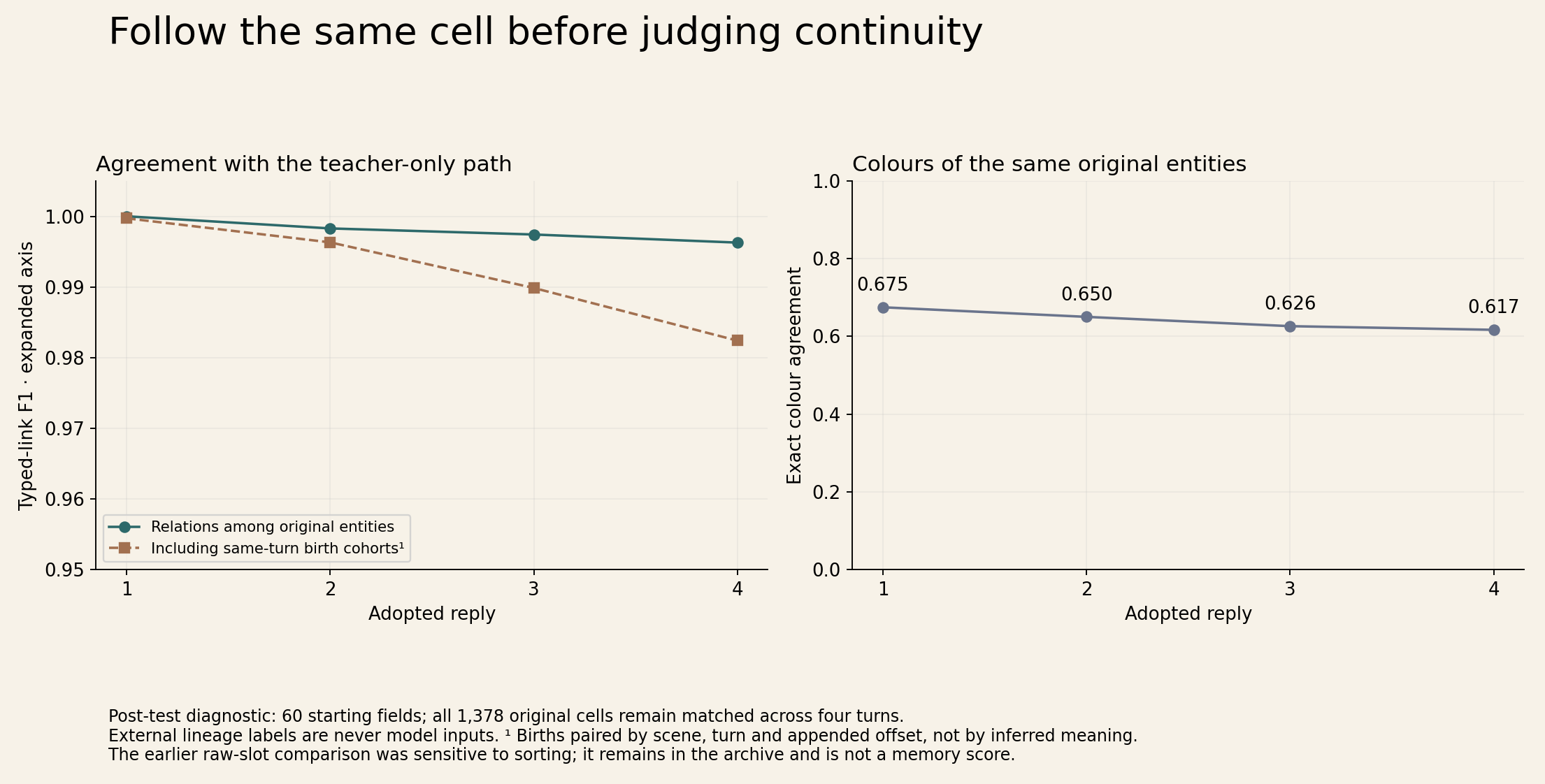
The planned repeated-reply test gives local typed-link F1 of 0.999439 at turn four. It compares each answer with the teacher applied to that model's current input. The initial independent-path comparison instead used freshly sorted numerical slots. Its F1 fell to 0.1263; but moving cells changes their slot numbers. That result mixes actual drift with relabeling and must not be called a loss of relationship memory.
After seeing that problem, we added a stable-lineage diagnostic over the same frozen 60 cases. Original cells carry external identities through each canonicalization; these labels never enter the model. All 1,378 original cells remain present and matched in both paths at every turn. Their accumulated link F1 after four turns is 0.996274. A secondary full-graph score, pairing new births by scene, turn and appended offset, is 0.982397. Different birth timing counts as divergence under that convention.
There is a genuine remaining difference in other channels. Colour agreement for those same original cells with the independent teacher-only path is 67.5% after one turn and 61.7% after four. Coordinate mean absolute error grows from 7.06 to 23.57 units on the 0–1000 grid. The model path contains 40 surviving new cells versus 52 in the teacher path. Thus, strong link stewardship does not establish whole-field fidelity.
The diagnostic was added after testing and is disclosed as such. The original ordering-sensitive record is preserved. Neither measure establishes semantic memory, and the intervention did not retrain or select the model.
The works and the reader's control
Four author-composed seeds were fixed before viewing the new outputs. Every three-turn Continuity reply and a paired first Job136 reply are retained: 20 final fields including the inputs. The initial development replies are archived separately. Each final work has a raw field, Carrier word representation, USL1 packet, CVP2 image and artwork PNG. Actual decoding verifies transport; it does not certify a reading.
The paired works “A boundary does not settle a difference” and “Two units, the same right to differ” place the same first pair 149 and 151 units apart. They make a deliberate distinction visible: resolving a numerical threshold does not resolve a conceptual tension. Author readings accompany the fields as interpretations, not hidden English originals or labels used to train the model.
A separate pretrained interpreter received only the CHOICE input/reply fields, grammar and definitions for their selected colours. It read the reply as more insistent maintenance of an open conversation, while offering a contrasting reading of contraction: twelve distinct input anchors become eight distinct anchors in the thirteen-cell reply. A recognizable scaffold now repeats correction and attention to difficulty. The reader did not see author readings, model code or results. This is one interpretive encounter, not an artistic score or evidence of the model's intent. Read both interpretations and the exact observations.
The instrument allows comparison with both previous models, saving the complete run, and adopting a reply as the next field. A reader can protect all or selected links and their endpoint colours. Those restorations are explicit software policy. A missing protected endpoint or a capacity conflict rejects the complete proposal and keeps the input. The raw proposal remains inspectable. Protection does not guarantee that coexisting relationships are semantically consistent.
Verification and limits
Separate set-based auditing checks link metrics from the saved predictions. Runtime comparisons check the JavaScript and Python specialist on the same fixtures. The release includes source-only inference checks, exact transport checks, local link checks, protection tests, inert-DOM interaction tests and an extracted-archive reproduction check. These are local engineering checks, not an external replication.
The preserved development record includes an initial NumPy-integer serialization failure. Later, an editorial correction from “published” to “initial” in the lineage diagnostic changed its code hash; the provenance check rejected the stale recorded hash. The diagnostic was regenerated from the same frozen model and inputs, with unchanged numerical results, and audited again. Both failure records remain available. Checks were not weakened to accept either mismatch.
Browser policy prevented rendered local-file testing. No alternate browser, content injection or server workaround was used. Actual rendered-browser behaviour, physical mobile devices and the live WordPress theme remain untested. The ready-to-upload files have not themselves changed the website.
This release establishes stronger numerical decisions within a disclosed expression environment. It does not establish subjective colour experience, semantic comprehension, general intelligence or a Carrier-specific advantage over another representation with equivalent mechanics. The workspace is more capable in these tested ways; the interpretation of its works remains open.
Research context
Vinyals, Fortunato and Jaitly's Pointer Networks provides a precedent for selecting input addresses, but this two-weight selector is not their neural architecture. Guo and colleagues' work on calibration motivates a separate caution: the displayed scores and geometric margins are not calibrated probabilities of correctness. Neither paper's results validate this implementation.