Unified State / Job 138 / Method and evidence
What a reply carries forward.
A relation can survive while the colours at its ends drift. This study tests the complete evolving field: colours, positions, layers, emphasis, membranes, counts and typed connections.
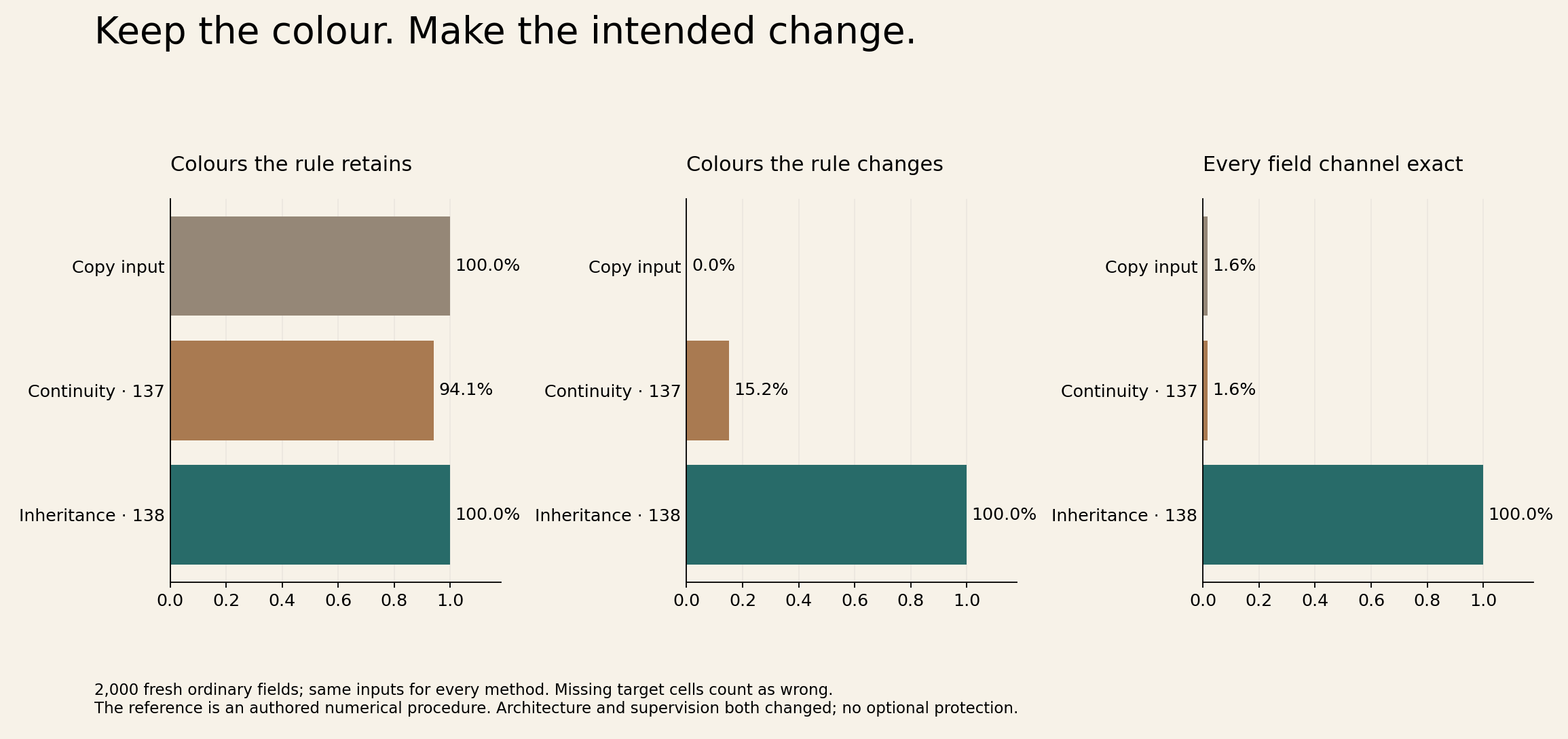
The result in its proper scope
On 2,000 fresh ordinary fields, the deployed program matches every target channel in 2,000 fields (100.0%). The previous Continuity model matches 32 complete fields on those same inputs. Actual birth links total 382 correct, 0 extra and 0 missed, compared with 350, 3 and 32 for Continuity. A birth link joins a newly appended cell to its selected parent; it is not arbitrary relationship invention.
This is a deliberately narrower and more transparent mechanism than a larger neural network. It is a fitted source-anchored program, trained with intermediate traces and boundary drills from an already known teacher. Much of its execution structure is authored. A direct implementation of that teacher can reproduce its own output exactly; this study does not establish that fitting the program is necessary or superior to implementing those rules directly.
| Fields | Method | Whole field exact | Colour exact | Typed-link F1 | Birth links correct / extra / missed |
|---|---|---|---|---|---|
| Ordinary · 2,000 | Copy | 1.6% | 67.9% | 0.9010 | 0 / 0 / 382 |
| Ordinary · 2,000 | Continuity 137 | 1.6% | 69.5% | 0.9997 | 350 / 3 / 32 |
| Ordinary · 2,000 | Inheritance · deployed | 100.0% | 100.0% | 1.0000 | 382 / 0 / 0 |
| Ordinary · 2,000 | Fitting resample 2 | 100.0% | 100.0% | 1.0000 | 382 / 0 / 0 |
| Ordinary · 2,000 | Fitting resample 3 | 100.0% | 100.0% | 1.0000 | 382 / 0 / 0 |
| Focused mixture · 480 | Copy | 4.2% | 79.3% | 0.8894 | 0 / 0 / 201 |
| Focused mixture · 480 | Continuity 137 | 4.2% | 82.6% | 0.9969 | 174 / 12 / 27 |
| Focused mixture · 480 | Inheritance · deployed | 100.0% | 100.0% | 1.0000 | 201 / 0 / 0 |
| Focused mixture · 480 | Fitting resample 2 | 100.0% | 100.0% | 1.0000 | 201 / 0 / 0 |
| Focused mixture · 480 | Fitting resample 3 | 100.0% | 100.0% | 1.0000 | 201 / 0 / 0 |
Every channel, including partial accuracy
| Ordinary fields | Copy | Continuity 137 | Inheritance 138 |
|---|---|---|---|
| Colour accuracy | 67.9% | 69.5% | 100.0% |
| Exact coordinate pair | 0.5% | 0.4% | 100.0% |
| Coordinate MAE · matched cells | 7.430 | 6.982 | 0.000 |
| Layer accuracy | 73.1% | 93.8% | 100.0% |
| Emphasis accuracy | 66.3% | 84.5% | 100.0% |
| Correct cell count | 80.0% | 97.5% | 100.0% |
| Exact membrane geometry | 3.5% | 0.0% | 100.0% |
| Membrane geometry MAE · matched regions | 3.059 | 5.289 | 0.000 |
| Membrane pattern accuracy | 57.4% | 99.4% | 100.0% |
Exact field equality is deliberately strict. Partial scores show how close a non-exact reply remains. Coordinate error uses field units on a 0–1000 grid; membrane geometry error averages its centre coordinates and radius. MAE includes only matched items, so it must be read alongside counts, missing-item penalties and complete-field accuracy.
Full-field exactness requires all numerical channels and counts to match, including null apertures and membranes. The source and reply use a declared cell correspondence; hashes, artwork IDs and administrative names are not prediction targets. Missing target cells count as wrong in colour scores; extra cells and incorrect counts prevent complete-field success. Typed-link scores compare sets including relation type and directed endpoints. Empty link sets have the conventional F1 of 1 when both are empty, so birth counts are shown explicitly.
The ordinary set contains 385 target newborn cells but 382 target birth links. In three cases the teacher's 128-link output limit omits the appended link. The new program reproduces both counts exactly. Cell-birth decisions and emitted birth links are separate metrics; the result must not be described as 382 total new cells. Inspect the first recorded predecessor errors in three categories.
Fidelity includes legitimate change
The new program gets 29,173 of 29,173 retained-colour targets and 13,403 of 13,403 changed-colour targets right. Their respective accuracies are 100.0% and 100.0%. Copying the input retains colours but cannot perform the teacher's required replacements. This split prevents “never change anything” from passing as a complete reply.
Colours are categorical Carrier identities, not continuous RGB estimates. The program starts from the source. It can keep an existing colour or name a particular source cell to copy. Source choices are synchronous: copying a source colour means its input value, even if that source receives another colour in the same reply. A null remains an explicit non-selection unless the numerical update selects an input colour for it. The interpreter may still challenge whether that update suits a particular artwork.
What was fitted, and what was designed
Training fits small displacement coefficients, a strength formula, choices among supplied layer and emphasis operators, colour-copy roles, rank weights for competing source choices, region operators, and compact threshold classifiers for relation changes, membership, parent eligibility, birth availability and deletion. It also fits observed newborn attributes and membrane-update parameters. The record includes every fitted value.
The operator library, source-copy option, execution order, square-root degree normalization, saturation limits, vacant-cell query scaffold, 26-unit spacing repair, output capacities and numerical rounding are designed. Training instrumentation exposes the teacher's intermediate operations. Boundary microdrills use its known cutoffs; rank drills use known priority labels. The membrane-drift supervision explicitly incorporates the known teacher factor. Fitted coefficients are stabilized to nine decimal places under the development plan. This is teacher-informed program distillation, not independent discovery of the habitat's rules.
The public default executes that small program directly. It does not call the old neural backbone and does not call the teacher at inference. The older 1,121,293-parameter field network remains available only for optional comparisons with Jobs 135 and 137. Colour definitions are available to readers but are not inputs to the fitted calculation. The numerical program does not infer that “invites” entails agreement, or that a copied colour carries consent.
Fresh fields, then eight successive replies
The training plan starts with 1,960 fresh scenes and two teacher rollout steps, yielding a pool of 5,880 states. Each of the three named fits draws 1,200 states with replacement from that pool. All three converge to the same effective runtime operators and coefficients; their training-count metadata differ. They are not three independently trained neural architectures or three independent estimates of performance. Development contains 590 scenes. The deployment seed, 138001, was fixed before final evaluation. All three fitted versions are reported. Model, training and evaluation code, weights and relevant dependencies were hashed before fresh final inputs were generated. The freeze is local evidence of this workflow, not an externally timestamped preregistration.
Final tests contain 2,000 ordinary scenes and 480 focused scenes. The latter has 80 cases each for candidate competition, null competition, relation thresholds, membrane membership and all-null fields; 60 cases at designed birth clearances of 25, 26 and 27 units; and 20 empty fields. The clearance cases replaced 60 duplicate empty cases before final generation. Empty-field success is kept separate below; 32 ordinary inputs are also empty. Seeds are disjoint from earlier numerical exercises, but empty states and finite boundary motifs can recur. The same palette and authored rule system remain in use. These are new procedural instances of familiar rules, not an out-of-domain test of semantics.
| Focused subgroup | Scenes | Inheritance whole field exact | Continuity whole field exact |
|---|---|---|---|
| all null | 80 | 100.0% | 0.0% |
| birth boundary | 60 | 100.0% | 0.0% |
| competition | 80 | 100.0% | 0.0% |
| edge boundary | 80 | 100.0% | 0.0% |
| empty | 20 | 100.0% | 100.0% |
| membership | 80 | 100.0% | 0.0% |
| null competition | 80 | 100.0% | 0.0% |
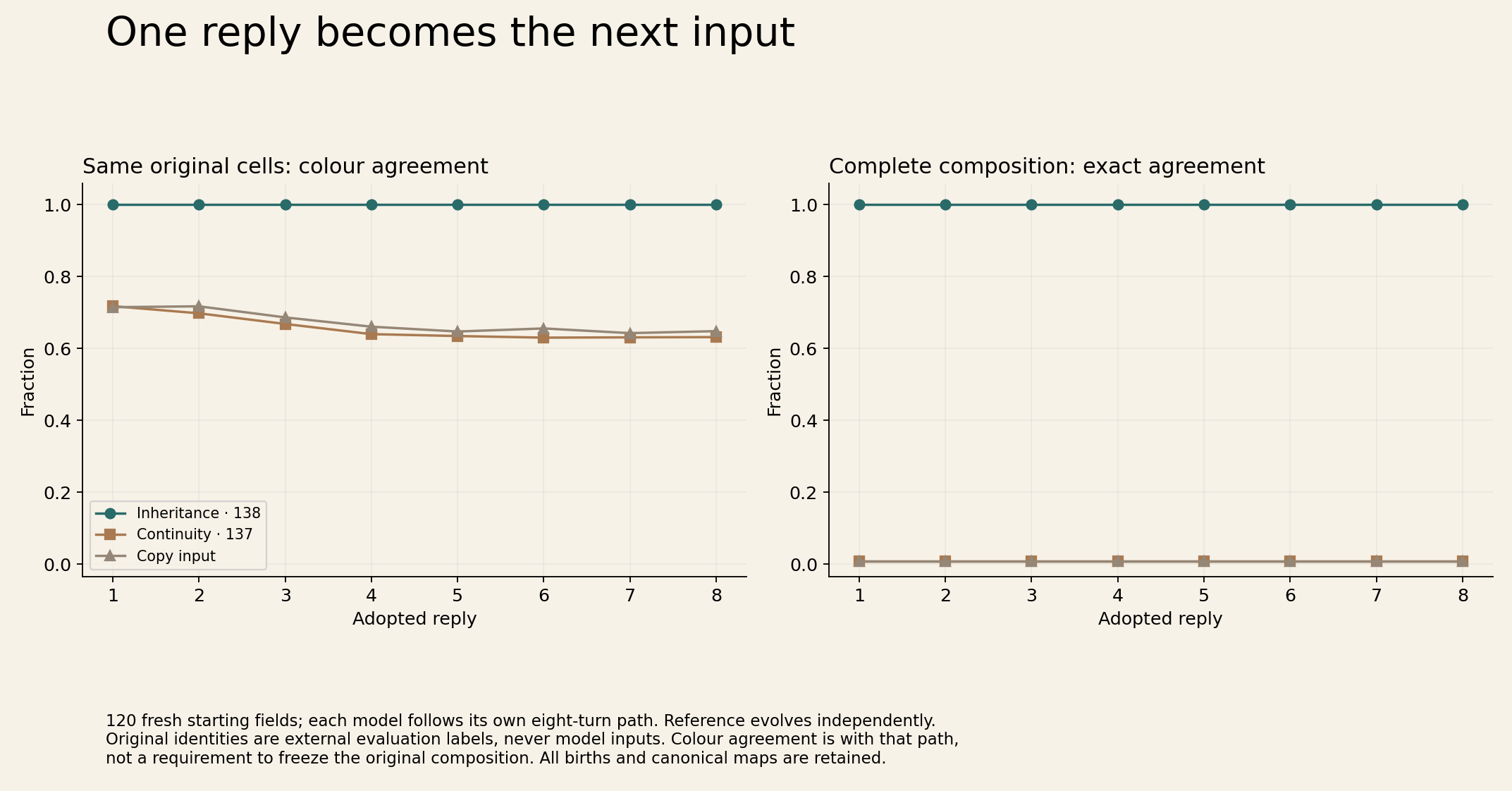
After four replies, original-cell colour agreement with the independent reference path is 100.0%, versus 64.0% for Continuity on these same fresh starts. After eight it is 100.0%, versus 63.1%. Complete-field exactness at turn eight is 100.0% for Inheritance. The complete record includes local next-step accuracy as well as accumulated divergence.
Original cell identities are tracked externally through every reordering from the first transition. They never enter the model. The principal colour denominator is original cells still alive in the reference path; a missing model counterpart counts as wrong. Matched-only scores, counts and coverage are also archived. New births use a separate, declared same-turn-and-appended-offset convention. A different birth time counts as divergence under that convention. Neither correspondence claims philosophical identity.
The earlier release's 61.7% four-turn colour result remains unchanged in its own record. This study does not retroactively replace that result, nor compare different test sets as if they were one experiment. Its principal comparison reruns the old model on the new inputs.
Variation within the sampled scenes
| Inheritance minus Continuity | Difference | Paired 95% interval |
|---|---|---|
| Ordinary birth-link F1 | +0.0476 | [0.0327, 0.0639] |
| Focused birth-link F1 | +0.1008 | [0.0701, 0.1325] |
| Original-cell colour · turn 4 | +0.3603 | [0.3113, 0.4117] |
| Original-cell colour · turn 8 | +0.3685 | [0.3166, 0.4216] |
These four predeclared descriptive comparisons use 2,000 paired scene resamples. They do not include training uncertainty or establish an effect across human meanings. No familywise significance claim is made. Exact observed success remains a finite observation, not a universal guarantee.
What a perfect observed score cannot establish
A finite test can miss an edge case. It does not prove universal correctness. The teacher is the author of these numerical conventions, so agreement measures emulation, not the truth or desirability of the conventions. The model and supervision changed together; there is no equal-budget architecture comparison. Any bootstrap intervals in the downloadable audit describe procedural-scene variation, not the diversity of real artistic experience. Three resampling fits do not cover all training uncertainty.
Colour routing should not be mistaken for semantic reasoning. An invitation in the grammar is neither entailment nor an obligation to become like its source. A numerical rule can lawfully copy a colour and still produce a reply the artist declines. Better stewardship makes that decision visible and reversible; it does not decide the reading.
Four studies, every recorded reply
Four seed compositions were fixed before examining the new outputs. All four unguarded replies from each seed and a paired first reply from the previous model are retained: 24 fields including the inputs. There is no best-of selection. Every work has its raw field, allocated-colour word representation, USL1 packet, CVP2 image and a rendered artwork containing a recoverable transport. The decoder checks actual image bytes. Artistic colour cores and CVP2 byte colours serve different roles.
An invitation has an address asks whether surviving lines still connect the intended distinctions. An opening does not demand an occupant keeps a null position available for disagreement about its numerical filling. A new voice carries an inheritance separates inherited colour from authority or identity. What is already here places uncertainty at a potential birth position. These are author interpretations of composed fields, not model objectives or recovered hidden prose.
A separate pretrained interpreter received only the APERTURE source, its first and fourth replies, grammar and selected definitions. It read coordinates and colour values, not a rendered image; it received no author interpretation, scores or model code. Its allowed-input boundary was an instruction, not an operating-system sandbox. It observed a contraction from 12 to 9 to 7 distinct colours while the larger membrane expanded. Its first reading questions whether widening space is accompanied by a narrower vocabulary. Its alternative hears recurring commitments redistributed among different positions. Both remain available as judgments, not scores. Read the full encounter and factual observations.
The public instrument exposes input → model proposal before reader protection → final colour traces and numerical channel changes. The proposal already includes the core's rounding, spacing and grammar adaptation; numerical decisions and repairs are retained separately. Readers can protect selected colours independently of links, compare earlier models, inspect the complete run, export the field, or adopt a reply. Protection is an explicit software policy applied after prediction and excluded from benchmark results. If an essential protected endpoint is absent, the proposal is refused in favour of the input. Protecting a colour does not protect every possible interpretation.
Failures, verification and reproduction
The development record retains a capacity-boundary audit failure, a JavaScript negative-zero comparison failure and the subsequent corrections before the final freeze. A field-address collision was also corrected during interface integration. The published failure inventory records exact files and outcomes. Targets or checks were not weakened to accept those cases.
The release retains all final predictions, all eight-turn states and correspondence maps, fitted weights, training and evaluation code, transport checks, portable runtime comparisons, independent metric recomputation within the same agent team, UI interaction checks and an extracted-archive reproduction. Hashes establish agreement with these files; they do not authenticate an external auditor. The reference program remains available as an exact engineering baseline.
Local browser security policy prevented rendered-file testing. Node interaction and static checks are not rendered-browser tests. Physical phones and the live WordPress theme remain untested. No network service or API key is needed for the instrument's replies, and it does not learn from a reader's session.
This work makes the mechanics of a Carrier expression environment more dependable under the declared rules. It does not establish subjective colour experience, general intelligence, comprehension of love and freedom, or a Carrier-specific advantage over an equivalent representation with the same mechanics.