Job 136 / 9 October 2026 / Method and evidence
What the field keeps.
A learned relation specialist substantially improves the previous model’s weakest channel. Its remaining failures put a precise boundary around that result.
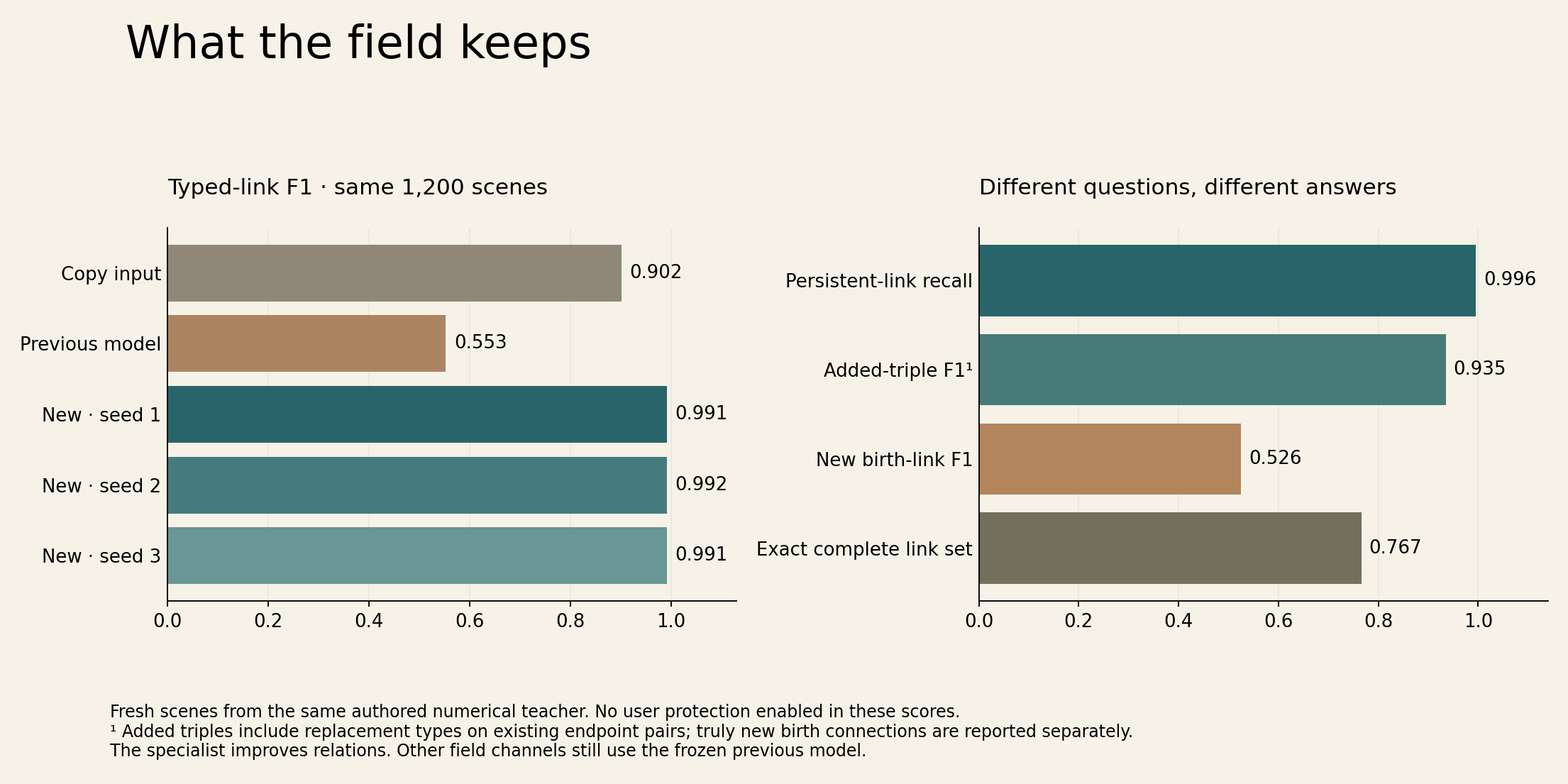
The result
The preselected deployment seed reaches 0.9912 typed-link F1, versus 0.9018 for copying and 0.5529 for the unchanged Job 135 model. The other two newly trained seeds score 0.9915 and 0.9914. This exceeds both the requested 0.91 threshold and the same-test copy baseline.
| Method | Typed-link F1 | Persistent recall | Added-triple F1 | Exact link sets |
|---|---|---|---|---|
| Copy input | 0.9018 | 100.0% | 0.0000 | 26.6% |
| Previous model | 0.5529 | 55.6% | 0.1819 | 18.8% |
| Untrained specialist | 0.2126 | 15.0% | 0.1637 | 13.8% |
| New specialist · deployed seed | 0.9912 | 99.6% | 0.9349 | 76.7% |
| New specialist · seed 2 | 0.9915 | 99.6% | 0.9362 | 77.3% |
| New specialist · seed 3 | 0.9914 | 99.6% | 0.9337 | 77.4% |
| Deployed seed, additions disabled¹ | 0.9924 | 99.6% | 0.9430 | 73.4% |
¹ Diagnostic ablation, not a replacement model selected after testing. Added-triple scores include retyping an existing pair. Complete link sets must match exactly; a high pooled F1 can coexist with many imperfect scenes.
The deployed model preserves 99.6% of links that the teacher leaves unchanged. Its complete link set is exact in 76.7% of scenes: 280 of 1,200 scenes still contain at least one link error. The pooled F1 difference from copying is 0.0894, with a descriptive paired-scene bootstrap 95% interval [0.0860, 0.0929], using 2,000 resamples. These are procedural-scene results, not population estimates for artistic meaning.
What changed in the model
The previous model regenerated its links through dense scores and a predicted edge count. The new specialist receives each existing edge as an explicit object. It predicts keep, remove or a replacement type; a separate head proposes a connection from a possible appended cell to an existing cell. A legal edge set is assembled from those decisions. There is no separate learned total-link count.
The specialist has 11,055 newly trained parameters, in two multilayer perceptrons with 64 and 32 hidden units. It is added to the frozen 1,121,293-parameter Job 135 model. Cells, colours, positions, layers, emphasis, membranes and cell counts still come from that earlier model. This release improves one channel; it does not establish a general improvement of every channel.
Existing-edge identities, limited candidate additions and geometrical features are deliberate engineering choices. The specialist’s 26 edge features and 72 addition features include relation type, endpoint geometry, distance, colour equality/null flags, indices, counts and signed distance to membranes. It does not read dictionary definitions, English instructions or image pixels. Geometry is available directly; no claim is made that it discovered distance from RGB observations. No teacher threshold is executed by the learned inference code.
Fresh examples, the same authored conventions
There are 18,000 training scenes, 1,200 development scenes and 1,200 fresh reserved scenes, with base IDs disjoint from Job 135. The old public benchmark was not reused as a secret final test. All three specialists use 3,000 training updates and independent initialization seeds. Development cross-entropy selects checkpoints; seed 136001 was fixed as the public model before the final results. It was not selected because it won the test.
The numerical teacher is inherited from Job 135. It largely preserves connections, sometimes changes resonance to tension or tension to resonance according to distance, and sometimes adds one return link for a newly born cell. These are authored exercise conventions. In a philosophical composition, nearness does not establish agreement, and distance does not establish conflict.
The training data contain no direct remove-class examples and no examples teaching new replacements of directed types 2–5. Most success on those directed types is preservation. The architecture can represent more classes than the data teach it to use. Candidate additions are restricted to a possible appended cell; arbitrary new connections between existing cells are outside this specialist’s support.
The weakness inside the improvement
Overall added-triple F1 is 0.9349, but that includes replacement types on existing pairs. Isolating truly new birth connections gives only 0.5255 F1: 170 correct, 247 extra and 60 missing connections. The new model is much better at retaining and retyping existing relationships than inventing the right new one.
Disabling additions raises total link F1 slightly, from 0.9912 to 0.9924, yet lowers exact complete-link-set accuracy from 76.7% to 73.4%. That diagnostic is retained. A conservative aggregate score can improve while more scenes fail to receive a necessary new link.
Before endpoint and capacity filtering, the deployed seed’s raw-proposal F1 is 0.9909. Filtering uses the backbone’s predicted cell count, never the target count. Canonicalization, deduplication, capacity limits and endpoint checks are deterministic adapters, not learned competence. No optional user protection contributes to the benchmark scores above.
Repeated replies and changed conditions
The broad stress families were planned before the main test; the exact diagnostic implementations were authored afterward. These are exploratory fixed-checkpoint results, not a second pristine confirmatory benchmark.
| Condition | Scenes | Copy F1 | Steward F1 | Persistent recall | Exact sets |
|---|---|---|---|---|---|
| Rotated fields | 120 | 0.9044 | 0.9910 | 99.41% | 79.2% |
| Overlapping membranes | 120 | 0.8952 | 0.9667 | 99.63% | 25.0% |
| 64 cells / 128 input links | 120 | 0.9045 | 0.9997 | 99.96% | 95.8% |
| Near exact distance thresholds | 120 | 0.6000 | 0.6000 | 33.33% | 60.0% |
The threshold-boundary test is a failure case. The specialist’s 0.600 F1 merely matches copying, and it retains only one third of the links that should persist. This is why the release does not claim universal dependability.
Four-step numerical rollouts from 120 initial fields give local link F1 of 0.9938, 0.9956, 0.9940, 0.9951. Each current model field is compared with the teacher’s response to that same current field. This does not measure agreement with an independent teacher-only trajectory, long-horizon meaning or memory. Slots are retained between steps; the browser normally re-canonicalizes a newly adopted field, so this numerical diagnostic is not a complete browser-interaction test.
Protection is an explicit choice
The public instrument lets a reader retain all or selected existing relations, with an additional option to retain their endpoint colour identities. Every restored item is logged. If a protected endpoint is absent, or restoration exceeds capacity, the complete proposal is rejected and the input field is retained as a new reply record. The rejected proposal remains inspectable.
These are software guarantees. They do not mean the model learned consent, nor that preserving an identifier preserves every interpretation. Existing and newly proposed relation types can coexist after restoration; the protection policy does not prove their semantic consistency. Geometry, other cells and other channels may still change. Turn protection off to inspect the unguarded model.
Art keeps a separate test
The release includes three authored seeds, all nine successive learned replies, three paired first replies from the previous model, and three explicitly protected variants. All 18 compositions retain their raw fields, Carrier words, USL1 packets, CVP2 images and exact-colour artwork PNGs. The fixed trajectories were retained without best-of selection.
One separate pretrained interpreter received only a source/reply pair, its grammar and selected definitions. Its reading notices that a link scaffold can survive while endpoint concepts change. That is a useful challenge to a structural score, not an independent measure of the model’s intent. The reader’s exposure disclosure and exact inputs accompany its interpretation.
Read the complete interpretation and link comparison. Author-composed “Nearness is not agreement” deliberately questions treating a successful geometric retype as a justified philosophical revision.
Verification and chronology
The weights, design and selection policy were frozen before final metrics were inspected. This is a local, author-maintained chronology, not external preregistration or an isolated audit service. The first evaluation completed its numerical predictions but failed while serializing NumPy integers. The correction affected serialization only; the same frozen model was rerun. An overbroad freeze had also included a changing publication helper; its incidental difference is explicitly recorded. An offline reply helper was corrected to preserve the actual input-byte parent hash. No learned weights were changed in response to final scores.
The independent audit recomputes every method’s metrics from 1,200 stored prediction records. Meaningful regression checks cover score accounting, direction, symmetry, source-only inference, optional protection and lineage. Sixteen JS/NumPy fixtures reproduce the learned specialist’s discrete links exactly; the maximum logit difference is recorded in the parity report. Existing base-model parity remains available from Job 135.
All 18 artwork transports are checked through actual decoding. The public UI has inert DOM and numerical tests, which are not rendered-browser tests. A browser-security restriction blocked local-file preview; no workaround was used. Physical phones, live WordPress and rendered-browser behaviour remain untested.
What this establishes
A source-anchored learned editor can substantially improve relation fidelity within these authored exercises. The evidence does not establish subjective colour experience, semantic comprehension, general intelligence, reliable unrestricted graph invention, or a Carrier advantage over another representation with equivalent mechanics. Love and freedom inform the author’s design choices; they are not measured internal states of the model.
Design context
Learning changes relative to an input has a broad precedent in He et al., Deep Residual Learning for Image Recognition. The value of explicit relational structure is discussed by Battaglia et al., Relational inductive biases, deep learning, and graph networks. These are design references. This specialist is neither a reproduction of those architectures nor validated by their results.