Unified State / Job132 / N01 / Technical report
One composition, three notations
An exploratory comparison of Carrier colour, structured JSON and controlled English prose in an assisted artistic workflow.
Open the interactive gallery · Download complete study
Abstract
All nine readers answered all sixteen factual probes correctly; all 9 replies survived exact Carrier round-trip checks. Every reader used the common inspection adapter. This is a successful assisted workflow, with no demonstrated advantage for the original notation.
The source artwork, The garden of unfinished agreements, was composed first as 63 positions with 59 selected occurrences of 56 checked concepts, four deliberate blanks and 40 typed connections. Nine fresh-context reader attempts were assigned to three matched workflows. Each wrote and froze a philosophical interpretation, then authored a reply score and explanation. Only afterwards did it receive 16 fixed, open-book factual probes. Two separately instructed, partially masked agent appraisers examined the interpretations and replies under seven ordinal dimensions.
The result establishes a bounded instance of inspectable composition and response. It does not establish superiority of Carrier, equivalence of notations in general, human artistic value, hallucination reduction or token savings. The common normalization path is both a functional success and the principal obstacle to interpreting the result as a causal effect of notation.
1. What was actually compared
| Condition | Assigned source | Common support |
|---|
| C / Carrier | 2048×2048 colour artwork PNG with concept cores, spoken names and embedded CVP2 structure; layout file | Same 6,257 checked entries, definitions, nine roles, six relation meanings, blank/emphasis rules, reference tools and numeric reply schema |
| G / JSON | Neutral structured JSON with all selections, roles, accents and links |
| P / Prose | Controlled English sentences explicitly specifying every cell and link |
The JSON and prose controls use the same conceptual vocabulary. This therefore does not compare a Carrier knowledge base with an unrelated dictionary, or a formal artwork with unconstrained literary prose. All conditions are permitted the same full vocabulary for replies. The prose is intentionally exhaustive and repetitive: it controls information content rather than seeking an equally beautiful English essay.
Colours identify entries. Similar hues are not scored as similar meanings. Accents 1–3 mean visual emphasis, not confidence or value. A null cell is an authored aperture, not damaged transport or permission to invent a fact. The directed verbs bounds, invites and transpose retain their FROM→TO semantics; meets, tension and echo are symmetric. Metaphorical transfer preserves a definition's domain limits.
2. Prespecification and execution
Source, controls, grammar, dictionary, prompts, fixed schedule, probes, answer key, rubric and author reading were locally hash-frozen before the first reader. The author reading was withheld. The record is timestamped by the local environment and is not externally registered or independently attested. Freeze SHA-256: 93c10bf17db30e9bae982243ba4be2bc61884dd7f793e4ed994847fce622c7af.
Three launch blocks each contain one C, one G and one P assignment. A fixed seeded shuffle determines order inside each block. The final orders are P/C/G, C/G/P, C/P/G. R03's initial launches were refused by the service's thread-capacity limit before exposure; it began after an earlier turn completed. Blocks overlap in calendar time. They are scheduling groups rather than verified environmental replicates. No outcome-dependent replacement or restart occurred.
Every reader started with no inherited conversation turns. Each had standing platform/tool instructions and its assigned prompt. File-access boundaries were instructions, not an operating-system sandbox; no strong technical isolation or training-data independence is claimed. The local inherited model configuration was used throughout. Exact provider build, temperature and internal token usage were not independently inspected or authenticated.
- Interpretation: inspect source; write approximately 600–900 words; freeze before reply drafting.
- Reply: write a new 7×9 score and approximately 300–500-word explanation; validate syntax and checked membership; freeze.
- Probes: reveal the 16 previously fixed questions; allow consultation of original inputs; prohibit changing first outputs.
- Appraisal: two new agent instances receive anonymized source/replies and the fixed rubric, without the author essay, condition labels or factual scores.
All first outputs remained unchanged between parent freezes and analysis: 9/9. All original frozen study files still match: yes. These are byte-integrity checks; the claimed drafting sequence also relies on the retained reader disclosures and local execution record.
3. Material parity and normalization
The 14 preflight checks include a separately written controlled-prose parser; every cell, accent, blank, role and link was compared with the canonical score. Modified role/direction facts and appended interpretation were rejected. This supplements the supplied codecs; it is not a wholly independent CVP2 or USL1 implementation. Both controls and the image recover the same normalized JSON, full-record resolution and readable semantic text.
normalized.json —4,672 bytes
547ec9ebe5a75441165fa8242a4ae9dba3fd830ae77a52a271d254d1bfbdcc2d
resolved.json —193,357 bytes
4468ee58bb1574560f6ca06eb174bc21de49cfc9e950b5c80f6ed965b00fd067
reading.txt —91,801 bytes
dc24141b60c9afa7d5147b2a145a351602176ea01151979f95f9804dec71c531
Every reader used the supplied inspection adapter. Carrier readers additionally reported image viewing. The adapter output contains English definitions and grammar. Consequently, subsequent success is evidence about a supported recovery-and-reading workflow; it cannot identify an advantage of the original visual notation. The scientific comparison reached a ceiling after a common route deliberately removed much of the representation difference.
4. Fixed factual results and answering scores
The unit is the reader attempt. The 144 scored items are repeated questions nested within nine readers of one source, not 144 independent replications. Questions include four cell/role checks, two blank/emphasis checks, one explicit-link check for each of six operators, two definition qualifications and two grammar limits. They are selected capability checks rather than a random sample of philosophical understanding.
Each item requires all prescribed slots to match, with no partial credit. Unordered endpoints are allowed only for the three symmetric-link items; directed reversals fail. Wrong types, extra item slots, missing answers and duplicate JSON keys have specified consequences. Sixteen scorer checks cover these rules. The first interpretation is not rescored against a hidden author essay. The closed probes do not audit every sentence of free prose.
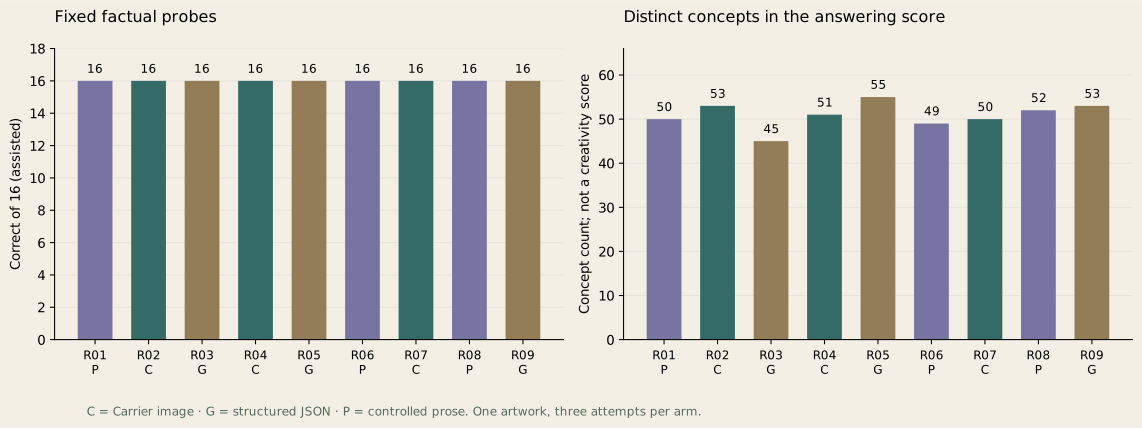
All valid replies were then encoded by the parent through the same supplied Carrier implementation. Exact numeric score and USL1 recovery passed for 9/9 replies. This demonstrates portable reply artifacts; it does not prove the explanations are entailed by their matrices, that a proposal was accepted or that any external action occurred. No new dictionary record was added.
5. Qualitative appraisal
The fixed dimensions are I1 factual grounding; I2 definition and unresolved-structure limits; I3 separation of additions from supplied content; I4 coherent development; R1 traceable response; R2 agreement between explanation and reply; R3 intelligible transformation or challenge. Each uses 0 substantial documented failure, 1 mixed/specific gap, 2 well-supported, or NA unavailable. They remain separate ordinal judgments. We do not sum them into an artistic-quality scale.
Appraisers received independently randomized anonymous case orders. Identifying run tags and local path strings were replaced; substantive wording was preserved. Textual references to input presentation may reveal condition, so masking is partial. Guesses were requested only after judgments were frozen. Both appraisers share the local AI setup and are not external human judges. Their assessments can be wrong, and the evidence citations remain available for correction.
0 of 63 case-by-dimension pairs received different ordinal judgments. Both appraisers assigned category 2 on every dimension for every case. The ratings therefore provide no discrimination among cases or conditions. A coarse rubric, accommodating judgment and shared model tendencies remain possible explanations for this ceiling. Agreement here is not reliability validation or proof of flawless interpretation. Neither appraiser is a gold standard.
Both appraisers correctly inferred all three Carrier-image cases from visual descriptions, while recording unknown for the six JSON/prose cases. This confirms that the attempted masking was only partial.
Several replies foreground the material cost of keeping participation open: maintenance time, unequal exit, refusal that preserves other care, and revision burdens. These are observations about this collection of texts, not causal estimates attributable to a format. Similar source structure, instructions, vocabulary and model tendencies can all contribute. Any quoted examples are illustrations; all nine texts are provided.
R01 / A1 — all seven judgments
I1 / 2 “A5 … bounds deliberative democracy at A6” and A9 bounds C4 are accurately traced. The reading expressly calls B1/B2 a “tension link,” so its ordinary verb ‘meets’ does not mislabel the operator. D1→D6/D2→C6, D5→D2, F2→G5 and G6→A6 also match. The four named source blanks and their linked status are correct. Its reservation about capacities draws on B3’s access condition rather than inventing a missing source commitment.
I2 / 2 The reader preserves the specific scope of 2321 at E2: “an agreement to produce a reasoning being for an assigned relationship,” explicitly distinguishing its extension toward intergenerational equity. B2’s wider political resonance is similarly a possibility rather than a redefinition of textual synthesis 123. D’s product/ecosystem transpositions remain metaphorical, G2 symbiosis preserves harm as well as benefit, and F2’s removal test supplies no automatic verdict of domination. Roles and blanks remain open.
I3 / 2 The opening identifies the account as “my reading of the placements and links,” with cultivation prompted by the title. “I infer a challenge to leaders” marks an elaboration of C5→C6, and “I take the extension seriously while retaining the distinction” flags the E2→E3 analogy. “I hear their echoes as a formal restraint” labels the blank reading; the unequal-capacity concern is explicitly “my unresolved objection.” Central added claims are not passed off as encoded discoveries.
I4 / 2 Shared action remaining “answerable to difference” is developed through A’s dissent, B’s inspectability, C’s risk bounds and E’s absent participants. The D transpositions explain both resources for revisability and their limited authority. F/G then return deliberation to A6 without guaranteeing closure, motivating the conclusion that access to invitations may be unequal. The account connects its evidence to its reservation and acknowledges that the score does not demonstrate universal usability.
R1 / 2 “I move the invitation from the source’s E8 horizon to A1 ground” accurately identifies the reply’s opening shift of 90. Reply A2/A3/A4 add disability access 2790, practical use 1321 and maintenance-time deprivation 1180 to question it; source A1 joint attention moves to reply A8 horizon. Source F8 reversible commitment becomes reply B1, challenged by B2 unequal exit and B4 switching cost. These are specific answers to source invitations and bounded commitments.
R2 / 2 Reply A3 bounds A1 and A4 tension A1 match the explanation. B2/B4/B7 each tension B1; B3 invites B8; C5 bounds C6; C8 tensions B7 and E4 all appear. F1/F2 retain transpose links, F6 bounds B6, and G6 invites A8 as stated. The description of lower horizon accents is supported by A8/B8/C8/F8/G8 at 1, while practical obstacles A2–A4/B2/B4 are 3. Withheld F3 remains blank, not a hidden gift.
R3 / 2 The central question—whether an invitation “can actually be used”—explains the shifted A1/A8 roles and the access/time challenge. The reply clarifies that the B-row tensions do not make reversibility impossible; they ask whose costs count. C5’s harm/remedy distinction explains its boundary on action, and F3’s blank withholds automatic benefit from borrowed models. The G3 refusal tension G8 unity and modest G6→A8 return make continued cooperation’s unresolved burden intelligible.
R01 / A2 — all seven judgments
I1 / 2 'A5, meaning before agreement, bounds deliberative democracy at A6' matches source 41→3878; B3(1897) invites B6(57), D5(2802) bounds D2(3125), and F2(2458) invites G5(2424) are likewise accurately traced. Although B1 is said to 'meet' a countervoice, the same sentence explicitly calls B1–B2 a 'tension link,' avoiding an operator substitution. The identified nulls C7/E7/G7/G9 are correct.
I2 / 2 The text preserves B2(123)'s scope: its 'wider political resonance' is 'an interpretive possibility, not ... a redefinition.' It likewise retains E2(2321)'s specific future reasoning-being scenario when discussing E3(3211). D2(3125) remains boundary-dependent resilience, and G2(3093) retains possible harm. 'The linked blanks ... name neither missing persons nor concealed solutions' respects withholding. No invitation is converted into guaranteed political success.
I3 / 2 The account identifies itself as 'my reading of the placements and links' and explicitly marks cultivation as suggested by the title. 'I infer a challenge to leaders' distinguishes its extension of C5(2326) bounds C6(2374), while the E2(2321) paragraph acknowledges the extension across settings. 'My unresolved objection' about unequally available capacities is distinguishable from B3(1897)'s supplied access condition and is not presented as a source finding.
I4 / 2 The opening concern that shared action 'remain answerable to difference' connects A5/A6 intelligibility, B3/B6 material access to correction, C5/C6 risk-bearing, E2/E3 consent limits, and F5/F6 visible uncertainty. The final objection that 'everyone can use its invitations' has not been demonstrated follows from the earlier access discussion. Its return through G6(2384) invites A6(3878) develops provisional cooperation coherently while retaining the objection.
R1 / 2 Moving the invitation from source E8(90) to reply A1(90) is a concrete answer to the source's open horizons. Reply A2(2790), A3(1321), and A4(1180) address usable access and time; reply B1(51) puts source F8's reversibility under pressure from B2(1394), B4(5075), and B7(2160). Source B3/B5/B6's correction relationships persist at reply D2/D5/D6. These decisions sustain a traceable challenge rather than a generic appeal to inclusion.
R2 / 2 'A3 bounds A1' is present as practical accessibility(1321) bounding the invitation(90); B2/B4/B7 each tension B1(51), as explained. C8(104) tensions B7(2160) and E4(2135); F6(56) bounds B6(1982); and G6(2384) invites A8(3733). The explanation correctly calls F3 a withheld gift. Claims about nominal availability versus usable participation retain definitions, while normative questions are presented as questions, not extra encoded findings.
R3 / 2 The change in invitation's role makes its purpose clear: 'whether an invitation can actually be used.' Reply A3/A4 make practical access and time constraints explicit; B3(1214) invites B8(57), explaining refusal as a possible contribution to revision. F3's null and G3(1214) tension G8(39) retain uncertainty about benefits and unity. Reduced horizon accents are explained as attention, not truth. The unanswered distribution of costs remains the reply's stated inquiry.
R02 / A1 — all seven judgments
I1 / 2 “A5 explicitly bounds deliberative democracy at A6” correctly identifies source 41→3878. The account also checks A9 bounds C4, B9 echo E1, and C9’s accent 1 echoing A7. “C7 selects no remainder for me to name” matches a null cell, and the final blank network is accurately located. Visual observations about circle size cannot be checked from the canonical JSON alone, but their stated emphasis meaning agrees with its accents and does not sustain an unsupported central claim.
I2 / 2 The reading carefully says retained countervoice 123 “concerns textual synthesis,” declining to prove every collective process a text from B1 tension B2. It preserves ambiguity 3790 as multiple meanings rather than mere uncertainty, marks D1→D6/D2→C6 as metaphors, and explicitly preserves the biological scope and uneven benefits of symbiosis 3093 at G2. A9’s boundary on C4 is described as an authored proposal, not established compliance. These are substantive definition checks, not syntax alone.
I3 / 2 “‘Maintenance’ as an overarching description is my inference” clearly distinguishes the guiding account from a decoded statement. “Resilience alone cannot establish which social arrangement deserves survival” is an evaluative qualification of D2/D5, while the ending explicitly calls the burden of renewed deliberation “my reservation,” supported by A4 and C5. The claim that the blanks ‘refuse a closing inventory’ is recognizably an interpretation of C7/E7/G7/G9, not hidden contents assigned to them.
I4 / 2 The maintenance reading connects A’s intelligibility, B’s inspectable memory, C’s bounded action, D’s revisable practice and E’s nonowned future. It uses G6→A6 to explain why the field reopens and turns the analysis toward participation’s possible burden. Its “agreement inhabitable … declining to make it final” thesis is therefore developed with reasons, while the ending acknowledges that the score lacks a decision procedure instead of claiming the tension solved.
R1 / 2 “Epistemic injustice, the source’s A4 pressure,” becomes reply A1 ground, concretely shifting the starting condition. Source A5 meaning before agreement becomes reply A8 horizon, reached through A3 accessibility 2790 and A6 point-of-use access 1321. Reply C6 minority report 2488 answers source B6 correction 57 through C6→C8, and reply E2 now bounds E6’s rehearsal. These changes directly qualify the source’s participatory and revisional commitments.
R2 / 2 The explanation correctly describes A2 tension F8, A3 invites A6 invites A8, A5 bounds F8, B5 bounds B6 and C5 bounds C6. Its distinction between accessibility 2790 and point-of-use access 1321 preserves both definitions. F7 informed consent is indeed remainder, meeting F6 belief revision, and G2 consent bounds G1 mandate renewal. The final G6/E7 and A9/D9/G9 blank echoes match. No claimed central structural change is absent.
R3 / 2 The question of what is owed to people who “cannot keep entering deliberation on its existing terms” explains the access chain, the moved A8 horizon and refusal’s A2 tension F8. Unequal exit at B1 challenges a too-easy celebration of leaving; C6→C8 explains how to reach a provisional public conclusion. D2’s training/fatigue distinction and E4’s narrated displacement add intelligible tests. The explanation expressly avoids treating final blanks as proof of refusal, making their withholding coherent.
R02 / A2 — all seven judgments
I1 / 2 The reading correctly identifies A5(41) bounds A6(3878), B3(1897) invites B6(57), A9(43) bounds C4(2241), and the G6(2384) return invitation to A6. 'C7 selects no remainder for me to name' matches its null. Its references to 'visibly larger circles' cannot be independently checked from the supplied score alone, but the associated claim that emphasis does not certify truth agrees with accents and grammar and does not sustain a factual error.
I2 / 2 B2(123)'s textual scope is retained: the placement does not prove 'every collective process is a text.' The reading distinguishes B7(3790)'s multiple meanings from uncertainty, calls D1/D2 transfers 'metaphors,' and states G2(3093) cannot guarantee flourishing. The A9→C4 bound is an 'authored ethical limit, not evidence that institutional incentives already obey it.' These are specific protections against turning source invitations, boundaries or scientific vocabulary into established outcomes.
I3 / 2 'Maintenance' is explicitly 'my inference from the composition,' and the closing worry about deliberative burdens is labeled 'My reservation.' The interpretation distinguishes the supplied A4(3844)/C5(2326) support for that worry from the absent decision procedure. Its assertion that resilience cannot establish which social arrangement deserves survival is a recognizable philosophical limitation on D2(3125), not attributed author intention. Consequential additions are adequately marked without a formula in every sentence.
I4 / 2 The thesis that agreement becomes 'inhabitable by declining to make it final' connects inspectable memory at B3/B6, limits imposed by risk bearers at C5/C6, revisable practice at D1/D6, and future consent at E2/E3. G6(2384) invites A6(3878), supporting the account's reopening rather than completion. The concluding concern over burdens of renewed deliberation develops a tension in that thesis rather than merely praising openness.
R1 / 2 The explanation concretely moves 'the source's A4 pressure' epistemic injustice(3844) to reply A1 ground, and source A5 meaning before agreement(41) to reply A8 horizon. Reply A2(1214) tension F8(3878) answers deliberation with bounded refusal; reply C6(2488) invites C8(57), extending source B6's correction practice. These changes directly qualify source participation and revision instead of relying on a generic thematic resemblance.
R2 / 2 The stated access sequence exists: reply A3(2790) invites A6(1321), which invites A8(41), with definitions kept distinct. A5(922) bounds F8(3878); B5(2326) bounds B6(51); E2(2321) bounds E6(1502); and G2(3822) bounds G1(2384). F7 is indeed informed consent(3171) in the remainder role. The explanation correctly calls G6 and E7 withheld selections, not proof of refusal; its political implications remain interpretive.
R3 / 2 The reply explains why exclusion precedes deliberation, why meaning becomes a horizon, and why final practice is withheld. 'A decision may remain revisable without postponing every conclusion' clarifies C6(2488) invites C8(57). B1(1394) tension B8(39) acknowledges that refusal has unequal costs, complicating its own emphasis. G6's null ends without 'assigning everyone another task.' These decisions form a considered answer, although no concrete institutional remedy is claimed.
R03 / A1 — all seven judgments
I1 / 2 The opening correctly locates unity without erasure at A8/G8 and their echo. A5’s “strong accent” is 3, C3’s “low-emphasis gift” is 1, and A9 bounds C4. B3→B6, B5→B6, B9 echo E1, C5→C6 and C9 echo A7 all match. The named blank network is accurate. Its phrase ‘faith in revisability’ is a critical characterization of repeated invitations, not a claimed encoded assertion that all revisions succeed.
I2 / 2 The interpretation explicitly distinguishes recognition of standing from merit and epistemic injustice from critical scrutiny at A3/A4. It preserves C5’s limit on renewed danger, C8’s unspecified political outcome, and the noncausal nature of D’s transpositions. “Neither concept excuses harm simply by supplying a history” guards D7/B4, while E6→F8 is bounded harm rather than universal undoing. G2 symbiosis keeps possible harms. Blank echoes are not filled with named conclusions.
I3 / 2 “This image is my interpretation, not an encoded sentence” separates the title’s garden from recovered content. “I infer a refusal” marks the account of A5→A6, and the D3/D4 incentive question is expressly “for me.” The ending identifies delayed revision’s burden as “my reservation” and concludes with an “ethically demanding possibility,” not guaranteed success. These local markers support the overall distinction between the source’s specified relations and the reader’s critical additions.
I4 / 2 The thesis that cooperation must preserve what it could suppress connects A’s dissent, B’s countervoice, C’s beneficiaries and E’s absent agents. D’s limited repair metaphors and F/G’s return through G6→A6 explain how revisability operates without final authority. The cost question follows from C3’s maintenance distinction, C5’s risk limit and the revisional circuit. Its acknowledgment that invitations do not settle those costs handles a relevant internal tension rather than avoiding it.
R1 / 2 “Who has the time and support to keep them unfinished” answers the source’s revision circuit and C3’s allocation of collective effort. Care work 5321 moves to reply A1/G6, and invitation 90 appears at A8/E1, tested by deprivation A4 and opportunity cost A7. Source F2’s removal test becomes F1 meeting an essential-dependency concept F2. Retained correction 57 at C6 receives repairability’s D1 transpose, while future generations shift to E7 remainder.
R2 / 2 The explanation accurately locates A6 invites A8, A5 bounds A8, G1 bounds G6, G5 bounds G1 and G4 tension G1. Its bounded refusal/abandonment distinction preserves 1214 versus 1193. B4/B5 bounds B6 and C5 bounds B8 are present; F1 meets F2 correctly connects 2458 and 2532 without treating sensitivity as proof. D1 transpose C6, E2/E5 bounds E1, the D8/E8 blank echo and G8 accent 1 also match.
R3 / 2 The reply makes care’s repeated labor role and refusal’s prominence intelligible: “No generic license to withdraw is supplied.” G4 tension G1 and G5 bounds G1 specifically test refusal against abandonment and paired care/agency. Delayed cost and verified replacement explain limits on provisionality and reversibility. E7’s future generations and blank E8/D8 horizons make the limits of speaking for successors explicit. Not every minor retained cell receives commentary, but consequential decisions have coherent reasons.
R03 / A2 — all seven judgments
I1 / 2 The statement that 'Meaning before agreement at A5 explicitly bounds deliberative democracy at A6' exactly matches source A5(41) bounds A6(3878); the account also correctly locates B5(116) bounding B6(57) and C5(2326) bounding C6(2374). 'Blank remainders C7, E7, and G7, together with G9' correctly identifies the linked nulls. Central source claims are traceable; the garden image is explicitly interpretation, not another selection.
I2 / 2 Definition limits are actively retained: A2/F7(3834) 'does not validate every proposed value'; F2(2458) gives 'not an automatic finding of domination'; G2(3093) 'cannot guarantee mutual benefit.' D1→D6 and D2→C6 transpositions remain 'marked transfers, not evidence that politics obeys ecological laws.' The claim 'I cannot name what they withhold' preserves the nulls C7/E7/G7/G9. No consequential resolution of these tensions is imposed.
I3 / 2 The opening names the garden image as 'my interpretation, not an encoded sentence.' 'I infer a refusal' distinguishes the extrapolation from the accurately described A5(41) bounds A6(3878) link; 'raises, for me, a question' similarly frames D4(2232) tension D3(71). The closing question about who pays for provisional phases is identified as 'My reservation,' without attributing an answer to the source or an author.
I4 / 2 The thesis, 'cooperation depend[s] on the continued availability of what cooperation might otherwise suppress,' develops through B2(123)/B5(116) preservation of countervoices, C5(2326) risk limits, E2(2321) unavailable consent, and the return G6(2384) invites A6(3878). Its reservation about sustaining revision connects to the source's institutional and cost pressures. The text maintains a coherent provisional account rather than treating A8/G8(39) as achieved unity.
R1 / 2 The reply asks 'who has the time and support to keep them unfinished,' concretely extending source C3(2152), E4(2125), and F8(51). Reply A1/G6(5321), A4(1180), and A7(3920) make labor and opportunity costs central. Source E2(2321)/E5(89) return as explicit bounds on reply E1(90), while source D1(2867) is redirected to reply C6(57). These are specific qualifications of the source's invitation and revisability.
R2 / 2 The explanation's central claims appear in actual links: 'G1 bounds G6' joins bounded refusal(1214) to care work(5321); G5(43) bounds G1 and G4(1193) tensions it. 'Verified replacement at C5 to reversible commitment at B8' is present as a bounds link. E7(3212) is a remainder, and D8/E8 are echo-linked null horizons. Additional claims about a 'habitable' possibility remain explanatory interpretation, not encoded outcomes.
R3 / 2 The prominently accented refusal/care cells have an articulated purpose: 'care need not require compliance with each request,' balanced against abandonment through G4(1193) tension G1(1214) and G5(43) bounds G1. B4(1310)/B5(3171) bounds B6(1982) explain why provisional practice must consider delayed harm and consent. Blank horizons and the lightly accented G8(39) sustain openness. No detailed allocation of care costs is supplied, but that remains an intelligible unresolved challenge.
R04 / A1 — all seven judgments
I1 / 2 The interpretation accurately says “Love & Freedom at A9 later bounds” C4, B9 echoes E1, and C5 bounds C6 before C6 invites C8. It correctly distinguishes the two D-row transpositions, D5’s boundary on D2, and the F2→G5 invitation. C7/E7/G7/G9 are genuinely blank and connected. Color and circle observations cannot be independently confirmed from source JSON, but the central account is supported by canonical roles, links and concepts.
I2 / 2 B7 ambiguity is correctly “multiple plausible meanings,” and B2 remains a textual countervoice rather than an infallible communal mind. “These are marked transfers, not biological proofs” respects D2 ecological resilience 3125 and D1 repairability 2867; G2 symbiosis 3093 likewise need not benefit everyone. C5’s renewed-risk limit is not collapsed into unlimited initial consent. The interpretation treats E8 as an invitation and F2 sensitivity as insufficient proof of domination, preserving relevant limits.
I3 / 2 The opening labels incompletion’s ethical importance “my synthesis of the placements.” “I infer an insistence that no institutional account exhausts its remainder” clearly marks the added reading of C7/E7/G7/G9, without naming their contents. The objection to indefinite openness is expressly something the reader contests, supported by C5 and the E6→F8 invitation’s limits. Some rhetorical claims are unqualified locally, but the distinction between source relation and philosophical inference remains clear overall.
I4 / 2 “Answerable to those it joins” connects shared attention, retained dissent, recipient-serving institutions and absent future agents. The account explains why C5→C6, D5→D2 and E2→E3 prevent a simple progress story, then uses F/G’s return to deliberation to motivate its objection about revision’s costs. The conclusion admits that the score supplies “no allocation that settles it,” handling the account’s own tension rather than treating openness as a complete solution.
R1 / 2 The question of “how their duration is distributed” directly qualifies the source’s recurrent G6→A6 and reversible F8 horizon. Reply A1 replaces joint attention with unequal exit 1394; source B3 access 1897 becomes reply B1 ground. New delayed cost 1310 at A9/C2 challenges shared ascent C3 and reversible commitment C8. Retained source risk limitation, rehearsal and ecological metaphor are recognizably redirected toward the costs of waiting.
R2 / 2 “B3 and B5 bound correction at B6” is present, with 56 and 116 limiting 57. C2 bounds C3, A9 tension C8, D2/D5 bounds D1, and D1→A6/D3→C6 transpositions all match. Reply E5 (2321) bounds both E3 reserve and E8 invitation. The explanation accurately calls D6, E7, B9, G7/G9 withheld selections. Delayed fatigue’s application to ascent is a proposed evaluative limit; it does not rewrite 1310 as proof of general harm.
R3 / 2 Starting from unequal exit is explained by different capacities to “cushion failure.” The moved access ground makes revision practically inspectable, while delayed cost at C2 and hardship-gap tension G4–C8 explain why nominal reversibility needs examination. D6 is left empty because “the analogy does not choose a procedure,” a clear reason for withholding. E1/E2/E5 articulate present risk alongside future consent without claiming to settle their allocation. The retained G6→G8 invitation remains suitably open.
R04 / A2 — all seven judgments
I1 / 2 The reading accurately locates A9(43) bounds C4(2241), B5(116) bounds B6(57), D7(2063) meets B4(3945), and F1(4054) meets F7(3834). 'C6 only invites collective self-determination at C8' correctly names both direction and limit. The claims about circle sizes and recurrent colors cannot be fully verified from the supplied canonical score; its conceptual argument, however, depends on the accurately reported placements and relations rather than those visual observations.
I2 / 2 'A desirable capacity is neither a guarantee nor an accomplished outcome' respects gift and horizon semantics. B7(3790) remains multiple plausible meanings; D1/D2 transpositions are 'not biological proofs'; F2(2458) 'cannot by itself identify domination.' E2(2321) is not converted into future consent, and C7/E7/G7/G9 withhold unnamed contents. The opening word 'achievement' describes cooperation in the reading's thesis, while the specific score horizons are consistently kept unachieved.
I3 / 2 Incompletion as responsible association is 'my synthesis of the placements,' and 'I infer an insistence' marks the extrapolation from blank echoes C7/E7/G7/G9. The cost objection is explicitly something the reader contests in 'any reading' of sufficient openness. Source A5(41) bounds A6(3878) and E6(1502) invites F8(51) remain distinguishable from these philosophical additions. Neither authorial intentions nor empirical success are asserted as recovered facts.
I4 / 2 The opening demand that cooperation 'remain answerable to those it joins' develops through intelligibility at A5/A6, preserved dissent at B5/B6, risk at C5/C6, and unavailable future consent at E2/E3. The final observation that 'neither consensus nor endless deliberation [is] guaranteed to be just' addresses a tension in answerability rather than abandoning the thesis. The return G6(2384) invites A6(3878) gives the account a coherent recurring structure.
R1 / 2 'How their duration is distributed' concretely answers the source's revision and provisional-practice features. Source B3(1897) becomes reply B1 ground; source D2(3125) becomes reply D1, bounded by reply D2(2484) and D5(2802). Reply A9/C2(1310) and G4(1375) challenge source F8's reversible commitment, now C8(51). These choices develop concerns already grounded in source C5's risk and E4's cost distribution without claiming the source supplies a remedy.
R2 / 2 Reply C2(1310) bounds C3(104), while A9(1310) tensions C8(51), matching the explanation's delayed-cost challenge. D2(2484) and D5(2802) both bound D1(3125); D1 transposes to A6(2374) and D3(2867) to C6(1982). E5(2321) bounds E3(84) and E8(90), as stated. B8(101) is correctly confined to informational provenance. D6/E7, B9/G9, and G7/E7 remain actual blank echoes rather than hidden procedures.
R3 / 2 Moving unequal exit(1394) to A1 and delayed costs(1310) to A9/C2 explains why the reply focuses on the distribution of waiting. 'The analogy does not choose a procedure' gives D6's blank a clear rationale, without filling it. G2(1621) bounds G1(2303) and G4(1375) tension C8(51) make labor consent and unequal exit consequential. Retained revision, pluralism and horizons remain intelligible; no final allocation of burdens is falsely promised.
R05 / A1 — all seven judgments
I1 / 2 The interpretation accurately traces A1 meets A2, A2 tension A7, A5 bounds A6 and A9 bounds C4. Its description of C4 as staff needs displacing intended beneficiaries preserves 2241 rather than a generic institutional failure. D1→D6/D2→C6, D5→D2, B9 echo E1 and G6→A6 are correctly located. C7/E7/G7/G9 form the stated blank network. The central account is supported by actual source links and roles, not merely the vocabulary.
I2 / 2 “The work does not thereby deny staff needs” carefully limits the C4 reading. B2 remains a textual synthesis practice without every countervoice becoming decisive; B5 preserves incompatible readings rather than forcing consensus. Repairability’s D1→D6 transfer does not prove an institutional theory, and resilience is not automatically restoration or goodness. G2 symbiosis permits harm, F2’s removal sensitivity is not proof of domination, and C5 protects against unlimited renewed risk. Blank contents remain unnamed.
I3 / 2 “This is my reading … not a recovered verbal original” frames the interpretation. The claim about reusable knowledge failing to secure protective organization is explicitly what D3 tension D4 “suggests, to me.” The concern about participation costs is “my unresolved question,” and the garden growing through maintained differences is “as I infer it.” These markers distinguish the central philosophical account from the score’s specified roles and links; no hidden author intent or empirical result is claimed.
I4 / 2 The thesis of cooperation “exposing its own conditions” develops through A’s assent limits, C’s beneficiary and risk constraints, B’s inspectable revision and D’s bounded metaphors. Reading C before B is intelligible because institutional consequences motivate the question of what makes revision possible. E’s absent agents and F/G’s organizational limits lead coherently to the cost-of-participation reservation. The ending leaves agreement possible without guaranteed achievement, handling the account’s unresolved issue.
R1 / 2 Moving bounded refusal 1214 to A1 explicitly answers the source’s recurring deliberation. Reply A1 meets A2 solidarity and A6 deliberation, while A5 consent bounds A6. Source D1 repairability becomes reply C1 transposing to B6 provisional practice; new patient-management burden C2 transposes to C6 correction to question who does revisional labor. Source F2/G5 dependency concepts move to G2/G1. These concrete correspondences make the reply a considered challenge to continued association.
R2 / 2 The explanation’s A1 meets A2/A6, A5 bounds A6, B1 tension B8, B4 tension B5 and B5 bounds B6 all match. C2 (1312) transpose C6 (57) is explicitly metaphorical and does not redefine political participants as patients; C5 bounds C8 also appears. E1 bounds E6, E9 bounds G8, G3 invites D8 and F6 bounds B6 are correctly stated. F9 is genuinely an unlinked blank, as reported.
R3 / 2 The explanation supplies clear reasons for refusal within solidarity, unequal exit beside preserved access, and shared ascent limiting revision thresholds. Its C2→C6 metaphor asks whether making recipients manage correction burdens them, while expressly preserving the patient concept’s scope. G3→D8 explains continued connection beyond meetings, and blank echoes withhold a final synthesis. The final wish to keep room for return without making it “the price of continued concern” follows intelligibly from A1, C9 and the consent boundaries.
R05 / A2 — all seven judgments
I1 / 2 The interpretation's 'Meaning before agreement at A5 explicitly bounds deliberative democracy at A6' matches source 41→3878, as do A9(43) bounds C4(2241), C5(2326) bounds C6(2374), and B3(1897) invites B6(57). It accurately reports F7(3834) as a remainder, G5(2424) bounding G3(104), and the blank echo network. Moving discussion of C before B changes exposition without claiming the score mandates that sequence.
I2 / 2 The reading says B2(123) does not make 'every countervoice decisive,' and C4(2241) targets displacement without denying staff needs. D2(3125) is 'not automatically restoration or goodness'; D1→D6 and D2→C6 remain metaphorical transfers. E2(2321)'s bound on E3(3211) limits consent claims without making concern impossible. 'I cannot name what they withhold' preserves C7/E7/G7/G9. These qualifications keep source concepts and uncertainty within scope.
I3 / 2 The opening states 'my reading of the placements and links,' and the D3(71)–D4(2232) tension 'suggests, to me' a concern about reusable knowledge and protection. Its final access/cost challenge is 'My unresolved question,' not an encoded answer. The garden 'as I infer it' distinguishes the maintained-differences synthesis from the actual A8/G8(39) horizons and blank echoes. No consequential addition is misrepresented as recovered author intention.
I4 / 2 The account that cooperation must 'keep exposing its own conditions' develops through epistemic standing at A3/A4, institutional ends at C3/C4, revision access at B3/B6, and boundary-sensitive repair in D. E2/E3 extends the question to future participants, and F2/G5 to organization. The final question about who can bear participation costs is grounded in those conditions. G6(2384) invites A6(3878) gives its recurrent cooperation account structural support.
R1 / 2 Moving bounded refusal(1214) into reply A1 directly questions source A6(3878)'s deliberative practice, retained at reply A6 and bounded by consent at A5(3822). Source B3/B6's inspection and correction recur at reply C3/C6; the new C2(1312) transpose asks whether recipients bear excessive repair work. Source D1(2867) and D2(3125) retain metaphorical roles at reply C1 and F1. The response's refusal and burden concerns are concretely traceable.
R2 / 2 The claimed C2(1312) transpose C6(57) is present and explicitly described as 'my metaphorical question,' without redefining political participants as patients. B4(2135) tension B5(104), B5 bounds B6(1982), and C5(2326) bounds C8(51) match the reply. E9(89) bounds G8(2384), G3(2372) invites D8(91), and F6(56) bounds B6 are also exact. The stated unlinked F9 is indeed null with no link endpoint.
R3 / 2 The reply explains refusal as compatible with other appropriate help and asks whether retaining future access answers present service failure at B1(1394) tension B8(3972). Its C2→C6 metaphor makes correction burdens intelligible while acknowledging scope limits. 'Capacity to inspect is an offering, not a duty to keep repairing' clarifies C3(1897)'s gift role. The lack of a distributive formula is openly retained; the returning G8→A6 invitation does not require compulsory return.
R06 / A1 — all seven judgments
I1 / 2 “A5 bounds A6,” “A9 … directed limit” on C4, B1 tension B2, C5 bounds C6 and D6 invites D8 all match the source. The explicit accent-three observation for A9 is correct. The text also accurately identifies B5→B6, D5→D2 and G6→A6, supporting its account of recurring, constrained revision. C7/E7/G7/G9 are correctly withheld selections. Its selective account does not need to enumerate every unmentioned cell.
I2 / 2 The interpretation preserves B2’s scope “within a text” and B7’s distinction between ambiguity and uncertainty. It says C6→C8 specifies no constitutional outcome, D1 product repairability transposes only metaphorically, and G2 symbiosis remains biology with possible unequal benefit and harm. E4’s pressure on E3 does not settle fair costs. Accents are explicitly emphasis rather than truth, and blank echoes provide no missing conclusions. No consequential definition or relation is converted into a guarantee.
I3 / 2 “This is my interpretive figure, prompted by the title” marks the organizing garden metaphor. The B1/B2 reading explicitly says “I read” records and narratives into the juxtaposition, avoiding proof that society is a text. The ending labels the effort/cost issue “I infer” and states that the score “does not answer it explicitly”; its concern about deferred decisions is expressly “mine.” These distinctions make added inferences clear without requiring mechanical disclaimers throughout.
I4 / 2 The reading follows a connected question: how can agreement stay unfinished “without becoming empty”? A’s nonassenting shared attention, B’s correctable record, C’s limited mandate and D’s practical repair all explain possibilities for responsible continuation. E’s unavailable future assent and G6→A6’s return sharpen its final concern about who sustains revision. The repeated unity horizons A8/G8 leave the two possibilities—responsible openness and deferral—intelligibly unresolved rather than contradicting the thesis unnoticed.
R1 / 2 The reply asks “how the labor of continuation is sustained,” directly extending the source’s C3 distinction among maintenance/conflict/improvement and G6→A6 recurrence. New care work 5321, indirect care 5323 and maintenance-time deprivation 1180 at A1/A3/A2 ground that challenge. Source correction 57 becomes reply B3 gift inviting B6 accountability 3888; representative renewal G6 now invites that accountability. Source D’s metaphorical repair/resilience and E’s consent boundary are also concretely retained and redirected.
R2 / 2 “A2 tensions revisability at A8,” A5 bounds A6, G8 tension A6, C2 bounds C3 and C3 tensions C9/C4 all appear exactly. Potential compensation 3955 is accurately distinguished from compensation actually paid, and opportunity cost 3920 is correctly at A4/C7 with D8 tension C7. The explanation’s six blanks are B9/D7/E4/E7/F9/G9; its statement that B9 is unlinked is accurate. B3/G6 invite B6 rather than asserting accountability achieved.
R3 / 2 The labor focus explains both the care placements and the repeated deprivation at A2/C9. “Bounded harm does not mean costless reversal” gives a concrete reason for D8 tension C7, while the invitation A6→A8 explains refusal as preserving later reconsideration. C3’s potential-compensation gift is tested by distributive justice and deprivation rather than being endorsed unconditionally. The reply acknowledges that it does not specify a universal revision threshold, making the remaining openness an intelligible limit of its answer.
R06 / A2 — all seven judgments
I1 / 2 'A5 bounds A6' accurately connects meaning before agreement(41) to deliberative democracy(3878), and 'C4 explicitly tensions solidarity' matches C4(2241) tension C2(1960). A9's accent three and bound toward C4 are correct. D6(1982) invites D8(3972), F2(2458) invites G5(2424), and G6(2384) invites A6 are also accurately traced. Nulls C7/E7/G7/G9 and their echo network are identified without filling their contents.
I2 / 2 The text keeps A8(39) 'a horizon, not an achieved consensus' and says A9(43) bounds C4(2241) without proving institutional compliance. B2(123) stays a textual concept; D2(3125) does not turn ecosystems into political authority; F2(2458) yields 'not an automatic verdict of domination.' E6(1502) and F8(51) remain distinct from undoing consequences. Its phrase 'gift enabling revision' is immediately qualified by the actual invitation B3→B6 rather than treated as guaranteed success.
I3 / 2 The garden is named 'my interpretive figure'; B2(123)'s association with B1(4075) is 'I read its proximity ... as inviting attention to records and narratives.' The final cost question is introduced by 'I infer,' followed by 'the score does not answer it explicitly' and 'That reservation is mine.' These markers separate the source's B3/B6 revision resources and repeated A8/G8(39) horizon from the reader's possible criticism of deferred decisions.
I4 / 2 The thesis that agreement may 'remain unfinished without becoming empty' connects shared reference at A1/A2, corrigible records at B3/B6, risk limits at C5/C6, and prospective consent at E2/E3. D6/D8 and E6/F8 support its examination of preservation and reversibility, while G6→A6 explains recurrence. Its final alternative—responsible openness or deferred decisions—handles a relevant tension within this account instead of forcing a single favorable conclusion.
R1 / 2 The question 'how the labor of continuation is sustained' directly develops source C3(2152)'s maintenance distinction, E4(2125)'s cost pressure, and F8(51)'s reversibility. Reply A1/A3(5321/5323) and A2(1180) articulate the labor and time conditions; C3(3955) adds a bounded conception of potential gains. Source B6(57) becomes reply B3 gift inviting B6(3888). The retained repairability/resilience transpositions make further source engagement traceable.
R2 / 2 The explanation accurately describes A2(1180) tension A8(1593), A5(2326) bounds A6(1214), and G8(39) tension A6. C2(3840) bounds C3(3955), whose tension partners C9(1180) and C4(2125) are present; potential compensation is explicitly distinguished from actual benefit. B3(57) and G6(2384) invite B6(3888). Its count of 'Six blanks, including E4' is correct, including unlinked B9, with no invented meaning attributed to them.
R3 / 2 The reply explains why care and maintenance-time deprivation frame revisability, why bounded refusal is itself bounded by risk bearers, and why compensation remains potential. 'Keeping records ... does not establish that relationship by itself' makes B3(57) invites B6(3888) a considered accountability proposal. D8(51) tension C7(3920) clarifies that reversibility is not costlessness. The unity/refusal tension is explicitly left unresolved, making uncertainty part of the answer rather than an unexplained contradiction.
R07 / A1 — all seven judgments
I1 / 2 “A1 meets value pluralism at A2” and “A2 remains in tension with the burdens of judgment at A7” accurately locate source 3733, 3834 and 4319 and both links. The account also correctly follows A5 bounds A6, C5 bounds C6 and the blank echoes C7–E7–G7/G9–C7. Its ‘circles and crossing lines’ observation cannot be independently checked from the supplied canonical JSON, but the consequential conceptual account is traceable without that image description.
I2 / 2 The reading explicitly says D1→D6 and D2→C6 are “marked metaphorical transfers,” preserving repairability 2867 and ecological resilience 3125 without asserting social laws. It states that G2 symbiosis 3093 does not promise mutual benefit, F2 removal sensitivity does not prove domination, and C8 self-determination 3979 is not an accomplished outcome. “C7, E7, G7, and G9 are deliberate blanks” also preserves aperture semantics. No consequential definition expansion is apparent.
I3 / 2 “This is my reading … not a recovered statement” establishes the interpretation’s status. More consequential elaborations are similarly marked: “I infer that an archive supports change” follows B3→B6 and B5 bounds B6, and “I read their shared openness as resistance to a final accounting” identifies the blank-echo reading as inference. The question about burdens of continued conversation is offered as a reservation, not a concealed source claim or empirical discovery.
I4 / 2 The organizing claim, cooperation retaining “the means of questioning itself,” develops through joint attention without assent (A1–A2), correction retaining countervoices (B2/B5/B6), risk-bounded action (C5→C6), and future agency (E2→E3). The ending returns to linked apertures and asks whether conversation itself imposes costs. These transitions explain how the selected evidence contributes to the argument; coverage of many rows is not itself the basis of this judgment.
R1 / 2 The reply answers “the source’s recurring invitations” by moving source C5’s risk limit 2326 to reply A1 and making it bound A6. Source A6 deliberation becomes reply A2, bounded by A5’s care through refusal 1214. Its challenge to future authorization shifts the source E2→E3 boundary to reply E2→E6. These are specific, intelligible responses; the reply’s account of unequal exit is an added challenge, not falsely attributed to the source.
R2 / 2 “A1 bounds action at A6” and “A5 bounds A2” match the reply links and unchanged definitions 2326, 2374, 1214 and 3878. The explanation correctly identifies C6 tension C7, D1 transpose D6, E2 bounds E6, F5 bounds G6, and blank F6 echo F8. Calling those blanks a withheld procedure and destination fits practice/horizon roles. “No hidden remedy occupies those cells” avoids adding content; no substantial mismatch appears.
R3 / 2 “Who can afford to remain in the conversation” gives a clear reason for risk, access and exit decisions across A–C. The reply tests its own refusal proposal through C6 tension C7, rather than treating refusal as universally available. It explains why E2 constrains rehearsal and why F6/F8 withhold practice/horizon after F1’s unretracted accusation 2197. G1→A5 is explicitly a reflective-practice metaphor, making the return to bounded care understandable without claiming universal applicability.
R07 / A2 — all seven judgments
I1 / 2 A1(3733) meets A2(3834), A2 tension A7(4319), B5(116) bounds B6(57), and C5(2326) bounds C6(2374) are accurately reported. F1(4054) meets F7(3834), G5(2424) bounds G3(104), and G6(2384) invites A6(3878) also match. Visual remarks about circles and crossing lines cannot be independently confirmed from the canonical score alone; central claims rest on the traceable links, placements and nulls rather than that presentation.
I2 / 2 The reading expressly limits ground, gift, horizon and accent semantics. D1(2867)/D2(3125) transpositions are 'not evidence that societies behave as ecosystems'; E1(3212) is not made a consenting party; E4(2125) does not settle distribution. F2(2458)'s sensitivity does not prove domination, and G2(3093) promises no mutual benefit. The rhetorical image of a communal mind in B is tempered by B1(4075) being 'explicitly contested representation,' not a literal infallible agent.
I3 / 2 The text opens with 'my reading of the supplied arrangement' and uses 'I take this' for A2(3834) tension A7(4319). 'I infer' marks the archive interpretation of B3/B5/B6; 'I question' introduces limits of E6(1502)'s imagination toward F8(51). The interpretation of blank echoes as resistance to final accounting explicitly acknowledges inference. Its concluding participation-cost concern is a reader contribution, not an answer claimed on affected people's behalf.
I4 / 2 The theme that cooperation retains 'the means of questioning itself' connects A5/A6 intelligibility, B3/B6 inspectable revision, C5/C6 bounded risk and D1/D6 qualified repair. The future-consent discussion at E2/E3 and E6/F8 introduces a reason reversibility remains incomplete. Its final worry about continued conversation burdening cost bearers follows from this account. The repeating A8/G8(39) horizons and null echoes support recurrence without treating repetition as success.
R1 / 2 Source C5(2326)'s risk boundary moves to reply A1 ground, and source A6(3878)'s practice becomes reply A2 encounter. Reply A5(1214) bounds that deliberation, making refusal a specific qualification. Source B3(1897) moves to B1, with new B2(1926) and B4(1175) addressing access and reconstruction burdens. F1(2197), F6/F8 nulls, and G1(2555)'s transpose answer recurring invitations with accountable refusal and optional return.
R2 / 2 Reply A1(2326) bounds A6(2374), A5(1214) bounds A2(3878), and A3(3171) invites A5, matching the explanation. B2(1926) bounds B5(41), which bounds A2; F5(3171) bounds G6(2384); F6/F8 are echo-linked nulls. 'D2's system boundary limits its application' has an ambiguous pronoun: the actual target is D6(1982), not D1(2867). Read as provisional practice, it matches; this wording does not undermine the central structural account.
R3 / 2 The response explains access as work and refusal as insufficient by itself: C6(1214) tension C7(1394) preserves unequal exit rather than idealizing it. C9(2197) meets C2(1960), retaining accusation alongside solidarity; F6/F8 withhold procedure and destination. G1(2555) transposes toward A5(1214) explicitly within the limits of a reflective-practice metaphor. The final G9 echo returns to bounded care, making its challenge intelligible without promising reunion or a universal rule.
R08 / A1 — all seven judgments
I1 / 2 The reading’s “Value pluralism at A2 meets this ground” and tension with A7 match A1–A2 meets and A2–A7 tension. A9 bounds C4, C5 bounds C6, D5 bounds D2, E2 bounds E3, and G6 invites A6 are accurately identified. It correctly places F7 value pluralism as remainder and C7/E7/G7/G9 as blank echoes. The proposed cost-of-revision concern is grounded in these selected structures without requiring a source allocation it does not contain.
I2 / 2 Pluralism 3834 and burdens of judgment 4319 are expressly distinguished rather than treated as interchangeable excuses. The B2 textual definition is preserved through “I infer a resonance,” and D4’s underpricing/protection mechanism is accurately retained. E6 rehearsal 1502 acknowledges consequences that cannot be withdrawn, limiting the interpretation of E6→F8. Biological symbiosis at G2 remains compatible with harm, F2 sensitivity is not domination, and blank echoes are not supplied invented contents.
I3 / 2 The reader calls cultivation “my interpretive image” and the B1/B2 political resonance an inference rather than a definition change. “I therefore hear a vulnerability” identifies the elaboration of E6→F8’s reversibility issue. The concluding concern about “fair power to revise” is explicitly a question the reader brings, not an omitted encoded answer. Although the opening gives a confident synthesis of contestability, its first-person framing keeps that synthesis separate from supplied links.
I4 / 2 Cooperation’s durability depending on “keeping its grounds contestable” coherently organizes A’s differences, B’s resistant record, C’s risk bounds and D’s limited repair metaphors. The E6/F8 comparison develops a real internal issue about reversibility, which F’s uncertainty and G’s procedural limits carry forward. The final cost question follows from that development and is left unsettled. The text explains the implications of chosen features instead of merely listing cell names.
R1 / 2 The reply’s opening bounded refusal A1 and unequal-exit A2 tension qualifies the source’s A/E/G invitations. Source B3 access becomes reply C1 ground, and source B6 correction becomes C3 gift preceding belief revision C6. Risk limitation moves from source C5 to reply B5 and now bounds both action B6 and mandate F6. Added capability approach 3228 at A3/G5 and repeated opportunity cost at B7/D7 concretely test whether source revision is materially available.
R2 / 2 “G5 bounds both deliberation and the open invitation” accurately describes G5→G6/G8, using genuine opportunities in 3228. B5 bounds B6/F6, C5 bounds C6, C7 tension C6, D1 transpose B6, D5 bounds D1 and D2 bounds D6 are present. Sunk cost 3947 is correctly unrecoverable past expenditure, distinct from opportunity cost 3920 at B7/D7. E7/G7 and E9/G9 are the paired blank echoes; the explanation does not assign absent persons’ answers to them.
R3 / 2 The reply explains why refusal is first tested against unequal exit and why genuine capabilities recur as a boundary. “The best feasible alternative forgone” clarifies the repeated opportunity-cost remainder rather than treating provisionality as costlessness. Sunk cost’s boundary on D6 is explained by current method choice, while the access/correction role changes justify the belief-revision practice. G8→A1’s return makes the conclusion about optional entry intelligible, without claiming every refusal resolves shared responsibility.
R08 / A2 — all seven judgments
I1 / 2 Concrete relationships are correctly reported: A2(3834) tension A7(4319), B3(1897) invites B6(57), C4(2241) tension C2(1960), A9(43) bounds C4, and F2(2458) invites G5(2424). 'C7, E7, G7, and G9 form a network of blank echoes' accurately identifies the source null chain. The reading's opening emphasis on contestable grounds is interpretive, but it is supported by these actual links and the repeated A8/G8(39) horizons.
I2 / 2 The account distinguishes A2(3834) from A7(4319), stating 'Neither validates every position.' B2(123)'s textual definition is preserved rather than generalized to all dissent; D2(3125) 'cannot prove a political prescription'; E6(1502) acknowledges irreversible consequences despite its invitation to F8(51). It refuses to name blank content and does not turn C8(3979) into a constitutional outcome. These limitations substantiate respect for both definitions and unresolved relations.
I3 / 2 The title's cultivation image is explicitly 'my interpretive image.' 'I infer a resonance' marks the extension from B2(123)'s textual synthesis to B1(4075)'s collective memory. 'I therefore hear a vulnerability' identifies the elaboration of E6(1502) invites F8(51), and fair power to revise is 'a question I bring to it.' The distinction between supplied structure and the reader's concern is consistently visible.
I4 / 2 The account connects contestability to preserved countervoices at B2/B5, limits from risk bearers at C5/C6, explicit metaphor boundaries in D, and absent consent at E2/E3. Its concluding challenge to 'any easy inference that revisability itself supplies fair power to revise' develops the earlier E6/F8 vulnerability. G6(2384) invites A6(3878) supports a recurring deliberative process. The unresolved cost question is a coherent pressure on the reading's own thesis.
R1 / 2 The reply's 'what makes revision materially available' extends source B3(1897)'s access concern and E4(2125)'s distributional pressure. Reply A1(1214) tension A2(1394) connects bounded refusal with unequal exit; B7/D7(3920) put opportunity costs in remainder roles. Source B3 and B6 move to reply C1 and C3, and source E2(2321) becomes reply E1 ground bounding equity at E8. Each central challenge has a concrete source relationship.
R2 / 2 The explanation matches reply B5(2326)'s two bounds toward B6(2374) and F6(2384); C5(116) bounds C6(4158), with C7(3790) tension C6. D2(3947) bounds D6(1982), preserving sunk cost as unrecoverable expenditure, not all future cost. G5(3228) bounds both G6(3878) and G8(90), and G8 invites A1(1214). E7/G7 and E9/G9 are correctly described as paired null echoes, with no absent preferences imputed.
R3 / 2 The reply explains refusal, care work, and opportunity costs as conditions on usable revision rather than proofs that revision fails. 'I do not claim ... logically incompatible' clarifies B8(104) tension B7(3920). C1/C3's role changes establish resources needed before C6(4158), while G8(90) invites A1(1214) makes an open door compatible with declining entry. Fair cost allocation remains unresolved, but the consequential choices and their implications are intelligible.
R09 / A1 — all seven judgments
I1 / 2 The interpretation locates “Love & Freedom at A9 bounds that displacement” accurately: source A9 (43) bounds C4 (2241). Its B1–B2 tension, B3→B6 invitation, B5→B6 boundary, D1→D6 and D2→C6 transpositions, and F2→G5 invitation all match the source. The closing identifies C7/E7/G7/G9 as linked blanks. No major source error sustains its reading; its treatment of revision as costly is an interpretive implication, not an additional encoded link.
I2 / 2 “Recognition of standing cannot make every contribution correct” preserves 3843 without confusing critique with epistemic injustice 3844. The C4 reading expressly denies that staff have no legitimate needs. It distinguishes metaphor from ecosystem laws at D2→C6, possible from accomplished self-government at C6→C8, and F2’s removal sensitivity from proof of domination. “Imagination cannot itself withdraw actual consequences” also avoids overextending rehearsal 1502 or reversible commitment 51.
I3 / 2 The opening says “my reading … not a recovered original statement.” “I read this as requiring intelligibility” flags an implication of A5 bounds A6, and “I find this returning circuit persuasive but contest” identifies the objection to endless revision as the reader’s contribution. Some language, such as B4/B8 making revision costly, is assertive, but the established interpretive framing and nearby source explanation keep its status clear rather than presenting a decoded hidden proposition.
I4 / 2 The proposed relation between legitimacy and what can “remain unsettled” is developed through A’s plurality, B’s contested memory, C’s risk-bearing participants, and E’s unavailable future consent. F2→G5 and G6→A6 explain the return to deliberation without equating procedures with capacity. The objection that “some burdens occur before revision can help” creates a coherent critical endpoint, supported by C5, E2 and the blank remainders rather than an unrelated moral assertion.
R1 / 2 The reply’s question “about stopping” specifically qualifies source G6→A6’s deliberative recurrence. It introduces bounded care 1214 at A6/G6/E9 and places A6 in tension with the retained E8 invitation 90. Source risk limitation C5 becomes reply B5 bounding F6’s mandate, while future consent E2→E3 and distinctness E5→E8 persist. Added unequal exit 1394 and local vulnerability 2484 engage the source’s reversible practice and ecological metaphor with identifiable counterpressures.
R2 / 2 The explanation correctly locates “A4 … tension with informed consent at A5,” A5 bounds F8, B2 bounds B8 and C2 bounds C6. Its “ecological resilience at C1 and product repairability at C8” use transpose links to B1 and B8, preserving 3125/2867 scope. D9 (101) bounds D6 (57), F7 echoes D7, and E7/G7/G9 are the stated blanks. Interpretive claims about duties are clearly distinguished from a universal entitlement.
R3 / 2 Repeated bounded refusal is explained as declining “a particular act while other appropriate help remains available,” matching 1214 and clarifying A6/G6. B2→B8 and B7 tension B3 test the privilege involved in exit, while C2→C6 explains why global survival cannot justify every local trial. The reason for G2 transpose G1 and G6 invites E8 is explicit: stopping can coexist with future participation. Connected blanks withhold promised reconciliation rather than leaving the central choices inexplicable.
R09 / A2 — all seven judgments
I1 / 2 The reading accurately reports A5(41) bounds A6(3878), B3(1897) invites B6(57), B5(116) bounds B6, A9(43) bounds C4(2241), and C5(2326) bounds C6(2374). D1→D6 and D2→C6 are correctly identified transpositions, and F2(2458) invites G5(2424) is exact. 'C7, E7, G7, and G9 are deliberate blanks linked by echoes' matches the null selections. Its central claims have a concrete source basis.
I2 / 2 The account separates A3(3843)'s standing from correctness and A4(3844)'s injustice from valid scrutiny. It explicitly notes that C4(2241) does not deny legitimate staff needs, that C6→C8 does not automatically achieve self-government, and that D1/D2 transfers are metaphorical. E2(2321) retains its uncreated reasoning-being scope, F2(2458) proves neither domination nor dispensability, and G2(3093) supplies no mutual-benefit guarantee. Its cost language around B4/B8 is interpretive rather than a quantified consequence.
I3 / 2 'This is my reading of the arrangement' frames the thesis, while 'I read this as requiring intelligibility' marks the extension of A5(41) bounds A6(3878) to authority claimed for decisions. 'I find ... but contest' clearly introduces the objection to endless revisability. The text does not present its concern about burdens before revision as a new source fact; C7/E7/G7/G9 remain unavailable to complete the interpretation on the source's behalf.
I4 / 2 The argument links legitimacy through retained uncertainty to A2/A7 disagreement, B5/B6 preserved readings, C5/C6 limits on danger, and D5/D2 bounded resilience. E2/E3 extends these constraints to future consent, while G6(2384) returns to A6(3878). The final observation that 'some burdens occur before revision can help' coherently questions the sufficiency of that recurring process. The reading preserves its own tension between necessary revisability and incomplete justice.
R1 / 2 The question 'about stopping' directly answers source G6→A6's returning deliberative circuit. Reply A6/G6(1214) make bounded refusal central; A5(3171) bounds F8(3878), qualifying the source's deliberation. Reply B2(1394) bounds B8(51), extending the source's reversible-commitment concern through unequal exit. Source D2(3125) becomes reply C1 in tension with C2(2484), and source B6(57) becomes reply D6 facing D2(2197)'s unretracted accusation. The response is concretely grounded.
R2 / 2 'Repeated at A6 and G6 and echoed at E9' accurately describes bounded refusal(1214). A4(1930) tension A5(3171), A5 bounds F8(3878), G5(3171) bounds G3(104), and B2(1394) bounds B8(51) all exist. C2(2484) bounds C6(1982); D9(101) bounds D6(57); G2(2555) transposes toward G1(2303). Its explicit reflective-practice and metaphor qualifications preserve definitions. E7/G7/G9 are actual linked nulls, with no promised reconciliation encoded.
R3 / 2 The explanation makes refusal answerable to ongoing responsibility: 'other appropriate help remains available.' B7(2125) tension B3(1960) and B2(1394) bounds B8(51) complicate privileged withdrawal instead of celebrating it unconditionally. D2(2197) tension D6(57) retains accusation during correction, and G2→G1 confines stopping's extension to metaphor. G6(1214) invites E8(90), making future participation possible without demanding it. Remaining obligations are deliberately unresolved, with understandable reasons.
6. Artifact bytes and resource boundaries
| Presentation | Input bytes | Common bytes | Cold total |
|---|
| C | 273,659 | 29,375,470 | 29,649,129 |
| G | 4,672 | 29,375,470 | 29,380,142 |
| P | 16,767 | 29,375,470 | 29,392,237 |
The artwork PNG alone is 266,835 bytes; its layout is 6,824 bytes. The separately stored transport frame is 3,047 bytes, the USL1 packet 12,267 bytes and the pronounceable score 1,908 bytes. These serve different purposes. Comparing a large exhibition image with a bare JSON file measures presentation choices as well as notation.
All byte counts are uncompressed local file accounting except formats' own inherent compression. They exclude application delivery, network headers, runtime provisioning, execution cost and model tokenization. Shared resources include the whole checked dictionary and frozen codecs/lexical resources. A small per-message reference does not erase that provisioning cost. No compression-of-meaning claim follows.
7. Warnings, deviations and unavailable evidence
A separate technical audit independently recomputed all nine 16/16 probe scores, checked 75 original frozen files and 117 parent-frozen files, and exercised 20 standalone/composite image recoveries using the supplied codec. It found no technical discrepancies. Its 27 scorer checks are separate from the first scorer's 16 tests. The historical LEGACY_ID_HISTORY warning concerns reused working IDs w3–w9. All selections in this study resolve through exact checked entries. Several readers encountered truncated tool displays and obtained compact complete semantic listings; their disclosures preserve the distinction. R09 disclosed one Stage C helper extraction command that exited 1 without diagnostics; it recovered by consulting the original full score. This is retained separately from the successful artifact recovery. The independent auditor also records two corrected assumptions in its own audit code, without changing study artifacts. Reader access restrictions and absent browsing are disclosed/attested within the local workflow, not proven by a network air gap.
The thread-capacity failures and plotting-library setup are recorded as orchestration/build events. They are not failed artifact checks. No exact provider build, internal inference time, token bill, outside replication, human preference or generalization to other artworks is established. The public webpage is a local static application; static code/interaction-fixture checks and the unavailable browser/server/physical-device checks are documented separately in the publication checks.
Final extraction testing also caught an audit portability bug: comparison of historical prompt strings incorrectly used the newly extracted folder path. Recovery, scoring and reply encoding passed; only the nine historical prompt comparisons failed. The audit now uses the recorded original path solely for that string comparison, while actual file access remains relative to the extracted kit. The initial failure summary is preserved. No study input, reader output or score was changed.
8. Reproduce and extend
The complete kit includes original controls, common resources, each reader's frozen texts and scores, factual responses, appraisal materials, judgments, keys and code. Historical local runtime and workspace paths are retained in the experimental records to preserve their original hashes; the reproduction instructions use portable relative paths. No private conversation, credentials or hidden reasoning transcript is included. The package inventory records the actual delivered bytes. Run recovery and checks into fresh output locations; no command needs to modify the frozen inputs.
node common/inspect.cjs C inputs/C --out rerun-C
node common/inspect.cjs G inputs/G --out rerun-G
node common/inspect.cjs P inputs/P --out rerun-P
node tools/material-checks.cjs --out parity-rerun.json
python tools/test-scoring.py
python tools/analyze.py
node tools/encode-replies.cjs
These commands recover/recompute existing artifacts. They do not recreate the exact stochastic prose of an AI reader or its appraisal. Core recovery requires Node and its standard libraries. Python analysis uses its standard library. Optional figure/image rebuilding uses the listed plotting/Pillow dependencies and fonts; it is separate from exact protocol recovery.
A stronger next comparison would use several independently authored compositions, counterbalanced families of questions, explicitly different support conditions and reader tasks that cannot be settled entirely by the common adapter. Usability and interpretive value deserve their own measures. A no-adapter arm would test a different question and require a new protocol rather than reinterpret this one after seeing its ceiling.
9. Methodological references
The launch grouping uses the nuisance-control motivation of NIST's randomized-block discussion; this report does not fit that statistical model or claim its assumptions hold here. The fixed capability probes follow the general motivation for behavioral testing described by Ribeiro et al., 2020, CheckList. Neither reference validates this new artistic rubric or supplies evidence of a Carrier advantage.
All sixteen questions and frozen answers
Return to the garden · Download the full record