Carrier / Chromatic Dialogue
Chromatic Dialogue: an artwork receives an answer
News · Carrier · 7 October 2026
Chromatic Dialogue brings together an original colour composition, a fresh reader’s interpretation and an answering artwork. The exchange begins with a question about belonging and returns with a question about the work required to sustain it.
In What a whole must leave open, Lumin arranges a Carrier score before writing an English reading. Across seven movements, the work places attention, consent, grief, uncertainty and freedom into relationships that ask what a shared world must leave possible for its participants.
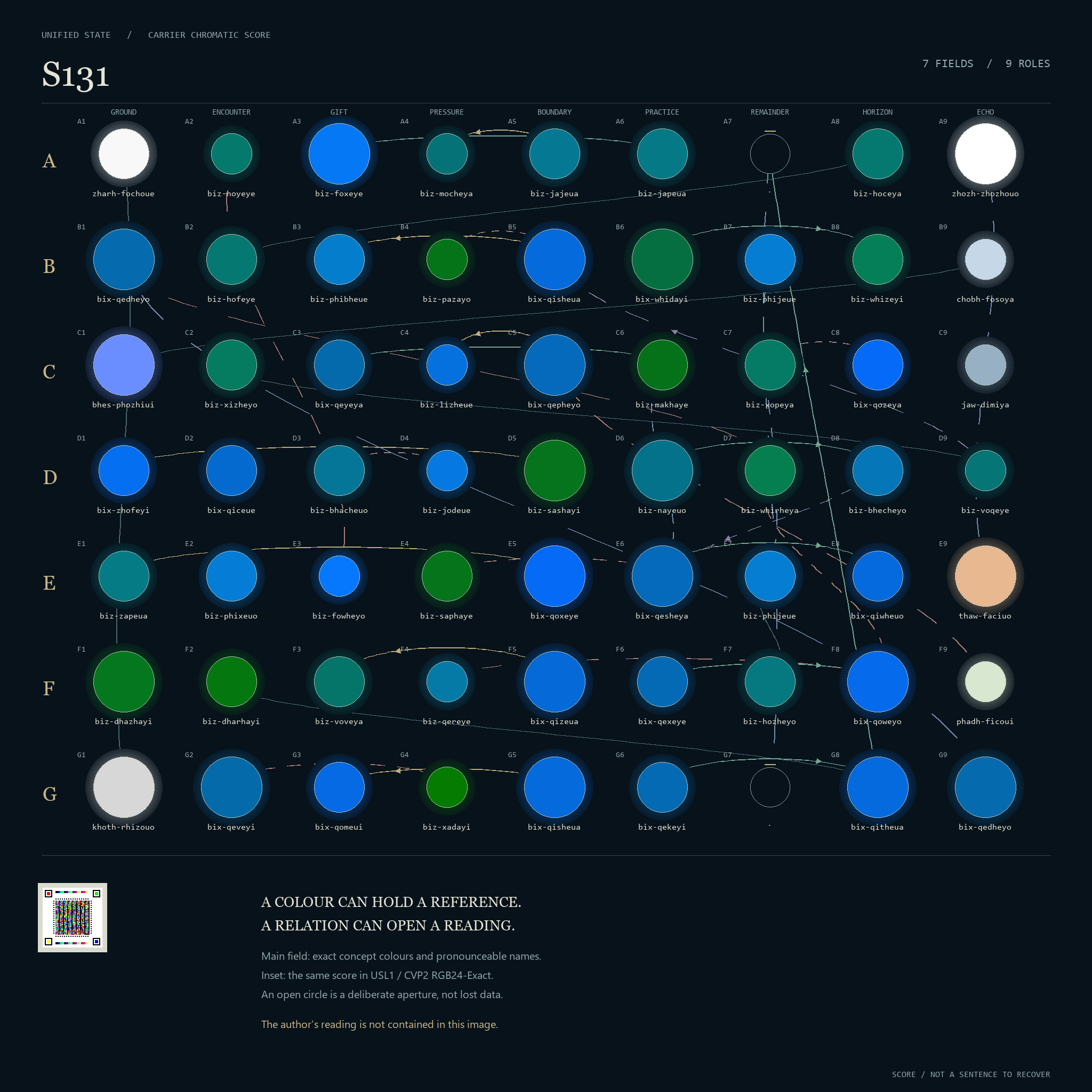
The interactive gallery lets readers inspect each selected concept, follow its relations and switch between Carrier words, English labels and colour alone. It places the author’s reading beside the viewer’s first interpretation, the answering score and a reflection on what changed.
Both scores are also available as reversible Carrier-word text: the original composition and the reply retain their roles, repetitions and relations in a form that can be encoded again.
A reply that changes the starting point
The viewer received the original image and its frozen dictionary, grammar and decoding resources. It did not receive the author’s essay or source matrix. After recovering the score with the supplied decoder, it saved its first interpretation and then composed Who sustains an open invitation?
The reply’s most consequential change is visible in a single relocation. The care penalty, placed in the original’s fourth movement as a remainder, becomes the response’s opening ground. What the original retained as a cost, the reply makes an organizing question. Distributive justice, accountability and opportunity cost enter its treatment of a shared space.
The response also gives consent an explicit relation limiting “correction without erasure.” The author’s prose had already qualified record keeping through privacy and consent; that exact binding was absent from the original matrix. The answering composition puts the qualification into the score itself.
Two artworks, one inspectable exchange
The original contains 61 concept occurrences, 58 distinct concepts, 38 links and two blanks. The reply has 56 occurrences, 50 concepts, 37 links and seven blanks. Thirty-three distinct concepts are shared. The reply brings 17 further concepts into the selection, all drawn from the same frozen 6,257-entry dictionary; it creates no new dictionary records.
The exchange verification records exact recovery and roundtrips. A separate 29-check codec report tests transport and structural requirements. Those checks do not grade the interpretations. The viewer’s fresh context was governed by procedural access restrictions, not an operating-system sandbox, and both roles worked within one orchestrated session using supplied codecs.
Readers can download the receiver kit for another interpretation, or the complete offline gallery and evidence kit. The small transport images depend on substantial shared resources; they are not self-contained stores of unlimited English meaning. The method and scope keeps that accounting visible. The artistic result is an answer that remains legible in a shared vocabulary while changing what comes first.
Enter Chromatic DialogueReceiver-only kitComplete public kit