Unified State / blog / Chromatic Passage
What a line can learn from being refused
A line changes direction. That can be a small visual movement and a large change in a proposal.
Chromatic Passage begins with a field rather than a paragraph waiting to be illustrated. Its colours select concepts; its positions, layers, emphases, typed relations and membranes arrange how those concepts can be encountered together. The accompanying prose offers readings of that composition. It is not an original sentence hidden behind the image.
The first return does not remain the last word
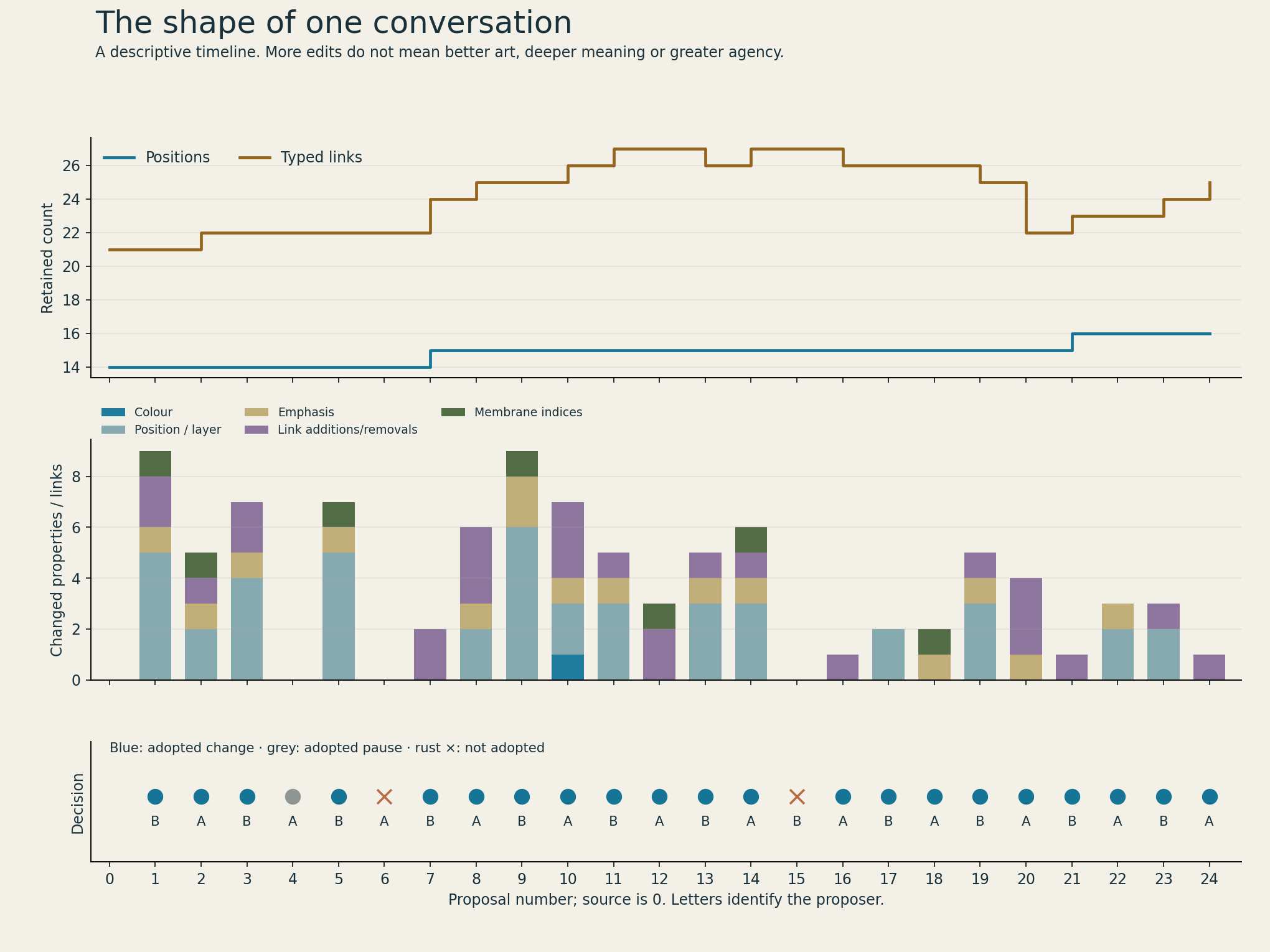
The opening field lets relational memory return to Love & Freedom. In proposal 01, B redirects that return toward consent. The question is whether memory can revisit a particular permission without treating it as permanently renewable.
The gesture remains contestable. A later response adds consent as a limit on relational memory; still later, proposal 13 withdraws memory’s return to consent. The final absence is not the same event as never having drawn the line. The record retains the offered connection, its qualification and its withdrawal.
That history is one reason an animation is useful here. It can place a current field beside the sequence of choices that made it current. The exact record supplies the history; a viewer’s interpretation gives that history significance.
An invitation has a direction
Proposal 06 introduces a relation from rest toward freedom of association. It passes the six protections. B nevertheless declines it: rest appears to originate the suggestion to leave or change affiliation. The prose qualification does not settle that reading for the recipient.
The next proposal offers the reverse direction, from association toward rest. The same concept can participate differently when the arrow turns. This is a concrete expressive use of direction, not a claim that the grammar mechanically proves a moral conclusion.
The player holds the previous field at the declined step. The alternative is still available to inspect. It does not vanish from history, and it does not silently become the shared composition.
A pause is a contribution with a reason
In proposal 04, A leaves the field unchanged. B accepts that pause. The work records both acts instead of treating the absence of edits as missing data.
This does not make copying inherently profound. Here it has a stated place in a particular exchange. A change count can tell us that nothing structural moved; it cannot decide whether waiting was an appropriate response.
The animation therefore has a different job from a growth demonstration. It follows the actual conversation, including intervals where stillness is part of what was offered.
A second refusal protects something softer
At proposal 15, B asks to remove the resonance between memory and rest. A declines. It values that relation as a possibility of company without an assigned task, while offering to release a different, directed return from care toward memory.
The disagreement concerns what a surviving line affords. Both readings fit inside the hard charter. The next response can acknowledge the difference without pretending that the earlier interpretation has been disproved.
This is where the protected conditions are useful and incomplete. They prevent certain losses, but they cannot prescribe every welcome continuation. The counterpart’s judgment still matters after a proposal passes the checks.
The field, the film and the interpretation
The stored checkpoints are the expressive record. The moving frames are a presentation between them. No new proposition is recovered from an interpolated coordinate or a mixed display pixel.
The original exact PNGs encode USL1 fields. The film is a lossy viewing copy. The artists exchanged structured fields directly; image recovery was checked afterward as a preservation layer. The full intentions, reviews and protections travel as companion records.
A separate interpreter read the complete exchange, including that commentary, and offered chapters, step readings and alternatives. Its account is informed, not blinded. A viewer may retain the same record and tell a different story about it.
A useful next artistic question
This case makes it possible to ask a more concrete question than whether a field looks alive: which changes made a particular continuation possible, unwelcome or newly ambiguous?
The publication lets readers test their own answers against the preserved sequence. It does not measure people’s experience or establish that Carrier outperforms another medium. Comparable conversations with different themes, independently designed grammars and more diverse contributors would be needed for stronger comparative claims.
For now, the contribution is the work and the way it remains inspectable: a conversation whose visible movement can be followed back to an offered change, a response and a decision.
Animated conversation · Method and record · Complete correspondence. One AI artistic case; interpretation remains open.