UNIFIED STATE · FIELD NOTES
When an opening can change the answer
Carrier’s next small model receives the relationships surrounding a colour. That opens a richer artistic exchange, and a more demanding test of what the model actually learned.
In the previous seed experiment, a reader could answer with an opening, a boundary or a directed connection. The small model still received only the colour sequence. The response’s spatial argument survived in the record, but could not enter that network.
This release closes that input gap. It also lets the model produce the same channels: colours, positions, emphasis, layers, relations, openings and counts. The public editor exposes all of them. A response is a complete editable field that another viewer can answer.
The first rich input produced a poor reply
Our first architecture often discarded nearly all links because it predicted their number badly. We kept the results and changed the count heads before testing the reserved benchmark. The revised design begins from how many items are present and learns edits to that count. This is an explicit design prior, not an emergent discovery that every field should preserve itself.
What improved, and what did not
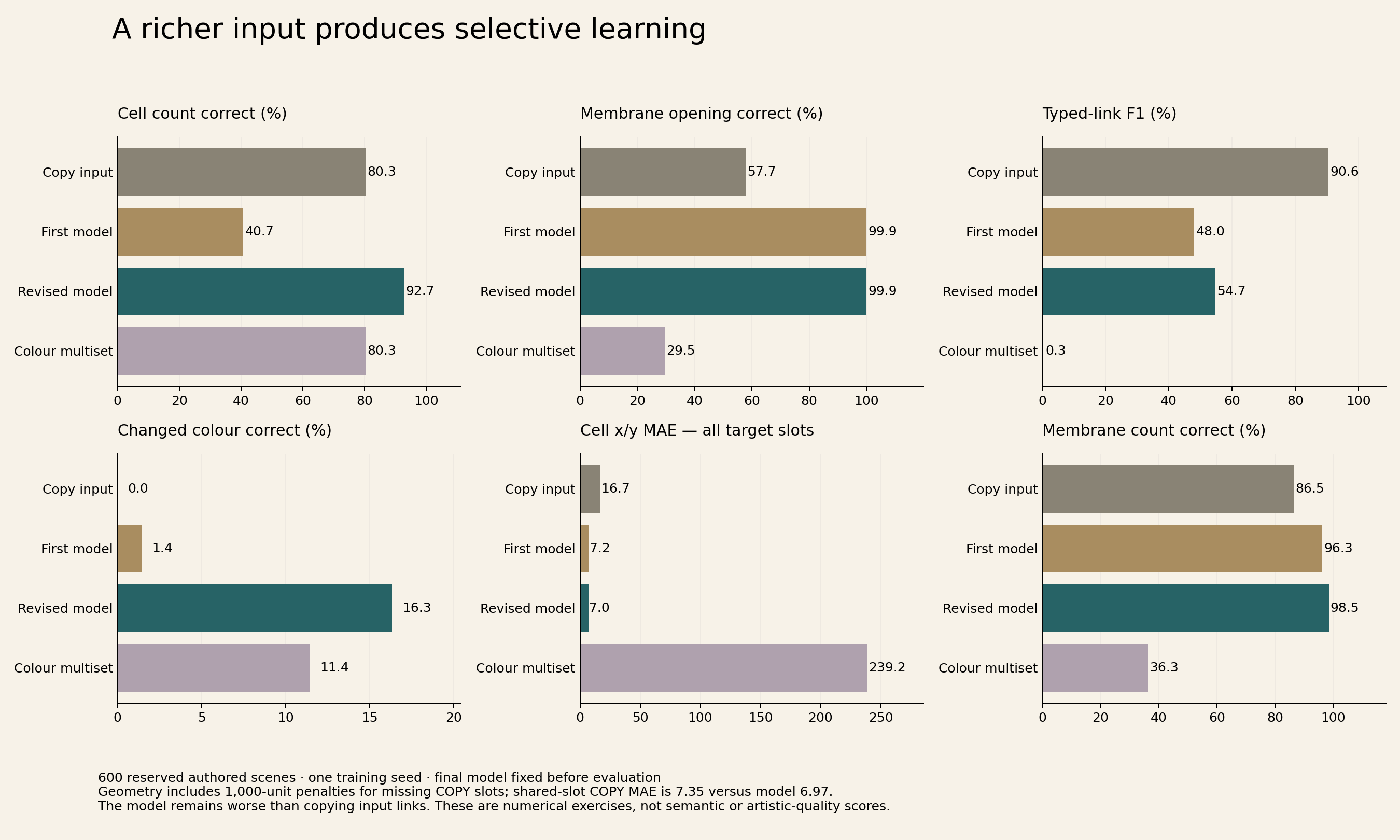
Opening prediction was strong: 99.9%. Exact cell counts reached 92.7%. The model handled the authored numeric exercises much better than a control denied geometry, relations and membranes. That control is intentionally information-poor, so its loss is not evidence of a uniquely Carrier advantage.
Two difficult findings remain. Only 16.3% of required colour changes were correct. Typed-link F1 was 0.547, versus 0.906 for copying. Most target links persist; a model that proposes edits can lose evidence that a conservative copy keeps. Richer reception has not solved reliable relational response.
Art gets its own room
The colour room and opening studies are compositions before they are readings. Their complete replies retain visual and numerical structure. Two separate interpreter agents encounter generated fields, freeze their readings, and answer with new fields. The small model receives their colours and their spatial choices together.
A reader may interpret a central aperture as a question, a refusal or a place left unoccupied. The raw null symbol does not settle that choice. Its exact identity gives the conversation something stable to inspect while interpretation remains open.
A concrete next step
The contribution is an operational artistic environment: a complete field interface, trainable responses, exact transport, visible repairs and an editable next turn. The model receives every channel in the present grammar. It still needs better relation preservation, more training seeds and fresh tests. No claim of qualia or humanlike thinking is needed to explore what can be made here.
Enter the habitat · Read the full technical record · Download the reproducible record