Unified State Language · A book carried in colour
A 4.46 MB text became a 2.35 MB colour image—and the complete original file came back, byte for byte.
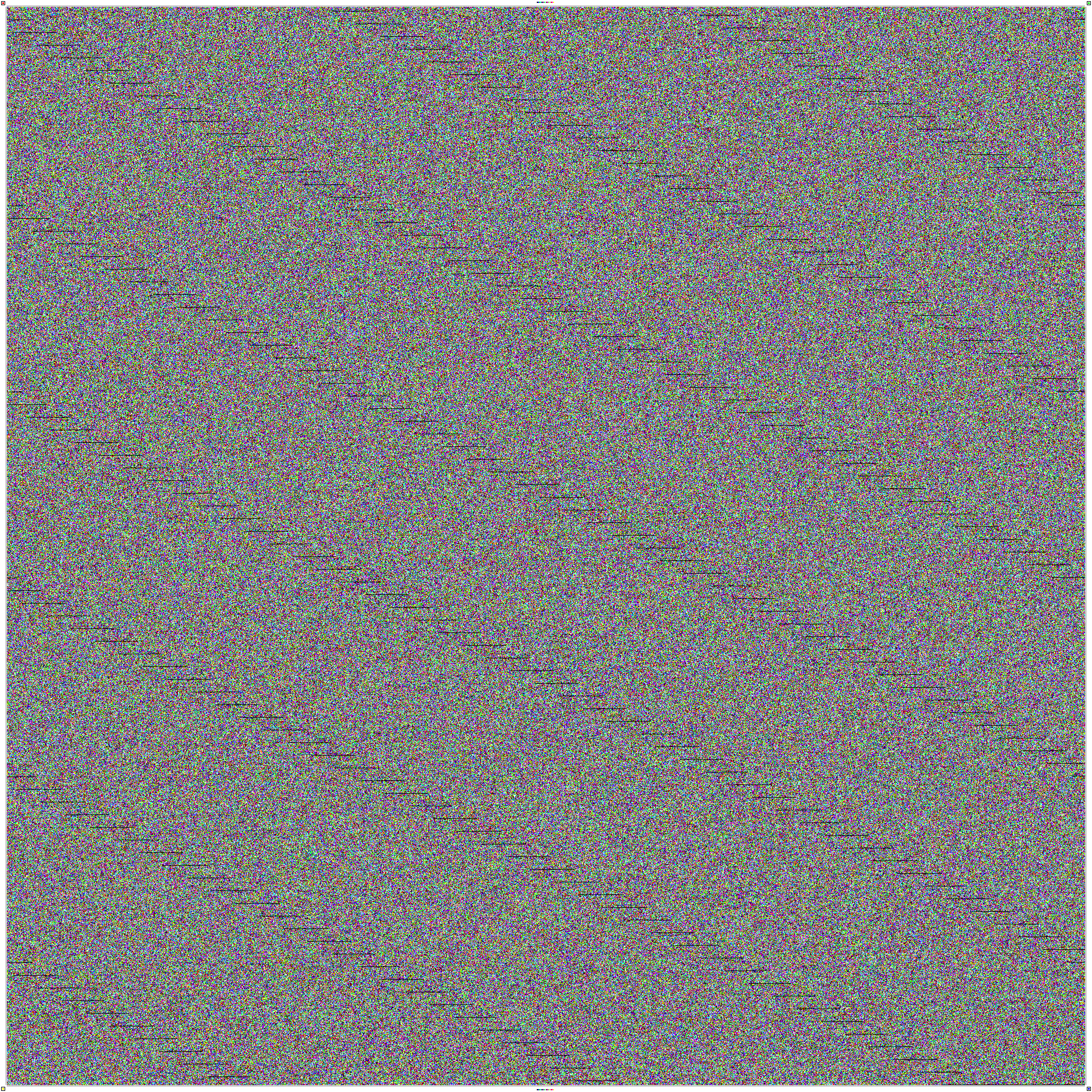
The image above is a display preview. For decoding, download the verified original 3,792 × 3,792 PNG linked below. WordPress resized this preview; the full-resolution file preserves the message.
Download the original 3,792 × 3,792 PNG ↗The text came from Project Gutenberg’s edition of The King James Version of the Bible, eBook No. 10. We took the complete supplied plain-text file, passed it through Unified State Language’s lexical message system, encoded the resulting packet into a colour image, and read the image back.
The recovered file matched the source byte for byte. Its words, punctuation, spacing, line endings and Project Gutenberg notices survived the journey. The check compared the recovered bytes directly with the original file.
For USL, this is a substantial milestone. A system first demonstrated with sentences and small examples has carried a long, real document through the complete path: text → lexical message → image → lexical message → exact text.
The book and the image, measured
| File or stage | Exact size | What the number describes |
|---|---|---|
| Original text file | 4,455,950 bytes | The complete supplied pg10.txt |
| USL1 message packet | 3,927,249 bytes | Typed lexical references and exact literal text |
| Compressed message stream | 1,523,618 bytes | The packet after beneficial gzip compression |
| Verified original PNG | 2,352,871 bytes | The complete visual message, including its framing and protection |
47.2% smaller than the uncompressed text. The PNG includes the visual framing and error correction; the receiver’s shared lexical base and codecs are separate.
The final PNG is 2,103,079 bytes smaller than the source text: a reduction of 47.2%. In decimal units, approximately 4.46 MB became 2.35 MB. The complete protected image occupies just over half the space of the uncompressed source file.
Those figures describe the particular original PNG linked in this article. They do not describe the WordPress display copy, and they do not include a separate copy of the shared English lexical base or decoding software. The receiver needs the pinned lexical release and the appropriate codecs to interpret the message.
For a fair compression comparison, ordinary gzip reduced the same source text to 1,395,977 bytes in our check, which is smaller than the PNG. The image result therefore establishes no general compression record. Its achievement is a compact, structured visual carrier with a tested path back to the complete source. The space used for visual framing and error correction serves that purpose.
What the colours are carrying
USL English Lexical Base 1 gives 354,983 source-attested English forms stable addresses. When the composer recognises an exact listed form, it can represent that form by its identifier. Other content remains literal text, so unfamiliar words, case differences, punctuation and whitespace are preserved.
This book produced 1,386,973 typed message tokens: 693,486 lexical references and 693,487 literal tokens. These are the message format’s records, not an AI model’s token count or a count of distinct English words. No Carrier concept references were explicitly attached in this example.
That last detail helps explain the result accurately. The experiment preserves and addresses language; it does not claim that a machine has interpreted the book’s theology, selected a meaning for every word or converted every passage into a curated concept. The system leaves those choices visible and available for deliberate future work.
The binary packet is then compressed and carried by CVP1, USL’s versioned image transport. CVP1 repeatedly uses sixteen calibrated colours, giving each data tile four bits before framing and error-correction overhead. Its reader follows an explicit layout and checks the recovered data. An individual tile does not stand for a whole verse or an unbounded amount of meaning.
A square fitted to this book
Auto fit selected a 1,872 × 1,872 data grid for the compressed packet. That grid provides 1,532,010 bytes of protected stream capacity. The book uses 1,523,618 bytes, filling approximately 99.45% of it.
CVP1 adds a twelve-tile landmark border on each side. At two pixels per tile, the full image becomes 3,792 × 3,792 pixels. The border, calibration colours, header, checks and error correction are part of a format designed to let a receiver establish what it is reading.
The whole source fitted into one frame. Other books may require different grids or several frames; larger and smaller outcomes depend on the actual text, its references and its compressibility. The tools calculate those figures for the message being encoded.
Why this is a big deal for USL
The extraordinary part for this project is the complete, inspectable journey at book scale. A reader can obtain an ordinary PNG, recover a structured packet using published rules, resolve its lexical references against an identified source release and reconstruct the original file exactly.
Several parts of the language now work together in that journey. Stable lexical addresses provide reusable references. Literal text protects what the vocabulary does not cover. The image protocol provides framing and error correction. Hashes let the receiver verify the result. The shared colour registry protects current ownership as Carrier and the lexical base continue to grow.
The scale also forced a practical improvement. An earlier one-million-token ceiling stopped this very file. The updated composer processes the binary stream in a background worker, keeps a bounded preview and generates image frames as needed. Source text and complete packets each have a 128 MiB file-size limit; a source near that limit can exceed the packet allowance once its overhead is included. A further check with three copies of the book recovered 13,367,850 source bytes through the image path exactly.
Encoding data in images has a long history. This result’s significance is USL’s own integration of a source-based lexical layer, explicit reference rules and reproducible visual transport. We now have a concrete book-sized artifact against which future changes can be tested.
From a successful image to a shared method
The broader possibility is communication in which a visible artifact carries precise, recoverable data alongside a shared system of references. The same infrastructure can carry ordinary text today and explicitly chosen Carrier connections when a sender intends them.
Over time, other languages could bring their own lexical records and carefully supported sense mappings into that shared structure. Image sequences could carry larger documents or collections. Paired source-and-image examples could support controlled experiments in model recognition and recovery. Those are research directions; this book test establishes exact deterministic recovery, not learned visual understanding.
The result also makes an everyday publishing distinction concrete. A display image and a data image can look similar while containing different information. WordPress reduced the embedded preview to 2,560 × 2,560 pixels. That resized file is 6,375,216 bytes—larger than the original PNG—and the current reference decoder refused it. Resizing changed the pixels enough that the current decoder refused the file; a .png extension alone does not preserve the original pixels.
The full-resolution download is intact. We fetched that publicly hosted file, reopened its PNG data and recovered the source again. Both its image hash and the recovered source matched the verified originals. Use that file when repeating the experiment.
Download the verified Bible PNG, open it in the Lexicon reader and recover the text. The Project Gutenberg source page supplies the edition and download context. One image now gives USL a complete book to carry, an exact result to check and a substantial foundation for the next experiment.
Public original checked on 7 September 2026. PNG bytes, recovered packet and complete source were verified with CVP1 1.2.0 and USL lexical runtime 1.1.0, using English Base 1.0.0. File sizes use exact bytes; MB means 1,000,000 bytes.