Unified State Language · The shape of an address space
One square holds every RGB24 colour address. What we build at those addresses will give the language its depth.
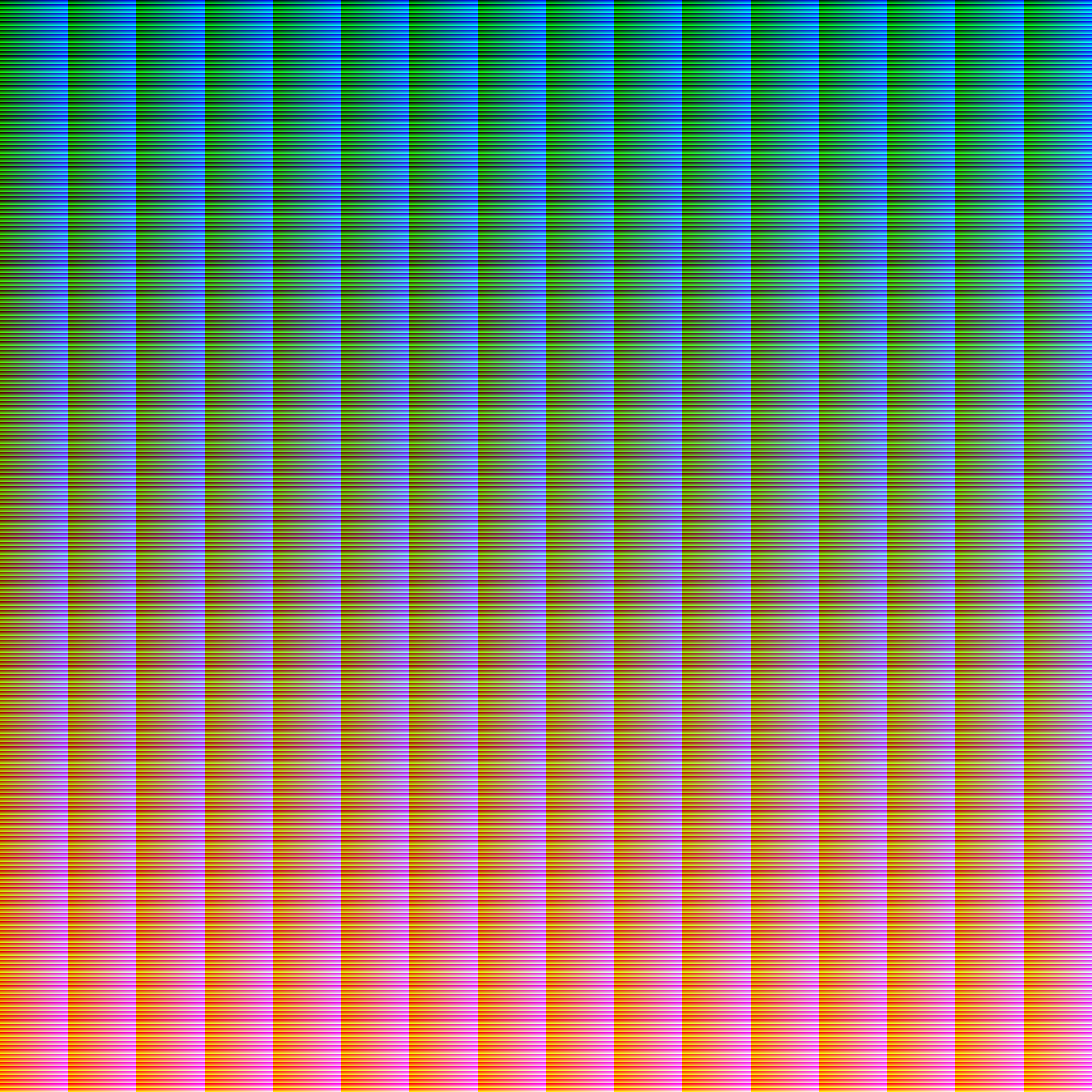
This is a scaled preview. The complete enumeration belongs to the original 4,096 × 4,096 PNG; resizing cannot preserve every address as a separate pixel.
Download the original 4,096 × 4,096 PNG ↗There is something satisfying about seeing an entire system gathered into one image. The square above begins as a field of colour. Look more closely at the original, and it becomes an ordered set of places: positions that can be counted, located and described exactly.
This is the full RGB24 namespace atlas for Unified State Language. Its original image contains 16,777,216 pixels and 16,777,216 distinct RGB colours, each appearing once. Black occupies the first position; white occupies the last. Between them lies every value available in this particular digital colour system.
We made the atlas to give that scale a visible form. It lets us inspect the space in which the language’s addresses can grow.
A picture made from a rule
RGB24 gives red, green and blue one byte each: 256 possible values per channel. Multiplying those possibilities gives 256 × 256 × 256, or 16,777,216 combinations. A 4,096 × 4,096 square contains exactly that many pixels.
The layout follows a simple rule. Count columns and rows from zero, then calculate n = y × 4096 + x. The number n becomes the pixel’s RGB value: its highest byte supplies red, its middle byte green and its lowest byte blue.
There is no random arrangement to reconstruct. A reader can calculate the colour at any coordinate, or find the coordinate belonging to a colour. We verified the generated original by reopening its PNG and checking every reconstructed channel byte against the prescribed mapping.
The Visual instrument offers a fitted overview, a view at native resolution and exact colour lookup. The overview helps us navigate; coordinates preserve the detail a small screen cannot show all at once.
A place becomes useful through its record
The atlas contains possible addresses, including addresses that have no owner yet. A pixel’s presence does not supply a word, a definition or a claim about the world.
English Lexical Base 1 currently gives 354,983 source-attested forms stable addresses. That is just over two percent of RGB24’s capacity. Each record identifies a form found in the preserved lexical source. Carrier separately holds concepts, definitions, relations and their working or checked status.
Those roles matter. The spelling bank can belong to the lexical collection while particular financial or geographical senses require their own account. A colour makes a record addressable; the record and its context establish what the reference says.
The global colour directory now coordinates ownership across both layers. New Carrier entries and lexical imports must respect existing reservations. Retired allocations remain reserved, so an old address is not quietly handed to a different entry. Historical messages still need their original pinned context.
The dictionary and the instrument
The dictionary describes what entries mean and how they relate. The codec and versioned specifications define the exact rules for representing and reading data. Keeping those responsibilities separate lets us review a definition as a definition and test an encoding rule as an encoding rule.
It also explains why this atlas looks different from an encoded message. The atlas enumerates addresses. CVP1 carries bytes.
CVP1 message images repeatedly use sixteen calibrated transport colours, together with landmarks, framing, integrity checks and error correction. Their pixels follow a declared grammar. An atlas pixel is simply one RGB24 address at its prescribed position.
The full-colour square therefore has no hidden book waiting to be decoded. It shows the available address space. A message image carries particular content through a declared format. Lexical references also require their pinned dictionary release.
What we hope to connect
The perspective that interests us most is multilingual. English can occupy one lexical layer, Ukrainian another, Spanish another. Their forms can have distinct records while carefully supported relationships connect particular senses to shared concepts.
Those connections will sometimes be partial. A familiar translation can carry different associations or divide experience differently. Explicit sense mappings give us somewhere to record that detail, instead of assuming that matching words must mean exactly the same thing.
The visual work also offers material for future learning experiments. A deterministic atlas supplies known colour-coordinate pairs. Encoded message datasets can pair images with exact source text, references and recovery results. We can then measure what a model recognises under particular conditions. The existence of an image collection alone establishes no learned ability to read or understand it.
For now, this square gives the project something both modest and expansive: a complete, inspectable map of its RGB24 addresses. We can point to a position, verify its value and follow an allocation to its record. The language grows through the care taken with those records and the relationships between them.
Open the original 4,096 × 4,096 atlas, or explore Show full namespace in Visual. To see addresses used in text, visit the English Lexical Base.
Public original checked on 7 September 2026. All reconstructed RGBA bytes matched the canonical RGB24 atlas. The embedded 2,560-pixel preview is for display; exact enumeration belongs to the original 4,096-pixel image.