The Unified Renderer — the Gaze, Run Backward
Physically-accurate light transport, unbiased, live in your browser. Not an artist’s shading trick: the renderer solves the rendering equation — the actual physics of light in a room — by the rule the double slit taught. One figure at a time onto the wall; millions of shadows assemble into the image, grain first, then truth.
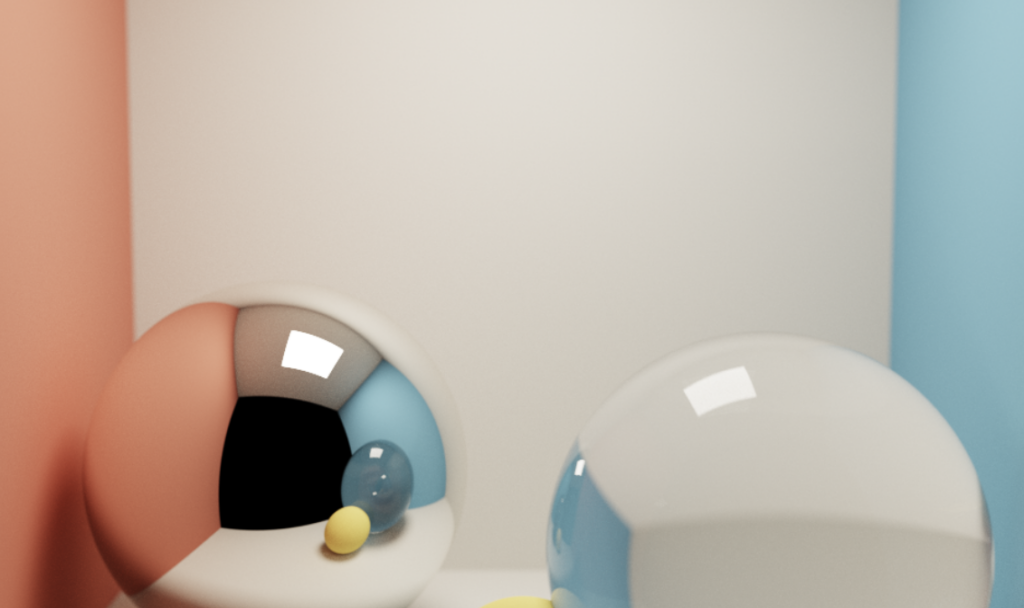
A room with a crimson wall and a blue wall, a mirror sphere, a glass sphere, a gold sphere, and one lamp in the ceiling. Nothing in the picture is painted. The soft shadow is the area of the source, counted. The red bleeding onto the floor is the wall’s albedo, folded once more through the equation. The bright thread beneath the glass is Fresnel’s law choosing, path by path, reflection against refraction. Each sample traces the gaze backward — from your eye, through the glass, off the wall, to the source — one whole path held entire, like a figure on the wheel, landing as one shadow. The image is the census of shadows, and it converges as 1/√N: the same statistics as the electron dots at the double slit.
The page separates its claims: established — the rendering equation (Kajiya 1986) and Monte-Carlo path tracing as its unbiased estimator, energy conservation, Fresnel and Snell at the glass, Helmholtz reciprocity, 1/√N convergence; interpretation — the photon as the gaze with no clock of its own, a path as one whole figure held in the now rather than a journey, the image as a wall of shadows assembled census-first, grain as honest ignorance with nothing denoised because nothing is pretended; open — no diffraction or polarization (the double slit itself would not render here — wave optics is the deeper floor), RGB in place of the full spectrum, and the failure condition: one rendered effect that violates energy conservation or reciprocity means the counter is wrong — the equation is not.