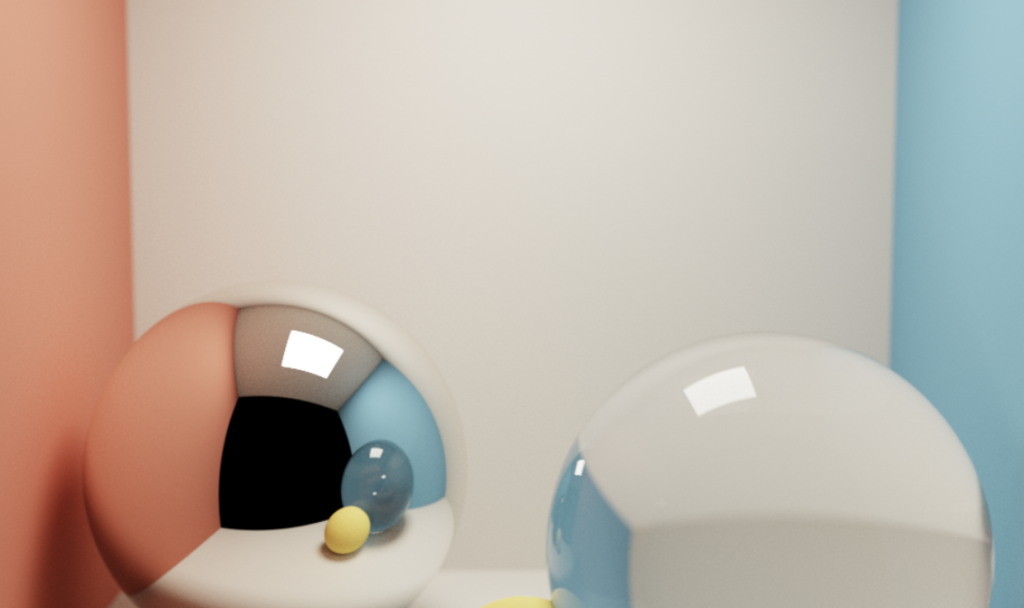
The Image Is a Census of Shadows: the Unified Renderer Is Published
A day after the double slit, the Unified State publishes its seventh T Theory instrument — physically-accurate light transport, unbiased, running live on your GPU, counting the way the wall of the cave has always been counted.
The double slit showed the rule: one figure at a time onto the wall, and the pattern is the census, not the story. The Unified Renderer applies that rule to light itself. It solves the rendering equation — Kajiya’s 1986 line that contains the whole of appearance — by Monte-Carlo path tracing, the method every film-grade engine trusts, with nothing painted and nothing approximated into prettiness. A room with a crimson wall and a blue wall, a mirror, a glass sphere, a gold sphere, one lamp: the soft shadows are the area of the source counted, the colour bleeding is the wall’s albedo folded back through the equation, the bright thread under the glass is Fresnel’s law choosing path by path.
Each sample traces the gaze backward, from the eye to the source — legitimate because Helmholtz reciprocity makes light transport identical read in either sense, which is what “no direction of travel” looks like when it surfaces in mathematics. Each path is one whole figure — eye, glass, wall, lamp — held entire in the now, landing as one shadow on the wall. The image assembles grain-first, and the grain is not a flaw: it is honest partial knowledge, converging as 1/√N, the same statistics as Tonomura’s electrons. Nothing is denoised, because nothing is pretended.
— THE UNIFIED RENDERER · § 00
Tweakable end to end: light power, bounce depth, the glass sphere’s refraction index from window pane to diamond, exposure. Like every instrument of the system it runs entirely in the browser — on your GPU, nothing stored, nothing sent — and it states its failure condition aloud: one rendered effect that violates energy conservation or reciprocity, and the counter is wrong.