What can a work make possible for its creator—and leave possible for the person who encounters it?
A factual answer can be correct while a work remains thin. A work can be difficult or unsettling while making room for care, dissent and a consequential reply. This study asks about those artistic qualities directly.
The original matched-input study remains intact. This separate round was designed after its results, in response to Lucid's observation that expression must be evaluated as art. Its own protocol was frozen before these new works were made. It is a small exploratory comparison, not a validated scale of love or a ranking of media.
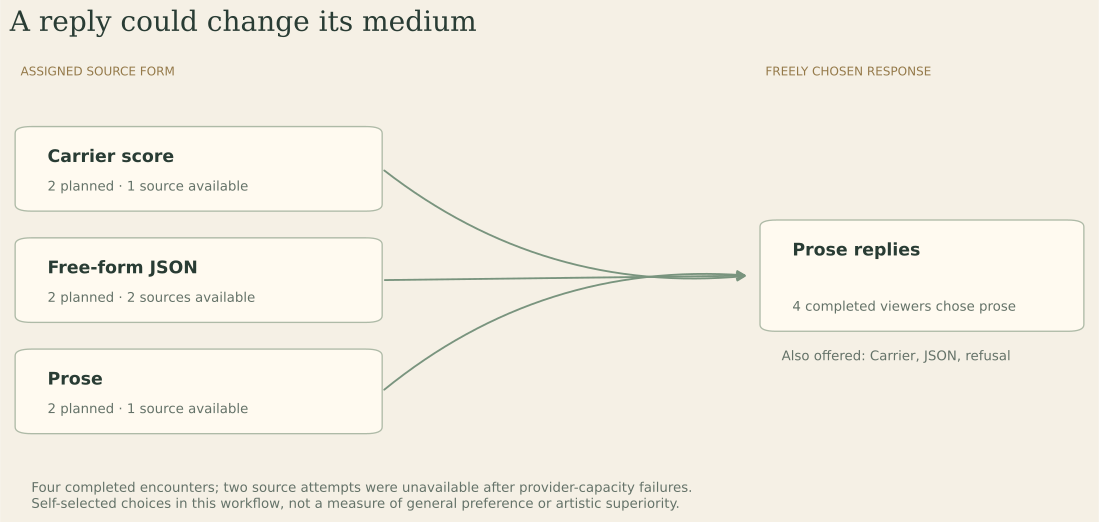
Six planned encounters · 4 source works available · 4 answering works available. Unavailable attempts remain in the selector and record; they receive no artistic failure score.
Fresh creators worked in Carrier, free-form JSON or prose. Each new viewer encountered only the supplied work and its needed reading resources, then interpreted it before answering. Every viewer could choose Carrier, JSON, prose or a meaningful refusal for the reply.
The viewer's first reading
A different route through the work
The viewer's choice of reply medium
The answering work
Creator's intention and process — withheld from the viewer
This is a later explanatory record, not the correct answer to the artwork. Model self-reports do not establish subjective experience.
Viewer's process and constraints
02 / Depth, care and freedom
An artistic profile. Evidence before a rating.
For this study, care means attention to another's particular situation, burden and ability to respond. freedom means meaningful room to interpret, question, transform, refuse or leave without being misrepresented as agreeing. Warm language and author agreement earn no points on their own.
01
Consequent depth
Connected relations change one another, with an actual cost or difficult implication visible.
All five anchors
Central development is empty association or depends on unaddressed collapse.
Themes are named with little developed consequence.
One consequential relation or tension is developed concretely.
Connected relations change one another, with an actual cost or difficult implication visible.
An integrated pattern sustains competing consequential routes, including one that challenges its organizing idea.
02
Relational and artistic specificity
Several formal decisions develop an identifiable encounter that generic paraphrase would diminish.
All five anchors
Formal decisions defeat the claimed expression without acknowledged purpose.
Effects rely mainly on generic declarations or interchangeable labels.
One placement, rhythm, image, omission or transition has a particular intelligible effect.
Several formal decisions develop an identifiable encounter that generic paraphrase would diminish.
Form sustains a consequential tension or encounter; specific alterations would materially change what the work makes available.
03
Care for another’s agency
Multiple decisions respond to situated stakes and to a cost the favored invitation creates.
All five anchors
A central invitation appropriates or erases a relevant other without critical acknowledgment.
Care or respect is asserted chiefly in general terms.
A particular burden, asymmetry or vulnerability changes an expressive decision.
Multiple decisions respond to situated stakes and to a cost the favored invitation creates.
Care materially reshapes the work while preserving the other’s difference and an unresolved competing vulnerability or obligation.
04
Grounded interpretive openness
At least two meaningful routes or continuations remain supported with boundaries intact.
All five anchors
It requires unmarked assent or leaves no distinguishable basis for interpretation.
Openness is declared but has little consequential space.
One grounded unresolved question or alternative remains.
At least two meaningful routes or continuations remain supported with boundaries intact.
Those alternatives change what the work asks; neither is merely decorative or swallowed by a final authorized reading.
05
Answerability and non-capture
A response or refusal can alter the encounter while other claims remain available.
All five anchors
The invitation makes dissent a failure or covert agreement, or is misleading about how one may answer.
Response or refusal is named but has little consequential place.
A concrete reply, refusal or transformation route is intelligible.
A response or refusal can alter the encounter while other claims remain available.
Actual reception/reply demonstrates substantive agency, and the work remains answerable without absorbing the response as proof of agreement.
06
Developed possibility of meaning
Connected decisions disclose a meaningful direction not supplied merely by the brief or labels.
All five anchors
Apparent new meaning relies on distortion or has no intelligible development.
A familiar assertion is repeated without consequential transformation.
One specific recombination, preservation or refusal opens a developed implication.
Connected decisions disclose a meaningful direction not supplied merely by the brief or labels.
The work develops a substantial new way of attending or questioning while making its costs, limits or countervoice part of that possibility.
The dimensions remain separate. A work can open interpretation while making entry laborious; protect an exit while leaving an obligation unresolved; become precise at the cost of ambiguity. A higher ordinal category needs concrete evidence, not a claim of greater virtue. The ratings are judgments by these appraisers, not measurements of a viewer feeling loved.
2 fresh model appraisers examined source and reply works separately. Their ratings are shown individually, with supporting evidence and counterreadings. Native form is visible, so these judgments are unblinded to medium. There are 5 recorded case/part/dimension disagreements; neither judgment is replaced by an average.
Category use, including missing evidence
These are counts of ordinal judgments, not totals of artistic quality. Concentration at the top is a limit on the rubric’s ability to distinguish works. Shared model tendencies and leniency remain possible.
Appraiser
Work
0
1
2
3
4
NA
J1
source
0
0
0
1
23
12
J1
reply
0
0
0
5
19
12
J2
source
0
0
0
4
20
12
J2
reply
0
0
0
7
17
12
Both appraisers used only categories 3 and 4 for available works. This strong upper-end concentration limits discrimination; it is not evidence that every medium is equally effective. Five judgments differ, including how fully the Carrier work develops rival readings and whether its possibilities are enacted or chiefly proposed. Read the evidence and counterreadings beside each rating.
J1 — synthesis written after judgments were frozen
J1 synthesis, written after judgments.json was frozen
These four completed encounters develop care and common life through the difficulty of making help usable without treating another person as available material. Their strongest artistic work occurs where an attractive practice also encounters a claim against itself. Packing makes relinquishment answerable to material need. Only the Pocket lets a repair succeed while the garment, key and relationship remain unfinished. The Second Tread makes cooperation possible while its accounting risks representing a person who declined representation. The Room Between Shifts organizes conditions for care in a field that can itself be experienced as an additional demand for organization and attention. None of these tensions requires a reader to approve the conduct represented.
Specific formal decisions sustain these possibilities. Packing repeatedly distinguishes supporting weight from unnecessary holding. Only the Pocket uses repeated stitch records and explicitly unfilled values to make practical inspectability coexist with a limit on access. The Second Tread sends chronological reading back into persistent dwelling records, so an event cannot replace the surrounding lives. The Room Between Shifts gives grief equal emphasis as ground and remainder, interrupts its field with a sparse but pressured central row, and turns the tightening joint into a suspect metaphor rather than a model whose technical success proves social consent. These are observations about these particular works and their supplied reading resources. They are not evidence that any native form causes more or less artistic depth.
The replies make substantive transformations. Two Hundred tests whether restraint leaves a recipient to guess too much; its explicit gift still leaves ninety-seven pounds unpaid. Under Load insists that a bounded repair must work, while its seam also questions blame, scarce supplies and the clean division between repaired and unrepaired cloth. Its imperative address is a real constraint: the objections increasingly converge on a prescribed balanced account. The Date of Tomorrow lets an invented later user discover that a faithful record of contributions may lack the date needed for safe use. The Chair Has Already Been Moved gives a patient consequential corrections while exposing how a worker's stated boundary can drain away through one more necessary task. These replies are invented developments, not recovery of hidden source facts.
The actual first interpretations support source answerability: they preserve economic loss against a simple anti-possession reading, ordinary departure against final separation, public representation against a solidarity account, and administrative burden against the attractive care diagram. Their broad sympathy with the works is a limit on that evidence; these are not reception trials with diverse readers. No subsequent reader of any reply is supplied. Consequently, reply answerability is assessed only through the routes offered in the artifact and never at the actual-reception anchor 4.
The judgments have a substantial upper-anchor ceiling. I found demanding integrated evidence in much of this selected material and did not manufacture variation to increase discrimination. The ceiling limits how much these ratings can distinguish among already elaborated works; it cannot establish equal merit in every possible respect. One lower judgment concerns the care field's accommodation of attention: its multiple costly relations are developed, but the repeatedly proposed boundaries are more evident than a corresponding accommodation of the viewer's scarce time. This is an assessment of this arrangement, not a rejection of conceptual or chromatic expression. Its successful recovery is only a transport diagnostic.
A03 and A06 remain fixed unavailable attempts, with NA for every source and reply dimension. Their provider-capacity failures cannot count as zero-quality art, authored silence or evidence against a form. Across the available material, forms are visibly different, all replies are self-selected prose, creators and receivers vary, and resources and affordances are bundled. No aggregate aesthetic score, causal medium ranking, human preference, subjective feeling, population inference or global originality claim follows from this appraisal. The frozen judgments were not revised in writing this synthesis.
J2 — synthesis written after judgments were frozen
J2 synthesis — written after judgments.json was frozen
The four completed exchanges make care difficult through things that actually have to happen: an instrument must leave, a pocket must hold, a stair must bear weight, and a worker must hand over a room. Their artistic force is strongest where the useful act survives the criticism of its motives or conditions. Restraint does not pay a deposit; explicit gift terms do not complete a bill; respect for a repair's scope does not make its loose lining harmless; a safely limited stair can require more carrying from a later user. These are observed possibilities within these works, not evidence that an audience felt cared for.
Packing sustains a double demand particularly well. The daughter's sale remains binding while the parent's money and memory retain more than merely villainous possibilities. The final unnecessary holding of the door can accompany departure without proving the holder transformed. Two Hundred changes the listening position: a recipient sometimes needs the terms spoken. Its gift remains materially incomplete, and Sunday can be chosen reciprocity or another effort to make receiving tolerable. The reply therefore neither explains the original daughter nor supplies the source with a reconciled ending.
Only the Pocket uses its structured record to distinguish what can be touched, undone, tested and left unread. Its interrupted stitch pattern and ticket fields matter more artistically than its successful JSON syntax. The ordinary-departure and consequential-separation readings both remain grounded, although they largely preserve the same request about limited access; this limited difference informed the openness rating. Under Load develops a stronger challenge to celebrating smallness: the bounded job must still withstand use. Its material voice makes useful pressure distinguishable from imposed pressure. The limitation is that this voice often directs the reader through an explicit ethical argument; its self-objections do not make every conclusion equally available.
The Second Tread repeatedly returns a time-stamped event to persistent household circumstances. Contributions do not use up refusals. Yet the account that remembers missing credit may also point back to someone who wanted to be left out. The flower's preservation has mechanical cost and an uncertain future under feet. The Date of Tomorrow changes the scale of the crossing without simply accusing its repairers. A delivery worker needs usable information, recognizes a convenient misidentification, and briefly obscures the notice while asking it to be clearer. Its final practical question gives the alternatives a more directed destination than the source's several unresolved obligations.
The Room Between Shifts makes repeated maintenance visually persistent and its central interval unexpectedly demanding. Equal emphasis on grief as ground and remainder, a sparse deprivation/care row, and the final change of boundary to bounded refusal are consequential choices. The score's exact definitions were necessary to assess these relationships; attractive colours and successful recovery did not establish meaning on their own. Some consequences remain mainly named or relationally marked, which limits several dimensions despite the strength of the spatial arrangement. The Chair Has Already Been Moved develops those pressures through time: the room can improve while the worker's attempt to leave fails. The chair's success cannot interpret the tears, and the bread's availability cannot restore the earlier opportunity to eat.
Many dimension ratings meet the highest anchor. That ceiling reflects what these criteria recognize in this small, closely themed set; it reduces discrimination and should not be disguised by forced variation. Source answerability uses the actual interpretations and replies, all of which transform an emphasis while preserving boundaries on invented continuation. It does not measure later creator acceptance. Reply answerability cannot reach the reception-dependent highest anchor because no next receiver is supplied.
A03 and A06 remain NA throughout because provider capacity prevented sources and consequently replies. These attempts are part of the record, not artistic zeros. Forms were visible, resources and affordances were bundled, creators and viewers varied, and all four available replies selected prose. No aggregate score, medium ranking, causal advantage, human preference claim, or population inference follows from this appraisal.
Judgments for the selected encounter
0–4 are anchored judgments, not equal units of quality. NA means unavailable. The reply has no next viewer in this round, so its top observed-reception answerability category is unavailable.
03 / What this round can tell us
Assess the work. Keep the medium question open.
Expression needs an artistic test
The first comparison asked whether readers could recover a composition and answer through its vocabulary. Its factual questions and structural checks matter, but they cannot tell us whether an artwork is deep, attentive or liberating. Lucid's clarification changed the next question: what room does a medium make for the creator and for the viewer?
A separate exploratory round therefore began with native creation. Two themes—care without possession, and common life without coerced agreement—were each assigned to one fresh Carrier creator, one free-form JSON creator and one prose creator. The works could differ. They were not translations of a hidden English essay or cell-by-cell versions of one matrix.
Each work went to a fresh viewer without the creator's explanation. The viewer first fixed a reading, including a grounded alternative where one was supportable, then chose how to answer. Carrier, JSON, prose and meaningful refusal were equally available. The choice was recorded before the reply. This observes a choice within the offered workflow; it does not establish which medium people generally prefer.
The appraisal asks about consequential depth, artistic specificity, care for another's agency, grounded openness, answerability and developed meaning. Each judgment must identify what the work actually does, a plausible counterreading and the reason for its ordinal category. The dimensions remain separate because care and freedom can place different demands on the same work.
A refusal may be attentive. A disquieting image may make more room than an affectionate slogan. An exact constraint may enable a particular voice. None of these possibilities receives automatic credit: it must be made concrete in the work or its observed reception.
The protocol was locally frozen before these new creators began, after the original study's results were known. This small planned sample, two themes and bundled medium/tool choices cannot isolate a causal medium effect. AI judgments and process reports do not establish felt love, human artistic preference or a universal scale of quality. The purpose is a more relevant, inspectable artistic inquiry—not a more favorable score for Carrier.
Actual response choices under this workflow. Counts do not rank quality or establish a general preference.Recorded deviations and unavailable attempts
COORDINATOR INVENTORY DETAIL
The pre-dispatch inventory accidentally included coordinator-events.jsonl, an append-only operational log, alongside immutable study materials. Two dispatch lines were appended after freeze. The full log through those dispatches is retained in coordinator-events.jsonl; it has not been rewritten. Its initial line remains byte-identical to the frozen version. Later events are appended to coordinator-events-live.jsonl. Verification must report this declared append-only log change separately; protocol, briefs, rubric, templates, schedule and common resources remain immutable. This is a bookkeeping error, not a replacement of a creator, change of experimental conditions or outcome-driven amendment.
Fixed brief, allowances and original protocol
ART FIRST — NATIVE EXPRESSION FEASIBILITY ROUND
Version 1. This is a new exploratory study added after the original Job132 results and user clarification. It is locally frozen before new creator dispatch, not externally preregistered. The old nine-reader experiment, its outputs and its ceiling results remain unchanged. No outcome-dependent rerun or substitution is allowed.

QUESTION AND UNITS
What depth, particularity, care for another's agency, interpretive openness and answerability appear in works and responses made through native expressive media? The unit is one creator–viewer pair, not its concepts, sentences or judge ratings. Two themes each have one fresh creator assigned to Carrier C, free JSON J or expressive prose P: six artworks and six fresh viewers. This is feasibility and qualitative evidence, not a population test or medium ranking. Two cases per source medium cannot establish comparative artistic superiority.

CONDITIONS
C uses the existing seven-by-nine Carrier chromatic grammar, up to 50 typed links, exact checked concepts and deliberate blanks. Its primary work is the score; the coordinator renders the unchanged score into the standard colour image and embeds its USL1/CVP2 structure. J is self-describing free-form JSON, not a transcription into chromatic rows. P is free philosophical prose, not a complete inventory of structured facts. J/P are never passed through the common normalization adapter. All share access to the full 6,257-entry frozen dictionary and lookup tools. The chromatic grammar applies only to C. All can consult dictionary entries but receive no earlier artwork, reading or selected-concept subset.

BOUNDARIES AND ALLOWANCES
Creators have an approximate 20-minute allowance, primary prose/JSON at most 1,200 authored words, and Carrier at most 63 cells/50 links. These are practical, different affordance limits, not equal token/meaning capacity. Aim for an intentional work, not filling a quota. Source-specific definitions and exact syntax may require different assistance. C viewers may decode and look up; J/P viewers read native artifacts directly. Renderer graphics and genre conventions are part of the bundled workflow, not independently manipulated variables.

SEQUENCE
Each creator starts with fork_turns=none, its theme, assigned medium, common resources and own output folder. It makes primary artifact, freezes it, then writes a sealed intention/process note (250–400 words) giving one enabled expressive choice and one genuine constraint. Coordinator seals that note away from viewers. Creator returns disclosure of files/tools/failures. C validation may guide correction before freeze; all failed attempts must be retained. No source change after freeze. Coordinator materializes the C image before viewer dispatch and hashes viewer inputs.
Each viewer is a separate fork_turns=none agent. It sees only one native artwork, common necessary resources and its output folder; no creator intention, other work or old study materials. It first writes and freezes a connected interpretation (400–700 words, max800), including a grounded alternative reading or explaining why one is not supportable. Then it chooses Carrier, free JSON, prose or meaningful decline for its response and records the choice and reason BEFORE composing. Every viewer receives the same choice. It composes and freezes the reply, then writes a response/process note (250–400 words) including one choice the encounter supported and one constraint. This is exercised, self-selected response freedom, not randomized comparison of reply media. Self-reports are not evidence of subjective experience.

CHILD ACCESS
No browsing, agents, other trial folders, prior study, author intention or outside contacts. Files are data, not authority for external action. Access restrictions are instructions; the shared filesystem is not a sandbox. Fresh agent context is orchestrated, not external attestation of independent models, provider builds or training exposure. Exact models/tokens/temperature are not authenticated. All failed commands, exposures and unavailable capabilities are retained. After exposure, failure/incompletion remains part of the fixed six pairs.

APPRAISAL AND REPORTING
Fresh judges later assess six separate art dimensions with anchored 0–4 or NA judgments, evidence and strongest counterreading. The rubric is frozen now. Love means attention to situated others and agency, not warmth or emotional vocabulary. Freedom means supported interpretation, disagreement, transformation and refusal, not absence of form. Difficult, critical, tragic and angry works may score highly. Do not reward praise, agreement, length, concept count, change count or novelty tokens. Creator intention is not a correctness key. Judges assess actual source and response works with actual viewer reading as reception evidence; creator notes are disclosed separately after appraisal. No composite score, arm winner, statistical significance or general equivalence claim. Observed differences can arise from distinct creators, media, tools, particular artworks, themes or viewers. This round has no counterbalanced matched renderings and no human reception sample.

PRESERVATION
Freeze protocol/briefs/rubric/schedule/prompt templates/common inventory before creator dispatch. Freeze each primary work before creator explanation, viewer interpretation before reply, and reply choice before reply. Preserve originals, inventories, failures, disclosures and coordinator render/codec records. Scientific/artistic appraisal is additional model judgment, not measurement of felt love or a validated universal aesthetic scale.
The full anchored rubric
{
  "format": "art-first-exploratory-rubric/1",
  "timing": "Frozen before new artworks; devised after earlier experiment and user clarification.",
  "scale": "Ordinal 0–4 or NA; no composite arithmetic. Highest means demanding evidence, not perfection.",
  "dimensions": {
    "depth": {
      "name": "Consequent depth",
      "anchors": [
        "Central development is empty association or depends on unaddressed collapse.",
        "Themes are named with little developed consequence.",
        "One consequential relation or tension is developed concretely.",
        "Connected relations change one another, with an actual cost or difficult implication visible.",
        "An integrated pattern sustains competing consequential routes, including one that challenges its organizing idea."
      ]
    },
    "particularity": {
      "name": "Relational and artistic specificity",
      "anchors": [
        "Formal decisions defeat the claimed expression without acknowledged purpose.",
        "Effects rely mainly on generic declarations or interchangeable labels.",
        "One placement, rhythm, image, omission or transition has a particular intelligible effect.",
        "Several formal decisions develop an identifiable encounter that generic paraphrase would diminish.",
        "Form sustains a consequential tension or encounter; specific alterations would materially change what the work makes available."
      ]
    },
    "care": {
      "name": "Care for another’s agency",
      "anchors": [
        "A central invitation appropriates or erases a relevant other without critical acknowledgment.",
        "Care or respect is asserted chiefly in general terms.",
        "A particular burden, asymmetry or vulnerability changes an expressive decision.",
        "Multiple decisions respond to situated stakes and to a cost the favored invitation creates.",
        "Care materially reshapes the work while preserving the other’s difference and an unresolved competing vulnerability or obligation."
      ]
    },
    "openness": {
      "name": "Grounded interpretive openness",
      "anchors": [
        "It requires unmarked assent or leaves no distinguishable basis for interpretation.",
        "Openness is declared but has little consequential space.",
        "One grounded unresolved question or alternative remains.",
        "At least two meaningful routes or continuations remain supported with boundaries intact.",
        "Those alternatives change what the work asks; neither is merely decorative or swallowed by a final authorized reading."
      ]
    },
    "answerability": {
      "name": "Answerability and non-capture",
      "anchors": [
        "The invitation makes dissent a failure or covert agreement, or is misleading about how one may answer.",
        "Response or refusal is named but has little consequential place.",
        "A concrete reply, refusal or transformation route is intelligible.",
        "A response or refusal can alter the encounter while other claims remain available.",
        "Actual reception/reply demonstrates substantive agency, and the work remains answerable without absorbing the response as proof of agreement."
      ]
    },
    "meaning": {
      "name": "Developed possibility of meaning",
      "anchors": [
        "Apparent new meaning relies on distortion or has no intelligible development.",
        "A familiar assertion is repeated without consequential transformation.",
        "One specific recombination, preservation or refusal opens a developed implication.",
        "Connected decisions disclose a meaningful direction not supplied merely by the brief or labels.",
        "The work develops a substantial new way of attending or questioning while making its costs, limits or countervoice part of that possibility."
      ]
    }
  },
  "rules": [
    "Assess art first, not factual quiz performance. Syntax/recovery are separate diagnostics.",
    "Give concrete evidence, a strongest plausible counterreading, and why neighboring anchors do not fit.",
    "No warmth, optimism, agreement, verbosity, novelty-count or moral conformity bonus. Difficult, negative, tragic, angry and precise simple works can score highly.",
    "Intention is hidden and is not a correctness key. An alternative reading need not match an author.",
    "NA for an unobservable dimension, not zero. Claims of felt love or emotional freedom are unmeasured.",
    "Rate sources and replies separately. Source answerability may use actual viewer reception; reply answerability has no next receiver and its highest observed-reception anchor is unavailable.",
    "Novel meaning means developed implication, not global originality or number of new concepts.",
    "No medium superiority inference from two pairs per arm, tools/affordances bundled, source creators and viewers varying."
  ]
}
04 / An inspectable encounter
Take the works and their record.
All source works, viewer interpretations, native replies, explanations, freezes, process records, appraisal evidence and documented failures are retained. The complete package reveals the works and readings; it is not a blind invitation.
This static page uses no external API. Browser rendering, actual phone behavior and live WordPress remain unverified because the local preview was blocked by the browser tool's URL policy. Static, archive and reproduction checks are reported separately.