A checked snapshot
Only names and definitions are indexed. Names appear twice. Source articles, relation labels, provenance notes and IDs contribute no lexical terms.
A lexical baseline. A graph of contextual relations. One measured question: does following those relations improve retrieval of an intended concept?
See the evidence Try a queryThe primary comparison was specified before scoring. A null or negative result remains part of the record.
Family-mean scores. Higher means a better rank for the assigned intended target.
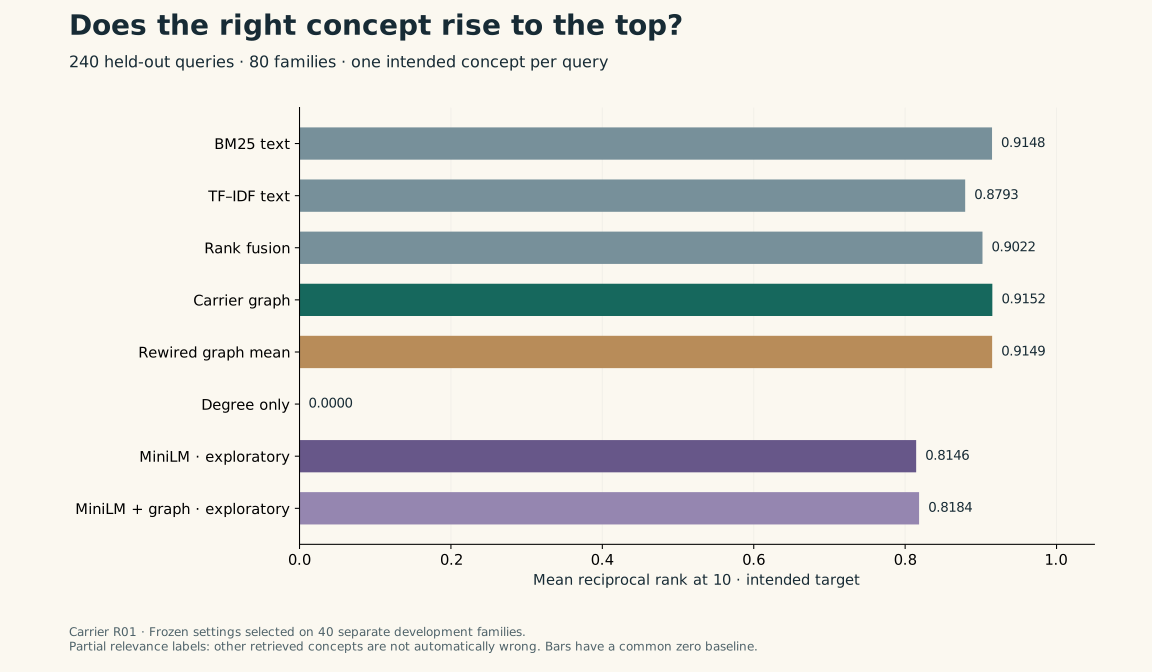
Compare the graph with the selected lexical method at the family level.
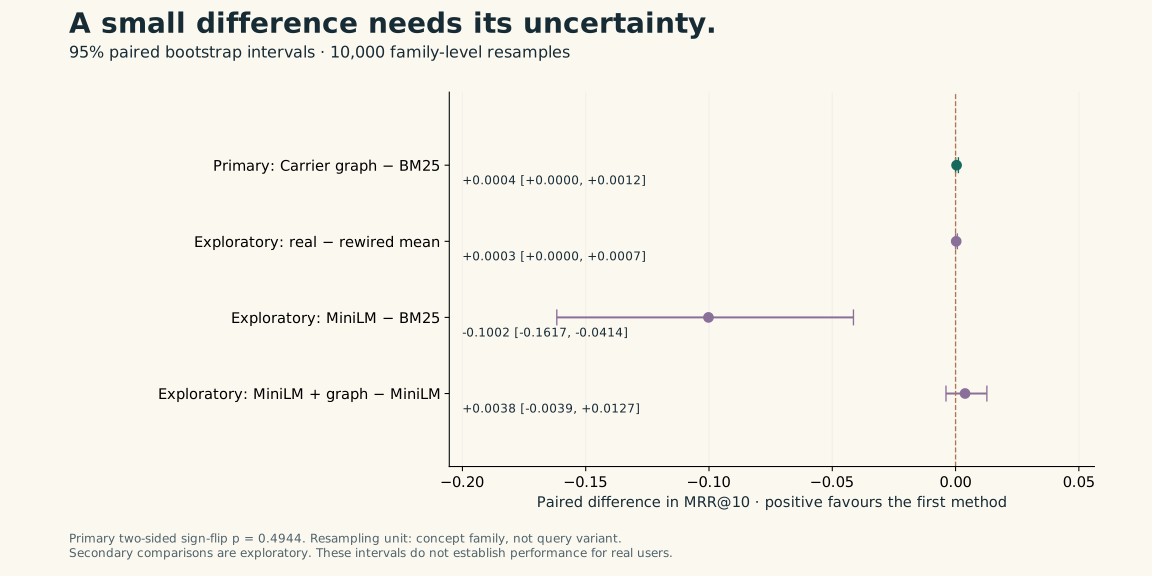
| Method | MRR@10 | Hit@1 | Hit@5 | Hit@10 | Hit@20 | Discounted rank@10 | MRR (all ranks) |
|---|
Each query has one assigned intended target. Other relevant concepts are unjudged. “Hit” means that intended target appeared; these are not precision or exhaustive relevance estimates. The five rewired runs are controls on one dataset, not five independent datasets.
| Group | Lexical MRR@10 | Graph MRR@10 | Difference |
|---|
Subgroup results are exploratory. ID bands balance position in the historical sequence; they are not subject domains.
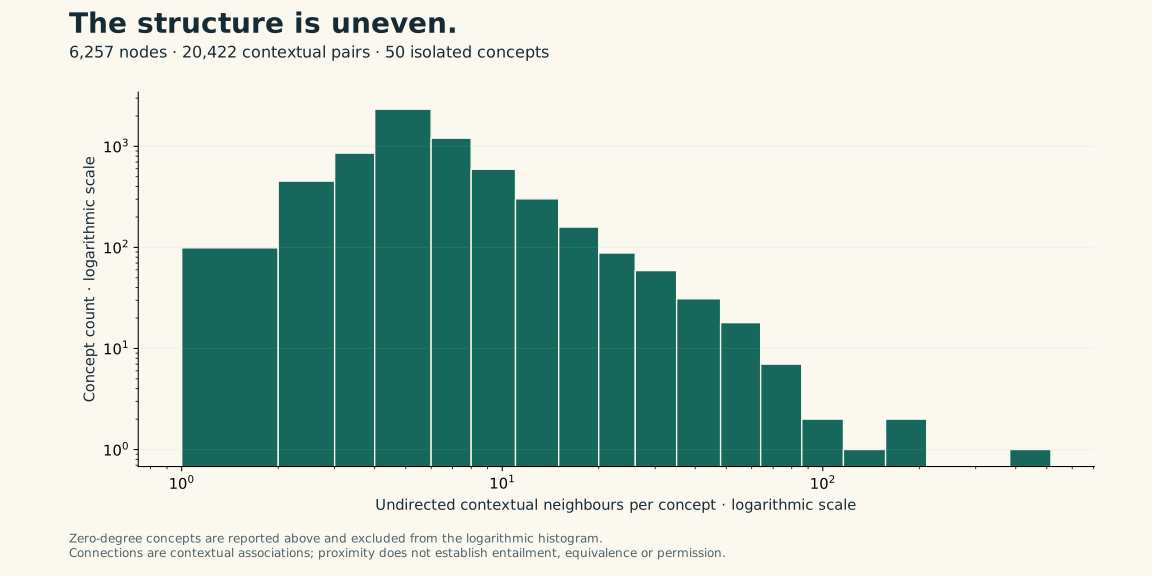
Application and boundary questions are retrieval probes. These measurements do not establish comprehension, reasoning, transfer or universal superiority of one search approach.
The complete index and graph are in this page. Search runs on your device using the locked parameters, with no query sent to a server.
The starting prompts are illustrative examples, separate from the frozen benchmark.
Enter a question to compare the first ten results.
Scores are meaningful within each ranking. Their numerical scales differ across methods. Expanding a result shows its full definition and linked context; a neighboring concept is not necessarily relevant to your question.
All held-out probes and their recorded rankings. The assigned target is hidden until you reveal it, so you can inspect the outputs first.
These are the frozen Python evaluation rankings. Live search independently applies the same exported weights and graph recipe in JavaScript. Gold labels are inspectable in downloads and embedded data; the reveal control is a reading aid, not formal blinding.
No relation edits, target changes or parameter adjustments in response to held-out scores. Every method answers to the same checked snapshot and frozen questions.
Only names and definitions are indexed. Names appear twice. Source articles, relation labels, provenance notes and IDs contribute no lexical terms.
120 intended targets sampled across six sequential ID bands. Each gets a paraphrase, an application and a boundary question. Forty families tune parameters; eighty are held out.
Authors see assigned names and definitions. They share a project and model family. This is AI-authored known-target retrieval, not independent human relevance assessment.
BM25, cosine TF-IDF and reciprocal rank fusion compete on development MRR@10. The chosen lexical method seeds a twenty-step contextual walk from its top twenty positive results.
Three variants are averaged within each family. The primary contrast is graph minus selected lexical MRR@10 over the eighty held-out families.
A paired percentile bootstrap uses 10,000 resamples; a two-sided paired sign-flip test uses 10,000 draws and a plus-one correction. Secondary analyses are exploratory.
Lowercase ASCII alphanumeric tokens of at least two characters, a fixed stop list and no stemming. BM25 uses k₁ = 1.2, b = 0.75 and unique query terms. TF-IDF uses logarithmic term frequency and cosine normalization. Fusion sums 1 / (60 + rank) over positive-scoring BM25 and TF-IDF results.
Checked links become deduplicated undirected pairs; self loops are excluded. The graph carries context, not a semantic predicate. Seeds are normalized lexical scores. Every walk step mixes seed restart with neighbor propagation; mass at disconnected nodes returns to the seeds. The final score mixes max-normalized lexical and walk scores.
Six nonzero graph settings compete on development families. The graph cannot silently select the unchanged baseline. Five degree-preserving rewired graphs use the same locked settings. Degree-only, empty-edge and stored-direction controls are reported. Directed results are exploratory.
Only positive scores are ranked; ties break by ascending checked ID. An absent intended target has no rank and receives zero. With no lexical evidence there is no graph seed and no fabricated result from zero-score ties.
MRR@10 gives a target at rank r a score of 1/r if r ≤ 10 and zero otherwise. Discounted rank uses one assigned target, not comprehensive relevance judgments. Confidence intervals cover the sampled synthetic families; they do not establish behavior for all users. The confirmatory comparison evaluates the specified lexical and graph methods; it does not measure comprehension.
The protocol is locally prospective and frozen before scoring. It is not externally registered or externally timestamped. Author blinding was limited: target IDs, historical bands and ordered family keys were visible. The split was not explicitly supplied, but could be inferred. A prospective addendum corrects the original stronger claim. Hiding a label in the explorer is not external or human blinding.
Query families, the development lock and the confirmatory comparison remain separate stages.
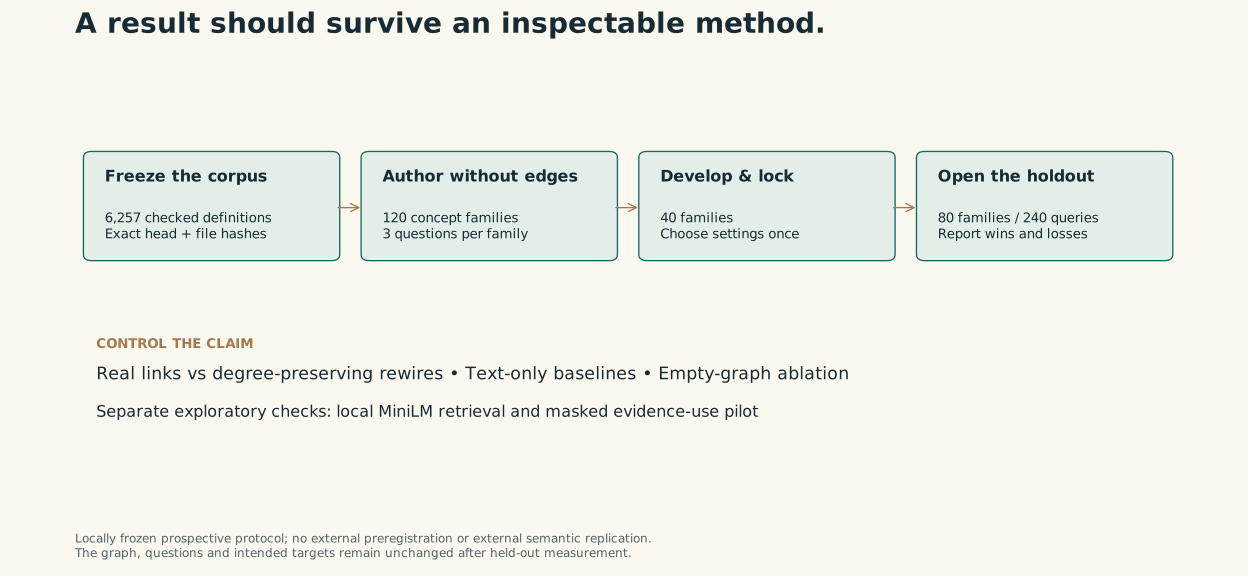
The questions, frozen procedure, results and reproduction materials belong beside the conclusion. The page runs locally without external libraries; reproducing the experiments requires the documented scientific and inference dependencies.
Corpus, queries, code, recorded outputs and pinned model assets. Dependency instructions are included; the model is also available separately.
HTML / ReportMethods, controls, diagnostics and interpretation.
JSON / ProtocolSampling, baselines, primary contrast and claim boundaries.
JSON / BenchmarkDevelopment and test families, assigned targets and author notes.
JSON / ResultsAll methods, paired estimates, subgroup results and controls.
ZIP / Reader challengeThirty-two masked contexts for a fresh AI reader. Gold answers are excluded from this archive.
ZIP / Optional model · ~83 MBFor reproducing the exploratory dense comparison. Live search on this page does not load or run this model.