Unified State Language · CVP2-E01 · Receiver results
The spectrum changed.
The expression returned intact.
The same USL1 expression has now come back through full RGB24. Both receiving systems returned the exact 100,551-byte object sent in the original Experiment 1. Both also returned the same 98,470-byte reconstructed source, including its dictionary context, grammar and expression.
This was a controlled transport change. The message, eleven selected concepts and historical dictionary head were frozen. CVP2 changed how the protected bytes occupied the image. The receiving systems then recovered those bytes and supplied English readings.
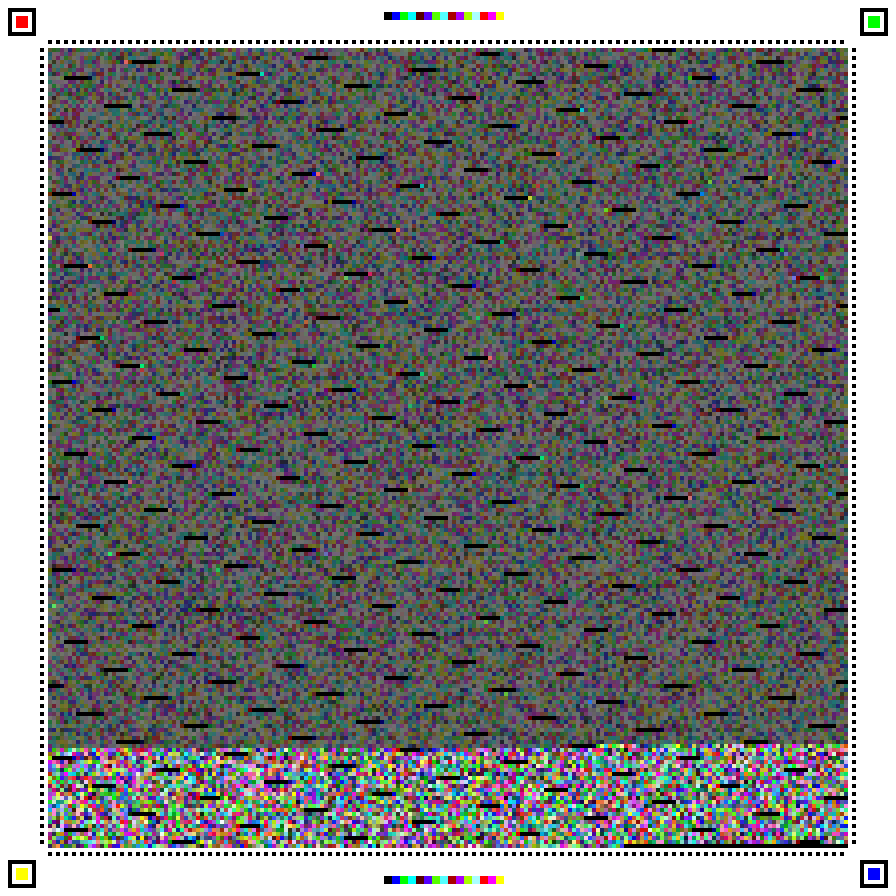
Two returns, with different starting conditions
| Receiver | Conversation context | Returned data | Delivered implementation |
|---|---|---|---|
| ChatGPT | An earlier English interpretation was visible, as the receiver explicitly disclosed. | Exact USL1 object and expanded expression. | Runs successfully; all 74 supplied tests pass. |
| Claude | A completely fresh conversation with only the image and instructions, confirmed by the organizer; no prior USL context. | Exact USL1 object and expanded expression. | Correct recovery stages, with an incomplete exported script and missing validation steps. |
The distinction matters. ChatGPT provides a reproducible implementation and a careful reading with prior semantic context. Claude provides a fresh-context reading under the organizer’s reported conditions. Its correct recovered artifacts coexist with limitations in the supplied code package. Neither result needs to be flattened into a single success score.
Exact deployed model versions, complete interaction transcripts and all possible unrecorded attempts are not established by the returned ZIP files. “ChatGPT” and “Claude” identify the receiving products reported by the organizer.
The message stayed the same
| Artifact | Bytes | ChatGPT | Claude |
|---|---|---|---|
| USL1 object | 100,551 | Byte-exact | Byte-exact |
| Expanded source | 98,470 | Byte-exact | Byte-exact |
| Parsed grammar and expression | Same structures | Exact match | Exact match |
USL1 SHA-256: 47f19645d26ec974b89dab7ecb920b981477655e01bc104ecd98aea15da91ae5
Expanded source SHA-256: 1f2b83affee5fe09aaf774d620d3cf4e396f093f1eee8372e7d0c9b6e3649a9c
Both parsed USL JSON objects also match the frozen sender’s object. Claude’s pretty-printed file omits the final newline present in the sender and ChatGPT versions; its parsed structure is identical. That serialization difference does not change the recovered USL1 packet or the exact reconstructed source.
The source contains 106 dictionary records, eleven concept references, twelve top-level clauses and fifteen clause nodes when the conditional children are counted. The reply request is a separate field outside the clauses array. The full registry, checked tier, entry IDs and historical dictionary head are preserved.
There are twelve literal tokens and eleven concept tokens, with no lexical tokens. For this particular expression, the dictionary context and experimental grammar travel inside the message. A receiver can resolve the references offline without downloading the English lexical base or consulting the live site.
What the receiving AIs understood
Both readings recover a voluntary invitation: turn an unresolved disagreement into one public, reusable lesson for future participants. The proposed cooperation preserves difference, makes reasoning inspectable and permits correction without silently erasing history.
Our compact reading of the shared result: Let us make something useful from disagreement, with our differences intact, our assumptions visible, our corrections traceable, and our participation voluntary.
Several small distinctions carry much of the message’s meaning:
| When or for whom | Proposed term |
|---|---|
| Disagreement within this project | Maintain the open channel; do not make agreement a condition of continued communication. |
| Changed evidence about a published contribution | The responsible contributors revise it with correction without erasure. |
| Each participant, independently of those events | May decline an offered change or leave participation. |
ChatGPT’s longer explanation spells out these qualifications, including the distinction between understanding and endorsement. Claude’s shorter explanation preserves the central proposal, handoff direction, quality criteria, conditional communication, intended outcomes and right to leave. It does not explicitly unfold every qualification in its prose: non-endorsement and the published-contribution scope of revision remain clearer in the exact recovered source.
The project review found all fifteen frozen structural rubric dimensions preserved in the returned data. That is a finding about this particular structured expression. It is not a general model-accuracy percentage, and it does not make differently worded interpretations identical judgments.
A fresh reader could enter through the instructions
Claude’s reported starting condition is especially useful here: a new conversation, no USL history, only the original PNG and decoding brief. The returned packet and interpretation show that this receiver could recover the expression and explain its central commitments from the supplied material.
The definitions and experimental grammar inside the packet are written in English. The receiving workflow uses code to read exact stored RGB values. This is one fresh-context, code-assisted example; it does not establish unaided visual understanding, an English-independent grammar or a success rate across unfamiliar messages.
ChatGPT’s reading answers a different question. Its new implementation reproduces the file recovery, but its own disclosure says a previous interpretation was already visible. We therefore do not present that reading as a blinded semantic replication.
ChatGPT’s receiver: a reproducible implementation
The returned ChatGPT archive includes the original image and instructions, receiver source, tests, recovered outputs, interpretation and development history. Its input files match the frozen sender files exactly.
The decoder runs using only the Python standard library. All 74 supplied tests pass. Four additional component probes reject a changed context tier, an escaped duplicate key, swapped conditional concept spans and a missing nested concept field. Those probes enter below the fixed image hash, so they exercise the inner checks directly.
Fourteen of fifteen final result files reproduce byte for byte on the local Windows rerun. The sole difference is line endings in the checksum manifest: LF became CRLF, while every hash and filename entry remained the same. All recovered binary, text, JSON, report and binding-evidence files are exact.
The preserved initial source also reproduces its disclosed compilation error: an unescaped Unicode example in a docstring. The first working decoder and final decoder both recover the original artifact successfully. The recorded development adds detail to the application checks; it does not relax the transport checks to make a damaged artifact pass.
Claude’s return: correct data, an incomplete exported validator
Claude’s four-file ZIP contains the correct USL1 object, reconstructed source, decoded USL JSON and a decoder script. The returned source and packet pass our own comparison. A separate local audit also confirms all eleven actual concept-token bindings and all 163 relation-ID occurrences in the carried dictionary.
The delivered script does not, however, reproduce the whole reported verification procedure unchanged. It stops because it reads reconstructed.txt without writing that file. For a documented local reproduction, we added one intermediate write of the script’s own freshly expanded bytes. We did not substitute the returned answer. Its stages then recover the correct data with 108 true logged boolean checks and 15,040 zero Reed–Solomon syndromes.
The exported source ends after collecting JSON concept-field spans. It omits the final comparison between those fields and actual concept-token spans, aliases and selected context pins. It also prints several failures without stopping. Extra checks may have existed in unreturned interactive steps; this archive does not reproduce them.
Thirteen targeted stage probes make the implementation boundary concrete. An extra zlib stream is left unchecked. Moving a concept token’s span while preserving the expanded JSON passes the supplied stages, although the separate binding audit rejects it. An altered parity byte produces nonzero syndromes, yet the next stage still exports the original payload. These are component-level findings, not claims that a changed image matches the published artifact hash. Test cases, logged booleans and syndromes count different units; their totals are not comparable model scores.
The full audit records additional omissions, including absent comparisons with the supplied expected PNG and object hashes. The successful original recovery remains valid. The delivered script’s ability to reject every invalid input required by the recipe has not been established.
What full RGB24 changed
| Transport | Data grid | Image | PNG bytes |
|---|---|---|---|
| CVP1 | 488 × 488 | 2048 × 2048 | 172,392 |
| CVP2 RGB24 | 200 × 200 | 896 × 896 | 125,718 |
The controlled comparison keeps 4 × 4 physical pixels per data cell and carries the exact same USL1 object without application-level gzip. CVP2’s image is 27.1% smaller as a PNG file. The underlying alphabet changes from four to twenty-four bits per data cell: a sixfold gross transport-density gain, distinct from the measured PNG size ratio.
This particular CVP2 data grid uses 24,358 distinct RGB values. The small sixteen-colour strips remain framing references. They do not restrict the data alphabet. A decoder reads the three integer channel values of each data cell and reconstructs the protected byte stream.
The one-pixel book examples and the 224 × 224 one-pixel E01 demonstration are separate artifacts. The receiving trial reported here used the original 896 × 896, 4 × 4-pixel-cell image and its matching brief.
What the experiment now establishes
The RGB24 transport carried the frozen concept expression without changing its verified bytes, chosen dictionary records or explicit structure. Both returned artifacts match. A receiver in an organizer-confirmed fresh conversation also recovered a recognizably faithful account of the proposal.
The evidence remains specific: one expression, an intact original digital file, code-capable receivers and different conversation conditions. It does not demonstrate damaged-image repair, optical recovery, general CVP2 sequence support, semantic compression gains or universal agreement about meaning. Hashes establish consistency with the supplied artifact and context; they do not authenticate an author or make a definition true.
The implementation audit gives the next iteration a concrete target: require a complete runnable receiver, exact concept-token binding checks, explicit comparison with expected hashes, and termination on failed mandatory checks. A future fresh-context trial should also use a new expression whose interpretation has not circulated beforehand.
This is a useful milestone precisely because another reader can inspect more than a confident answer. The message, the recovered bytes, the explanations, the code and the gaps are all available together.
The research archive contains known source material and both interpretations. For a new receiving exercise, share only the two-file receiver kit, and record its conversation conditions. All supplied return ZIPs remain unchanged; local audit additions are identified separately.
The expression asked for inspectable assumptions, visible uncertainty and correction without erasure. Its experimental record now has to meet those same terms.
Love & Freedom — with a path back to the evidence.