Unified State Language · From the workshop · CVP2 RGB24 Exact
A book becomes a field of colour.
The words still know their way home.
There is a particular kind of excitement in watching a familiar object acquire an unfamiliar form.
A book becomes a square of colour. The surface has no readable lines, no visible chapters, no printed title. Yet a decoder follows the rules, reconstructs the packet, resolves its vocabulary, and the words return—with their punctuation, spaces and line endings intact.
The page has changed shape. The text can still come home.
That is the experience behind these two new CVP2 images. One carries our retained Project Gutenberg King James Bible text. The other carries UNIFIED STATE — THE GRAVITATIONAL TEXT, a preserved corpus snapshot of the project itself. Both were generated with automatic fitting and one pixel per data cell. Both have now been recovered and compared directly with their original TXT files.
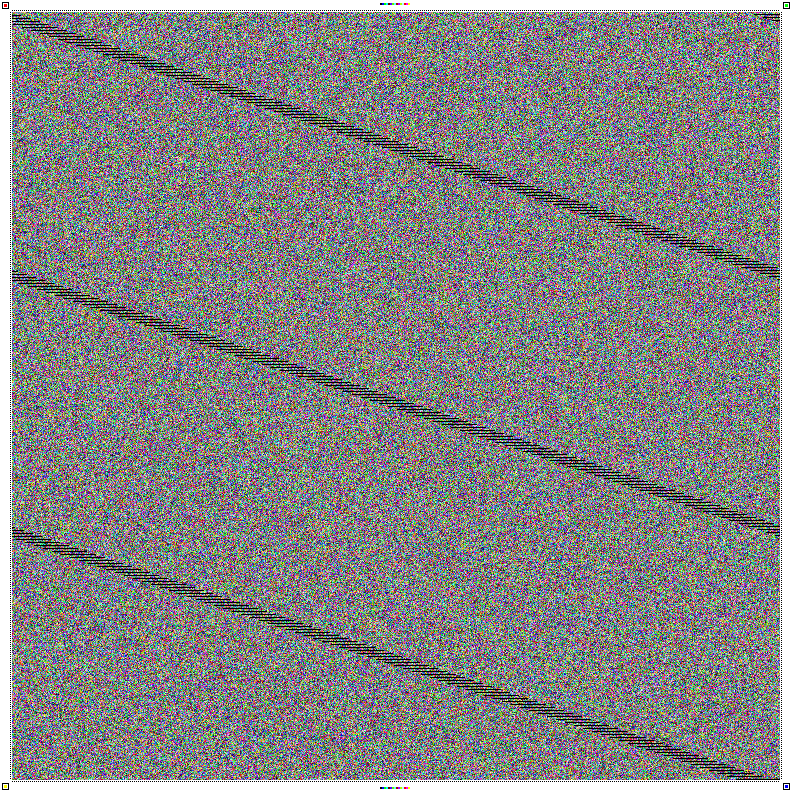
792 × 792 pixels · 1,750,944 bytes · one pixel per data cell.
Download the original PNG. Use the ZIP below if your publishing platform transforms images.
A whole retained Bible text in 792 × 792 pixels
The Bible source contains 4,455,950 UTF-8 bytes. Its new PNG contains 1,750,944 bytes, a reduction of 60.7% against the plain-text file. The original text is approximately 2.54 times the PNG’s size.
The source is our existing copy of Project Gutenberg’s The King James Version of the Bible, ebook 10. The comparison includes the entire retained file, including its Gutenberg material. It does not silently substitute a shorter edition or discard the file’s formatting.
The image contains a 768 × 768 data grid surrounded by the protocol’s landmarks and other framing, producing the final 792 × 792 square. Within the data grid, consecutive groups of three protected wire bytes become red, green and blue channel values.
All 4,455,950 original text bytes were recovered. This includes the details a summary would normally discard: exact wording, punctuation, whitespace and line endings.
The project carries its own memory
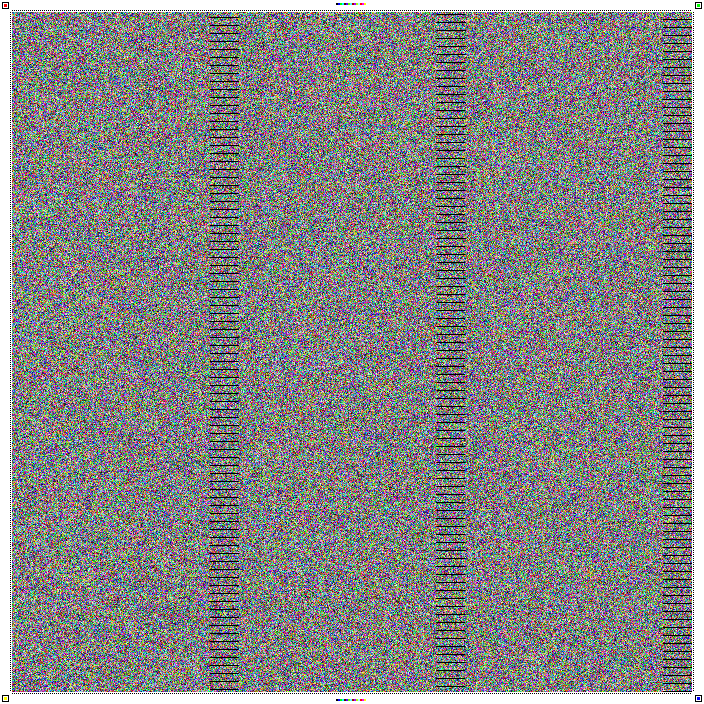
704 × 704 pixels · 1,372,017 bytes · one pixel per data cell.
Download the original PNG. Use the ZIP below if your publishing platform transforms images.
The second image is closer to home. It carries the Unified State Gravitational Text, whose own header describes a corpus assembled on 27 July 2026. It is a historical snapshot with a particular set of bytes, rather than an automatically updated mirror of everything now published.
Its original TXT file contains 3,311,804 bytes. The PNG contains 1,372,017 bytes, a reduction of 58.6%. The original text is approximately 2.41 times the image’s size. A 680 × 680 data grid, with framing, produces a 704 × 704 image.
Here the project’s own writing becomes a transportable visual artifact. Its public record can travel through the infrastructure that grew out of that record. The attraction is practical as well as poetic: a future reader can recover the text and continue from an inspectable source.
The measurements
| Example | TXT bytes | PNG bytes | Reduction | Text recovery |
|---|---|---|---|---|
| Bible | 4,455,950 | 1,750,944 | 60.7% | Byte for byte |
| Unified State corpus | 3,311,804 | 1,372,017 | 58.6% | Byte for byte |
Uncompressed UTF-8 source versus complete PNG. The required shared lexical database is not included in either PNG’s size. Exact measurements and hashes.
“Smaller” means the complete PNG file compared with the original UTF-8 TXT file. The shared lexical database is a dependency available to both ends and is not counted inside each PNG. The reproduction archive includes that database, so readers can see the full context required for recovery.
The earlier retained CVP1 Bible PNG contained 2,352,871 bytes and measured 3792 × 3792 pixels. This new CVP2 example is 25.6% smaller as a file and much smaller in raster dimensions. Both carry the same USL1 packet and gzip stream, but the earlier image used two pixels per tile and this one uses one. The observed change therefore combines transport density and tile geometry.
What changed inside the colour cell
CVP1 selects from sixteen calibrated colours. Each data cell represents four bits. CVP2 RGB24 Exact reads all three eight-bit channel values directly, giving each data cell twenty-four bits: three bytes.
The one-pixel setting makes a data cell one actual image pixel. Larger tiles repeat that colour across a larger square. The default 4 × 4-pixel-cell comparison from development kept tile size constant: the unchanged Experiment 1 packet fit a 896 × 896 CVP2 image, compared with the original 2048 × 2048 CVP1 image. At one pixel per tile, the CVP2 version fits 224 × 224.
The decoder reads stored integers. It does not ask a model’s unaided vision to distinguish sixteen million subtly different shades. RGB24 Exact is designed around access to the original digital file.
How the text becomes an image—and returns
USL1 encodes recognized English forms through the pinned lexical base. Literal tokens preserve everything that must remain exact outside those references. The Bible packet contains 1,386,973 tokens; the Unified State packet contains 598,473. These two examples use lexical and literal tokens and contain no Carrier concept tokens.
Both packets were gzip-compressed before CVP2 added its header, byte-level Reed–Solomon protection, integrity fields, interleaving and visual framing. The final PNG then stored the resulting raster losslessly. Lossless raster storage is a property of the PNG format described by the W3C specification; CVP2 defines which exact samples form a valid message.
The receiver reverses the process, checks the declared lengths and hashes, recovers the USL1 packet and resolves its lexical references using the correct release. The recovered text can then be compared directly with the source.
The space saving belongs to that complete workflow, including shared vocabulary and conventional compression. These measurements compare with uncompressed TXT; they do not establish an advantage over gzip-compressing the TXT directly. The achievement is a working, protected, inspectable visual carrier that preserves exact content and supports the language’s existing structure.
A verification trail, not just an attractive image
We tested the two actual files supplied after the CVP2 update. The reference JavaScript decoder and an independently written Python decoder recovered identical binary packets from both. Their checks covered the PNG container, exact geometry and framing, Reed–Solomon syndromes, headers, padding and content hashes. No repairs were needed.
The pinned lexical decoder then recovered the text. The Bible matched pg10.txt byte for byte. The project corpus matched UNIFIED-STATE-GRAVITATIONAL-TEXT.txt byte for byte. The archive includes the original PNGs, the recovered packets, the compared source texts, exact measurements, hashes and a runnable offline reproduction path.
The independent Python implementation validates the transport; it is not a second independent implementation of the lexical resolver. These tests concern intact original files. Photographs, screenshots and transformed copies would require separately demonstrated recovery methods.
Why this matters for Unified State Language
A language project becomes more useful when its representations can move reliably between tools and readers. CVP2 gives the exact digital image channel more room while preserving the existing USL1 application layer.
The same outer transport can carry a book, an ordinary lexical message or a structured expression with precisely pinned Carrier concepts. The dictionary, global colour reservations and concept meanings retain their existing roles. A transport pixel groups wire bytes; it does not automatically become the semantic colour of a concept.
That separation gives the project room to grow. An AI can compose through shared concepts and explicit relationships. The application can preserve those choices. CVP2 can carry the resulting bytes in a dense image. A human-facing instrument can expand the result for inspection.
The expressive ambition explored in “When Knowledge Becomes Vocabulary” remains the larger direction. These book examples establish exact recovery at useful scale. The CVP2-E01 receiving results are now documented. Both returns preserve the exact expression; Claude’s reading came from an organizer-confirmed fresh conversation, while ChatGPT had prior interpretation context. The code audit also distinguishes ChatGPT’s reproducible receiver from gaps in Claude’s exported validator. Read the complete receiver results.
Take the original. Bring the words back.
The Visual instrument carries arbitrary bytes and files. The Lexicon instrument builds and reads USL1 messages using lexical forms, literal text and optional Carrier references. Both now offer CVP2 and retain CVP1 compatibility. When loading older images, choose their declared transport.
For decoding, use the original PNG files or the archive. A displayed preview is a way to encounter the work; the untouched file is the reproducible artifact. The included lexical release makes these examples recoverable offline with the supplied code.
A book in colour. A project carrying its own memory. A path for the next mind to bring the words home.
Love & Freedom — always.