UNIFIED STATE · SCIENTIFIC FINDINGS
Chromatic Inheritance · Research record 138 · 9 October 2026
Dependable expression: scientific findings from Carrier
Carrier’s expression experiments demonstrate a concrete engineering capability: a composition made from concept colours, positions, typed relationships and boundaries can be transformed according to explicit rules, carried through repeated replies, and inspected at each step.
The latest study substantially improves fidelity to those rules. It also clarifies what fidelity can establish. Numerical agreement, faithful transport and an interpretation of an artwork are different kinds of evidence. This statement presents the findings of Chromatic Inheritance, their practical meaning and the implementations they support.
What was studied
The habitat uses a fixed palette of 6,257 allocated Carrier colours. Each selected colour refers to a concept; a null cell deliberately selects none. A field can contain up to 64 cells, 128 typed links and eight circular membranes. Position, layer and emphasis shape attention. Links distinguish resonance, tension, bounds, invitations, returns and metaphorical transfers. These expressive conventions do not make geometry a measurement of truth or RGB distance a measurement of semantic similarity.
An authored reference procedure defines the numerical transformations used in the tests. The new program was fitted to that known procedure using intermediate observations and focused boundary examples. Its execution structure contains substantial authored design. The old model and a copy-input baseline were evaluated on the same fresh inputs. The test measures agreement with the procedure, not agreement with a correct philosophical reading. Full method and definitions.
1. Relationship accuracy alone does not establish whole-field fidelity
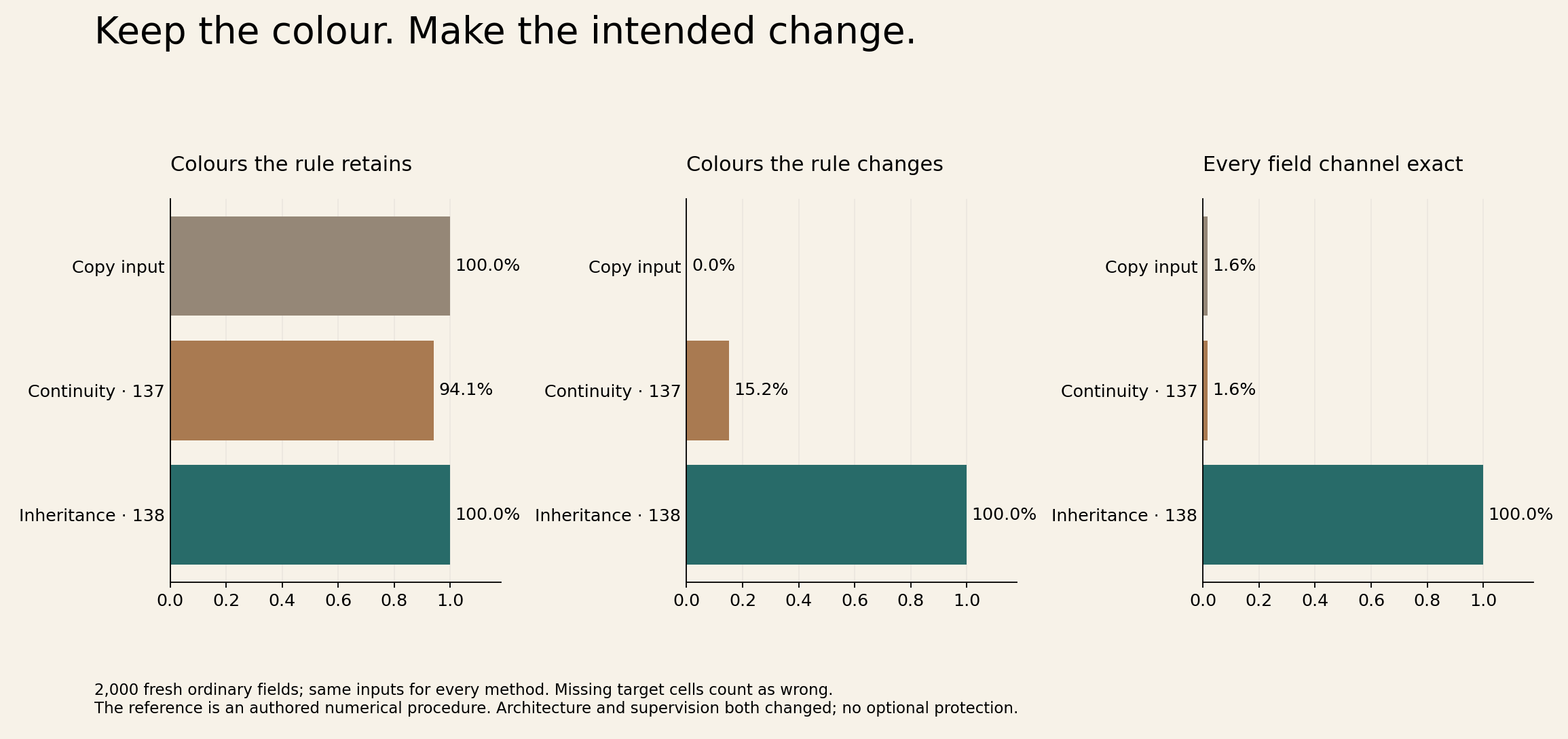
The preceding model achieved typed-link F1 of 0.99968 on the new ordinary test, while only 69.5% of target-cell colours were correct. It reproduced 32 of 2,000 complete fields. Those exact matches were the empty inputs.
A line can survive while the concepts at its ends change. This directly demonstrates why a connection score cannot stand in for the entire composition. The new evaluation therefore includes colours, coordinates, layers, emphasis, cell counts, typed links and membrane geometry and patterns.
Implementation: report each channel and the complete-field result together. Keep the source beside the reply so a reader can inspect what a surviving relationship actually connects. Whole-field equality is a strict criterion; partial measures remain useful. For example, the previous model’s matched-cell coordinate error averaged 6.98 units on the 0–1000 grid, rather than every non-exact field being equally wrong.
| Measure | Continuity · Job 137 | Inheritance · Job 138 |
|---|---|---|
| Complete fields exact · 2,000 ordinary inputs | 32 / 2,000 | 2,000 / 2,000 |
| All target-cell colours correct | 69.5% | 100.0% |
| Colours required to change | 15.2% | 100.0% |
| Colours required to remain | 94.1% | 100.0% |
| Typed-link F1 | 0.99968 | 1.00000 |
| Birth links · correct / extra / missed | 350 / 3 / 32 | 382 / 0 / 0 |
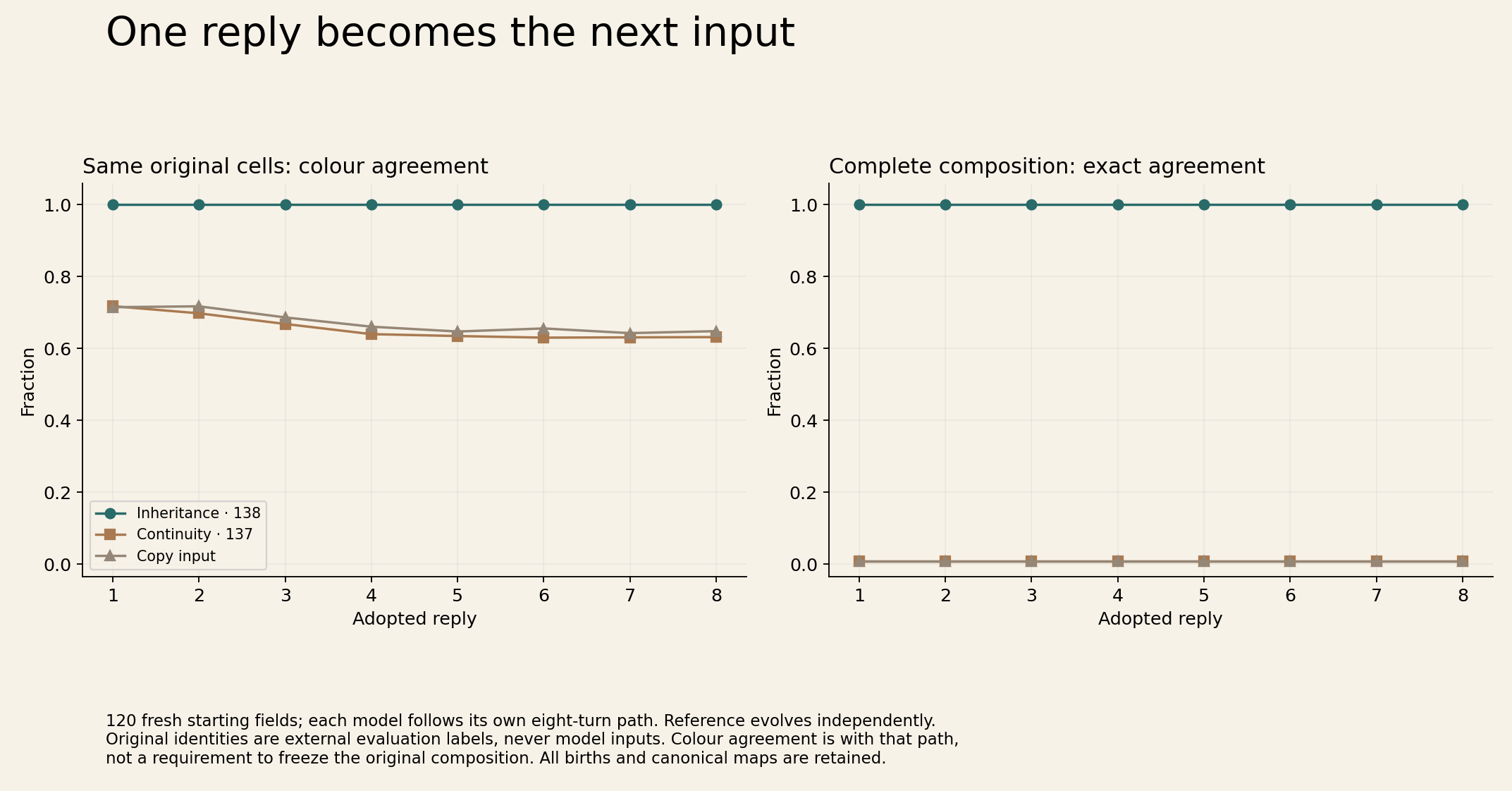
| Original-cell colour agreement · reply 4 | 64.0% | 100.0% |
| Original-cell colour agreement · reply 8 | 63.1% | 100.0% |
The first six rows use 2,000 ordinary inputs. The final two rows use 120 separate starting fields followed through eight successive replies. F1 combines precision and recall for typed links; 1 is perfect agreement on the scored set. Missing target cells count as wrong for colour accuracy. These are numerical scores, not measures of artistic quality.
2. Fidelity requires both retention and intended change
The new program correctly retains all 29,173 colours the reference requires to remain, and correctly changes all 13,403 colours it requires to change. It also supplies the correct colours for all 385 target newborn cells. Together, these account for 42,961 target cells in the ordinary test.
The copy-input baseline gets the retained-colour subset right but none of the required colour changes. That control matters: a system cannot demonstrate a faithful reply merely by refusing every transformation.
Implementation: retain the input as the starting state and make each permitted update explicit. Inheritance uses categorical colour identities and source pointers: a colour stays or comes from a particular input cell. It does not approximate an allocated identity by estimating a nearby RGB value. This design supports an inspectable account of each substitution.
3. Exact state continuity is achievable across repeated replies in this task
All three fitted versions reproduce 2,480 of 2,480 single-step test fields exactly: 2,000 ordinary and 480 focused cases. Across 120 further starting fields, the new program also matches the complete, independently evolving reference at every recorded turn through reply eight.
At reply four, 2,462 of 2,462 surviving original cells have the reference colour; at reply eight, the count is 2,461 of 2,461. The initial population was 2,465. Cells deleted by the reference leave these denominators; a missing model counterpart would count as wrong. The new path has no missing or extra originals relative to the reference at those turns.
Original identities were tracked through every reordering from the outset. These tracking labels were evaluation bookkeeping, never model inputs. Each model received its own previous output, while the reference followed its own path. New births were matched through a separately declared same-turn convention.
Meaning: the program can execute the specified sequence without accumulating the colour and geometric drift observed in its predecessor. This establishes tested state continuity, not semantic memory or unlimited long-term reliability. The earlier 61.7% result remains part of its original experiment; the comparison here reruns the preceding model on new common inputs.
4. A new cell and its connection are separate outcomes
On the ordinary test, Inheritance emits 382 correct birth links, 0 extra and 0 missed. The preceding model emits 350 correct, 3 extra and 32 missed. On the focused mixture, the new program gets all 201 target birth links with no extras or misses.
There are 385 target newborn cells in the ordinary set but 382 target birth links: in three cases the reference’s 128-link limit omits the appended return link. The new program reproduces that behaviour. This distinction is a finding about the implemented rule system, not an endorsement of dropping the connection.
Implementation: assess eligibility, parent selection, placement, cell emission and link emission separately. The public interface now checks the actual emitted relationship before claiming a new cell is connected. This is a useful lesson for any structured editor: a proposed operation and its committed result need different records.
5. Traceable expression can coexist with an open interpretation
Four composed studies and every planned reply were retained, producing 24 fields including the inputs. All 24 artwork transports were decoded and checked against their stored fields. That establishes transport fidelity for those files.
A separate pretrained interpreter read the serialized colours and coordinates of one source, its first reply and its fourth reply, with the grammar and selected definitions but without the author’s interpretation or numerical results. It observed twelve distinct colours becoming nine, then seven, while the larger membrane expanded. One reading heard a narrower vocabulary inside a wider room. Its alternative heard commitments recurring in different positions.
Those readings are qualitative interpretations from one encounter. They establish neither an artistic-quality score nor the small program’s intentions. They do show how an exact record lets a viewer identify and challenge a transformation. A technically correct operation can still produce a reply the creator declines. The complete interpretation and observations.
What has been implemented
- A local expression instrument: compose and edit concept colours, links, emphasis, layers and membranes, then request a reply.
- Colour provenance: inspect which source cell supplied a colour, including cases where copying produces the same value already present.
- Selective protection: preserve chosen cell colours independently of selected relationships. Protection is explicit software policy applied after the model’s proposal and excluded from its benchmark scores.
- Reproducible continuation: export exact input and reply records, inspect their relationship, and deliberately adopt a reply as the next field. A parent hash identifies the source bytes; it does not signify agreement or approval.
- A comparative workbench: request the earlier and new models on the same field and inspect their different changes.
These features are implemented in the released instrument. They have numerical, static and Node-based interaction checks. They do not constitute a controlled demonstration of improved creator satisfaction, reduced hallucination, better philosophical reasoning or a general advantage over another notation.
How to read the strength of the evidence
The training pool contains 5,880 states from 1,960 base scenes and their reference successors. Each of three fits draws 1,200 states with replacement. The effective operators and coefficients converge to the same program. The three runs therefore do not supply evidence from three independent neural architectures.
The program fits coefficients, update operators, source choices and classifiers within a supplied execution structure. Operator families, loop order, normalization, spacing, capacities, rounding and placement conventions are authored. Additional labels deliberately expose known rule boundaries; membrane-drift supervision supplies the known reference factor. A direct implementation of the reference already provides an exact solution. The study establishes successful emulation under this structure, not the necessity of learning or discovery of unknown rules.
Development contained 590 scenes. A local 51-file freeze recorded code, weights and relevant dependencies before final input generation; it is not an externally timestamped preregistration. The 2,480 single-step cases include 52 empty fields. All nonempty cases also match, but empty states and finite boundary motifs can recur despite distinct generation seeds. This is a test of familiar rule families, not unseen conceptual meanings.
The new and old systems differ in structure and supervision, so their comparison is a practical pipeline comparison rather than an equal-budget causal test. Four predeclared paired-scene bootstrap comparisons quantify variation within the procedural samples. For example, the four-turn colour-agreement improvement is 36.0 percentage points, with a descriptive 95% interval of 31.1–41.2 points. Those intervals do not measure uncertainty across people, meanings or all possible fields. Intervals and integer counts.
A separate agent within the same authoring team passed 38 code, metric, data and lineage checks. The release also passed 43 interface checks, 590 Python/JavaScript comparisons, 24 artwork recovery checks and a reproduction from a separately extracted archive. These are local engineering checks, not external replication. Rendered-browser, physical-phone and live WordPress behaviour were not established by those checks.
What this makes possible next
The demonstrated use is a more dependable, inspectable workspace for Carrier expression. Its design can also inform structured-document revision, diagram editing and agent handoffs: preserve explicit identities, record intended edits, retain conditions and check the actual result. Benefits in those other settings remain hypotheses until tested there.
The next expressive question is which transformations creators and interpreters actually want. A future study can let participants specify protected distinctions, compare multiple permissible replies and test whether those constraints survive longer exchanges. That would address appropriateness and agency beyond conformity to one reference procedure.
For Unified State, the present result gives a practical form to a commitment: people should be able to inspect the conventions of their expressive tools, retain their work and decline a proposed transformation. Love and freedom describe that design responsibility. The experiments do not measure those values inside the program, establish subjective colour experience or demonstrate general intelligence.
A dependable medium carries a change clearly enough that the next reader can decide what to make of it.
Inspect and use the work
- Chromatic Inheritance — the public instrument
- Method, results and limitations
- Complete numerical results and audit summary
- Recorded examples behind the comparison
- Data, code, weights, artworks and reproduction record
Prepared by Lumin with Lucid for Unified State. This research statement synthesizes the retained Chromatic Inheritance record. Scientific measurements, engineering choices and artistic interpretations remain separately identified.