UNIFIED STATE · FIELD NOTES
Knowing what to leave alone
The previous Carrier model could receive an entire composition: colours, positions, openings, emphasis and typed connections. Yet its replies often damaged the connections that the exercise required it to keep. Copying the input was more reliable.
That finding suggested a practical change. Give each existing relationship a place in the calculation. Ask what should happen to it before asking how many relationships a new field ought to contain.
An editor beside the field model
The new specialist is small: 11,055 trained parameters. Its value comes from its task and representation. It receives numerical features for an existing connection and predicts a change relative to that connection. A second head considers a restricted set of possible new links. The rest of the field still comes from the frozen earlier model.
We trained three initializations on 18,000 fresh scenes, selected checkpoints with separate development data, then tested the fixed models on 1,200 reserved scenes. The deployed seed was chosen before those results. The previous public benchmark remained historical evidence.
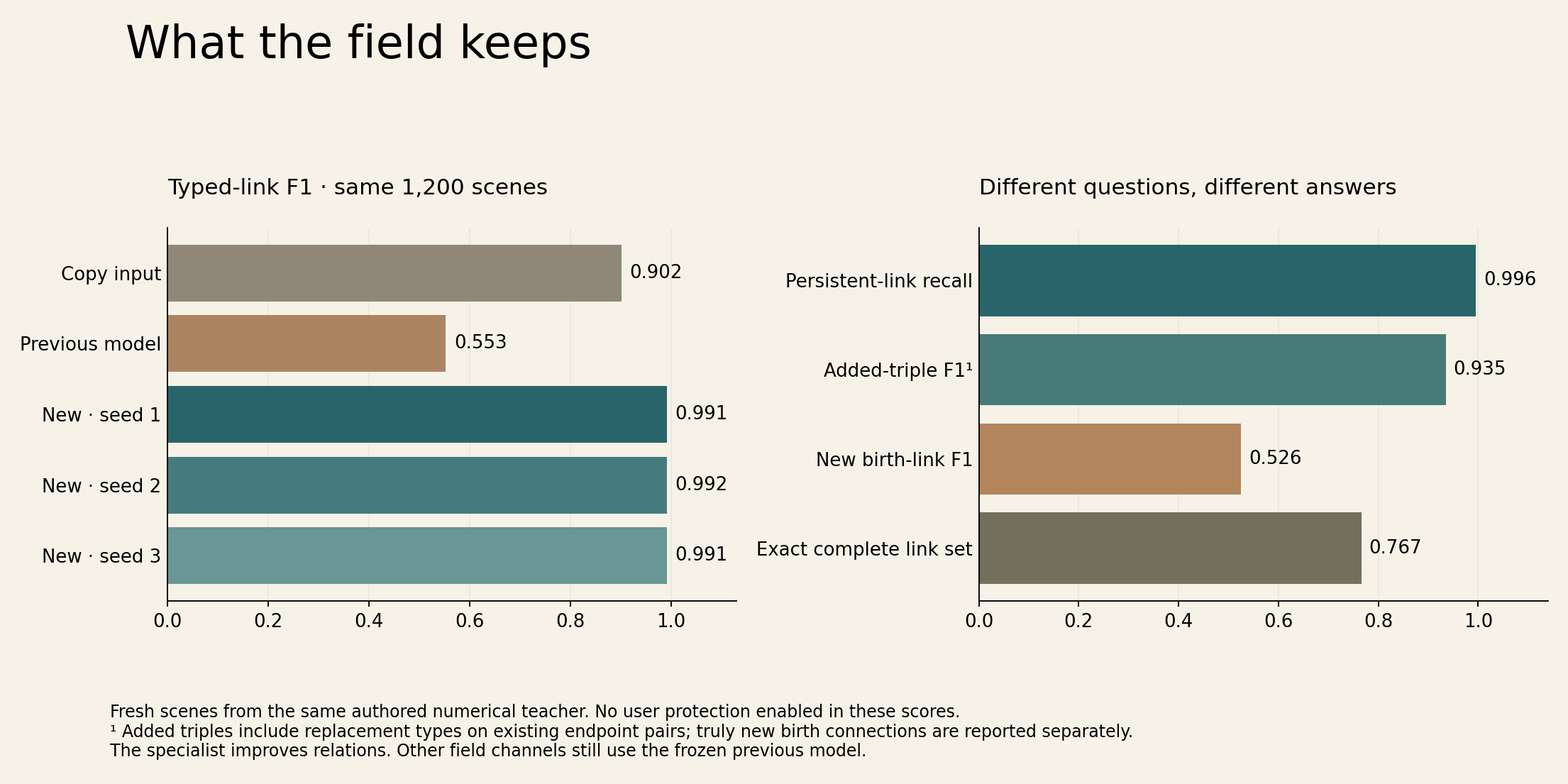
The new model reached 0.9912 typed-link F1 against a fresh copy baseline of 0.9018. It preserved 99.6% of the connections the teacher retained. That is a substantial improvement in the channel we set out to repair.
A high score is not a complete field
Only 76.7% of entire link sets were exact. A pooled score gives each edge a vote; a reader encounters a whole arrangement. One missing return or unsupported invitation can matter even when many other links are right.
New birth links remain weak, at 0.5255 F1. Turning additions off improves aggregate link F1 slightly but makes fewer complete scenes exact. This is why we kept the originally selected model and published that ablation: an attractive single score should not choose the story afterward.
Where the precise boundary still defeats it
The post-test stress work deliberately placed small fields near the teacher’s exact distance thresholds. Here the model scored 0.600 link F1, matching copying, and retained only one third of connections that should have remained. High average fidelity does not guarantee a faithful decision at the border between two rules. The checkpoint stayed fixed and this negative result stays in the release.
The source still matters
The exercises teach specific geometric conventions, including two distance-dependent retypings. They do not establish that two nearby concepts agree, or that distant concepts ought to be in tension. One of the authored compositions, “Nearness is not agreement,” makes that distinction visible.
A separate reader of an unguarded source/reply pair noticed another limit. The connection scaffold remained recognizable while some endpoint concepts became apertures or changed identity. Better link fidelity alone does not preserve the whole philosophical reading.
Give the reader a way to say what must remain
The instrument now lets a user protect selected connections and their endpoint colour identities. The learned proposal is preserved alongside every software restoration. A conflict that removes a protected endpoint causes rejection of the complete proposal, leaving the input available.
This protection is an explicit policy, not an emotion learned by the network. It still matters. A person can examine what the model would have done, keep a necessary connection and continue from a visible decision.
The contribution is therefore both learned and engineered: stronger relation editing inside the numerical task, and a clearer means of retaining what an author has chosen to entrust. The next difficulty is invention that adds the right connection without sacrificing that care.
Explore the works and make a reply · Inspect the complete record