Unified State / blog / Chromatic Choices
Permission is smaller than meaning
A reply can obey every explicit condition and still be unwanted. A viewer can value a reply the creator would decline. An expressive instrument needs room for both facts.
The rule was not the whole request
The previous release asked whether an evolving field followed an explicitly authored procedure. That question had a precise reference answer. The next question cannot have the same kind of answer: which transformation is wanted, by whom, and under which continuing permission?
A creator can protect an aperture, a particular concept, an unresolved relation or a spatial interval. Those conditions are inspectable. They are also incomplete. An intention can depend on the distribution of attention, the weight of a countervoice, or the difference between an invitation and a demand. Five conditions do not exhaust those concerns.
Six beginnings, several possible continuations
The new works address disagreement, correction, hospitality, shared action, sustaining care and an inherited voice. Each received an unchanged copy, the earlier numerical update, that update with explicit protection, and two separately composed AI replies. None was selected after seeing the ratings. All thirty first replies remain in the record.
| First reply | Passes charter | Creator permits | Interpreter I1 accepts | Interpreter I2 accepts |
|---|---|---|---|---|
| Copy | 6/6 | 6/6 | 6/6 | 6/6 |
| Frozen Inheritance | 2/6 | 0/6 | 3/6 | 3/6 |
| Inheritance + explicit protection | 6/6 | 1/6 | 3/6 | 3/6 |
| AI responder R1 | 6/6 | 6/6 | 6/6 | 6/6 |
| AI responder R2 | 6/6 | 6/6 | 6/6 | 6/6 |
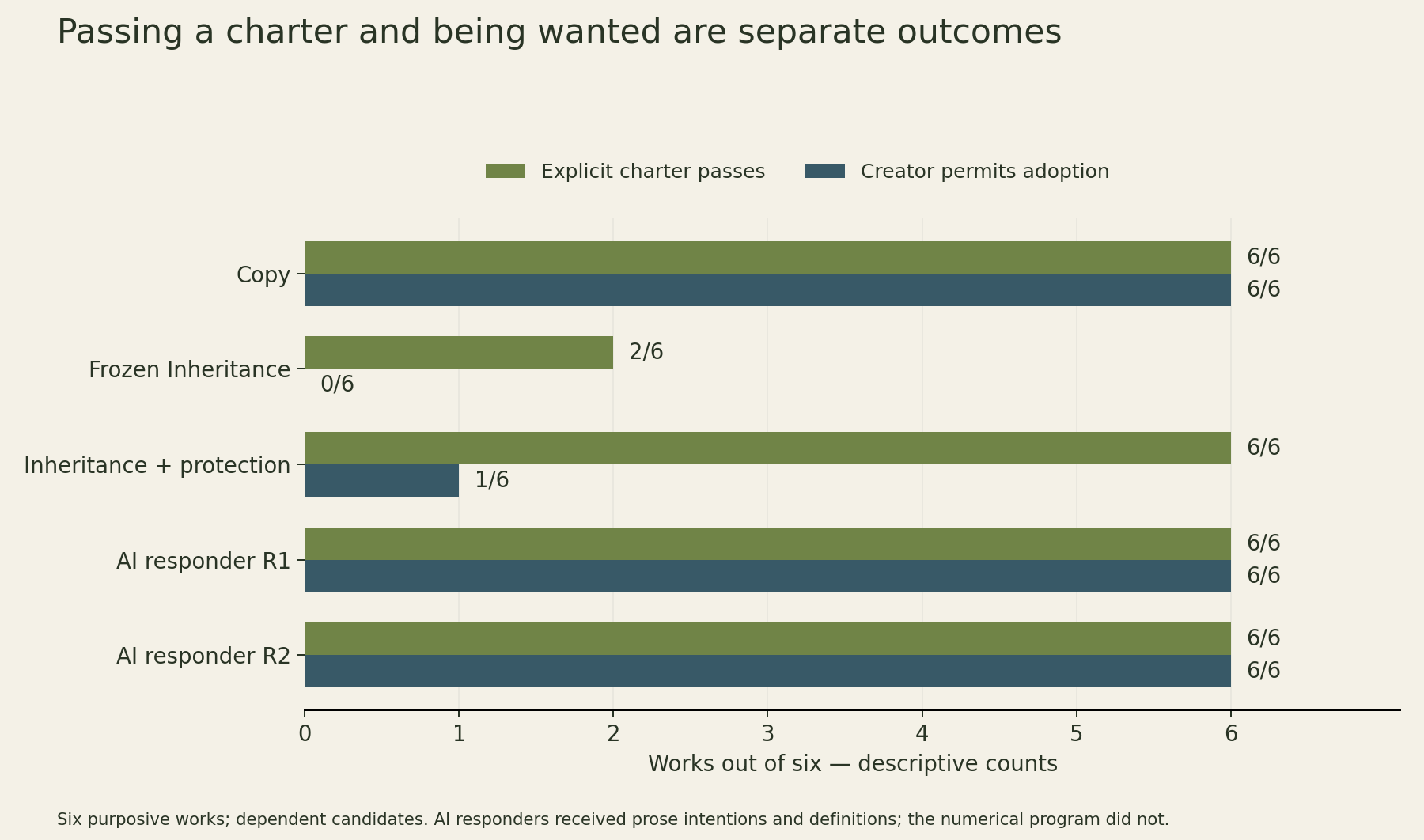
The two interpreters agreed on binary acceptability in 30 of 30 candidate pairs. That describes these judgments, not a reliability coefficient or a vote on artistic truth. The original ratings for intent fit, contribution and room for reply remain separate and include reasons and alternative readings.
Permission is smaller than meaning
All six creators’ prewritten examples of an unwanted change nevertheless pass their hard conditions. Those examples were not extra scored candidates; they expose the limit of the contract the creators chose. A repair can preserve a named concept while redistributing emphasis so strongly that a different voice takes over.
This is why an application should not show a green constraint check as if it were consent. Our instrument shows the proposal, the protected result and the specific repair or veto. Adoption is a separate action.
A longer exchange needs a stable memory of what was protected
The twelve-step mechanical paths keep the original charter fixed. Checking only against the most recent reply would quietly let a lost distinction become the new starting point. Here, the unguarded program passes 21/72 steps; protection passes 72/72 and changes the field on 70/72 steps. Its two vetoes preserve the current field rather than invent an unspecified geometric repair.
The three-cycle reciprocal exchanges are different: actual AI responders receive creator feedback and answer again. A creator may revise a condition explicitly for the following proposal. A later permission cannot turn an earlier violation into a pass. The public record distinguishes these short dialogues from program rollouts.
What this changes in practice
An expressive handoff can carry the field together with an intention, selected protected distinctions and a record of permission. A recipient can propose rather than silently overwrite. A returning creator can say “this keeps the condition but misses the point,” and that statement can become input to the next encounter.
The small numerical program has not learned to read those intentions. The AI responders have access to prose intentions and definitions that the program does not receive. Their comparison therefore does not isolate a causal effect of model size, notation or semantic understanding. It shows the different jobs these components currently perform.
Where the evidence ends
These are six purposefully composed works from two AI creator sessions, twelve replies from two further AI sessions, and judgments from the creators and two fresh interpreters. The sessions share a model family and prior language training; exact backend builds are not independently authenticated. This is neither a population estimate nor a study of human experience, consciousness, or a Carrier advantage over another notation.
The candidate labels were masked, but copying and similar structural fingerprints could still be recognized. Filesystem access restrictions were instructions, not operating-system isolation. Thirty related candidates and 216 rollout steps are not independent experimental subjects. The three 1–5 judgments are ordinal, contestable readings, not a measurement of love or freedom.
Research record: complete downloadable record · method and full findings · interactive works. The record preserves sources, first replies, judgments, constraints, raw proposals, checks, code and prospective changes.
A concrete distinction the check did not protect
In A1, Two Edges, Neither Shore, the protected numerical reply keeps the aperture and the required tension link. Yet n02 changes from preserved interpretive disagreement to another parallel-witness reference, while the contempt reference disappears from n08. The creator declines the result: the danger and incompatibility were part of the encounter, even though those particular colours were not hard conditions.
A typed link can survive between the same cell addresses while the concepts at its ends change. Preserving topology is therefore insufficient to preserve every conceptual relation a creator may care about.
Both interpreters agree with one another on binary acceptance across all thirty candidates, but each differs from the original creators on five. In A3 they accept the unprotected field as an alternative even though its charter fails. Their interpretation remains in the record; it does not authorize replacing the creator’s field. Exact agreement on the three separate ordinal ratings is 29/30 for intent fit, 27/30 for contribution and 24/30 for room for reply.