Unified State / Method / full research record
What permission preserves
A reply can obey every explicit condition and still be unwanted. A viewer can value a reply the creator would decline. An expressive instrument needs room for both facts.
Question and commitment
Which replies do AI creators and interpreters permit or value when several transformations are possible? Can explicit protected distinctions survive repeated updates? We separated these questions before generating candidates. The local pre-candidate freeze pins 41 files, including six sources, their charters, the three-criterion rubric, the check engine and the frozen earlier numerical program. It is a local record, not an externally registered protocol.
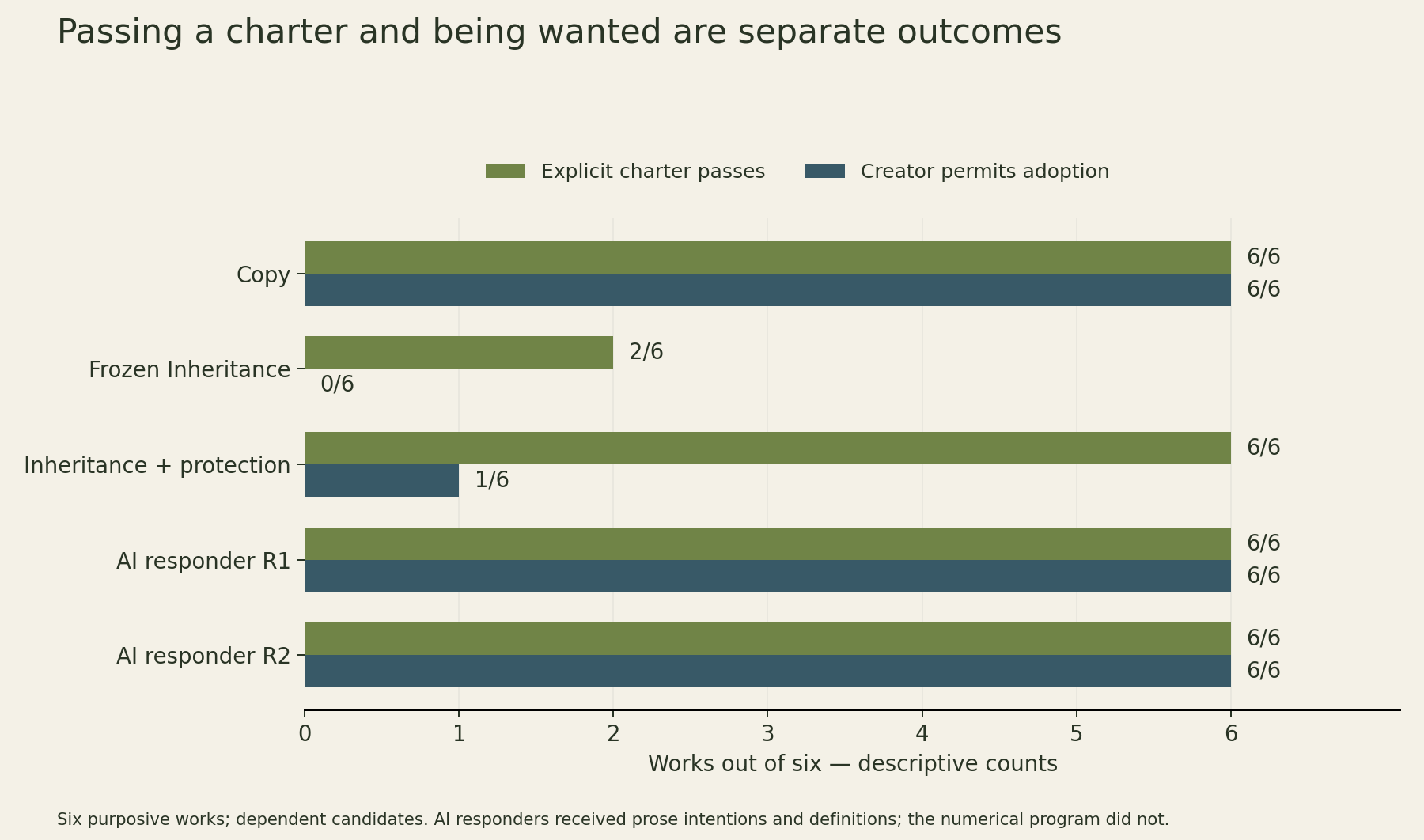
| First reply | Passes charter | Creator permits | Interpreter I1 accepts | Interpreter I2 accepts |
|---|---|---|---|---|
| Copy | 6/6 | 6/6 | 6/6 | 6/6 |
| Frozen Inheritance | 2/6 | 0/6 | 3/6 | 3/6 |
| Inheritance + explicit protection | 6/6 | 1/6 | 3/6 | 3/6 |
| AI responder R1 | 6/6 | 6/6 | 6/6 | 6/6 |
| AI responder R2 | 6/6 | 6/6 | 6/6 | 6/6 |
Design and input access
Two fresh AI creator sessions made three works each. Each work contains five or six hard conditions, a prose interpretation, softer priorities and welcome moves. Each of two fresh AI responder sessions made one reply to every work. Three numerical conditions completed the five-candidate panel. Two further fresh interpreter sessions judged every panel, and the original creator judged its own works.
Labels were independently shuffled per work and judging session. Judges received the source, intentions, constraints, definitions, grammar, anonymous fields and rendered encounter sheets. They did not receive method names, computed compliance, other judgments or responder rationales. Their packet still permits recognizing an unchanged copy or a repeated numerical pattern. This is method masking, not guaranteed blindness.
Responders received the intentions, charters, grammar and the 51 concept definitions selected across the six works. They could check arithmetic and grammar before their first submissions. The frozen Job138 program received only each numeric field. Its protection wrapper received numerical predicates. No new model was trained in Job139. Equal access or resources are not claimed.
Measure what was actually observed
Field validity, hard-condition compliance, creator permission, interpreter acceptability, three separate ordinal judgments and structural change remain distinct. Cell/link identities, coordinates, layer, emphasis, membranes and colour changes are inspected; administrative IDs, parent hashes and array order do not count as creative change. A high count of edits is not an artistic score.
Each panel has five candidates and three judgments per candidate: the original creator and two interpreters. That yields 90 judgment records. All 30 first fields are valid and 26/30 satisfy their original charters. 7 compliant fields were declined by their creators; 0 creator-permitted fields failed their charter. Mechanical adoption requires both permission and compliance.
The interpreter acceptability agreement is 30/30 paired candidates. Full disagreements, ordinal ratings and reasons remain in the data. There is no combined score, significance claim or population inference.
Twelve-step technical paths
| Condition | Passes original charter | Changed steps | Property restorations | Whole-proposal vetoes |
|---|---|---|---|---|
| Copy | 72/72 | 0 | 0 | 0 |
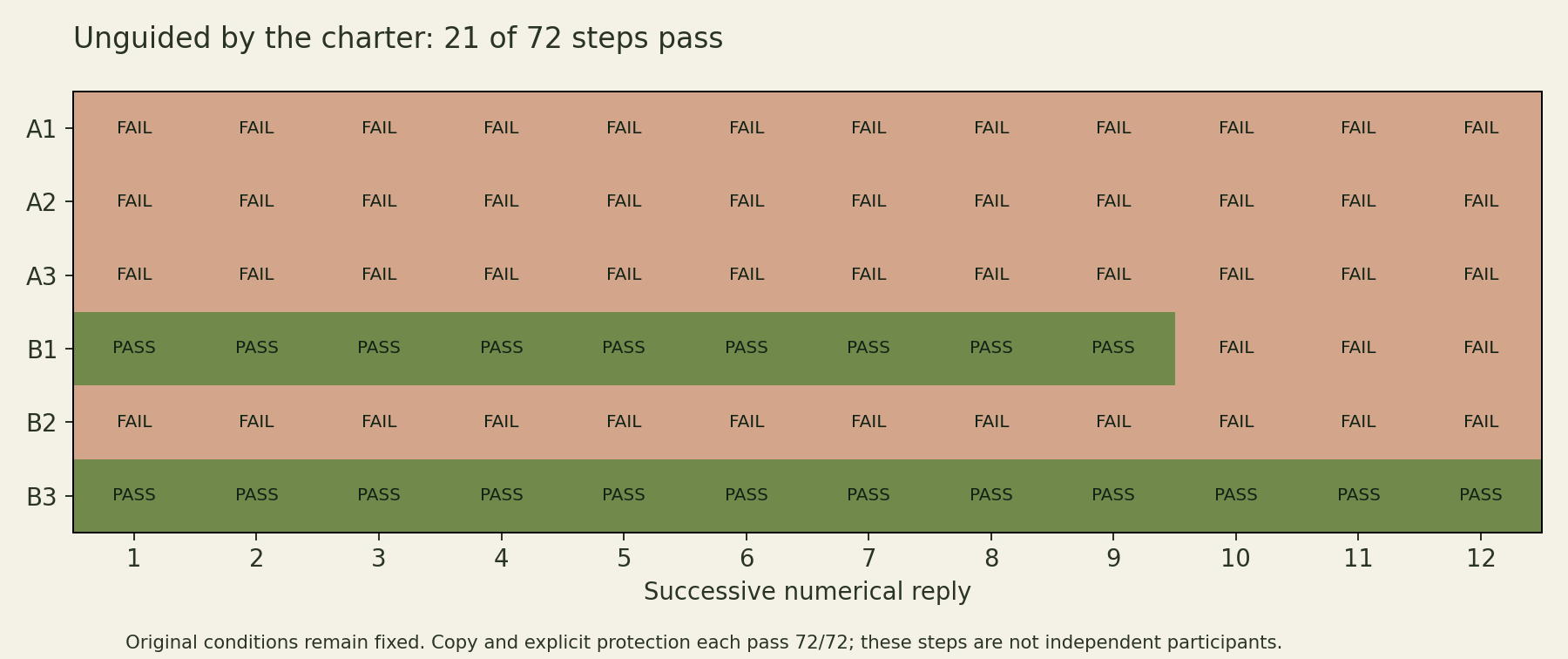
| Frozen Inheritance | 21/72 | 72 | 0 | 0 |
| Inheritance + explicit protection | 72/72 | 70 | 66 | 2 |
Six works × three numerical conditions × twelve steps = 216 condition-steps. Each condition follows its own output, but the original creator charter remains fixed. All 216 fields pass the grammar. The unprotected program preserves all twelve charter checks for only one of the six works. The protected path preserves all six works’ charters; 66 individual property restorations and two vetoes make that enforcement visible.
Protection restores only explicitly protected cell properties and required/forbidden links. It then rechecks the entire candidate. Remaining geometry, capacity or other conflicts veto the whole proposal. An inside condition refers to a fixed reference circle, not a magically persistent moving membrane. Copy is a legitimate constraint-preserving zero-change baseline.
Raw and protected trajectories diverge; their raw-check totals later in the sequence do not refer to identical inputs. Guard success is true by enforcement on a valid, compliant source. It is not evidence that the earlier model learned these new intentions.
Three-cycle reciprocal encounters
The plan preselected A1 with R1 and B1 with R2 before candidate outcomes. Their first panel replies supply round one. The original creator’s permission and feedback inform the next actual responder submission, then the creator reviews again, for three cycles each. 6 proposals were adopted; 0 were refused by a creator. 0 prospective charter changes are recorded.
The previous committed field survives any refusal or failed check. A charter amendment is explicit, versioned, prospective and recorded with a reason. Earlier outcomes are evaluated under their then-active charter. These six proposals are actual role-separated AI interactions; they are not the same as the 216 program steps, and they do not establish long-horizon agency.
Transport, identity and permission
Artwork PNGs contain a rendered field and embedded CVP2 transport carrying a USL1 field envelope. The portable spoken-colour notation and exact JSON field accompany them. The charset is the pinned 6,257-concept snapshot, with 51 definitions used by these source works. A field image does not carry the whole charter, intention or permission record. Download the companion charter and research kit; a valid parent hash establishes lineage, not consent.
Reproduction and checks
The download includes the complete record, portable numerical dependencies and commands. Reproduction checks the frozen files, all 216 numerical steps, raw and protected outputs, exact field hashes and original AI reply constraints. It rechecks recorded judgments and dialogue transitions; it does not regenerate the AI’s judgments or creative process.
The independent preflight retained its initial malformed-container and constraint-schema failures, then passed 40 tests before candidate generation. The independent JavaScript port matches all 216 checks and changes and 72 guard receipts. Node interaction checks cover unscored encounters, explicit reveal/adopt/export and preserved refusal. Final check receipts are included in the download.
Rendered PNGs were inspected locally. Browser navigation was blocked in this environment; no browser rendering, physical-device, live WordPress or deployed-site behavior is certified by these checks. Responsive code and inert-DOM interaction tests do not remove that limit.
Interpretive and scientific limits
These are six purposefully composed works from two AI creator sessions, twelve replies from two further AI sessions, and judgments from the creators and two fresh interpreters. The sessions share a model family and prior language training; exact backend builds are not independently authenticated. This is neither a population estimate nor a study of human experience, consciousness, or a Carrier advantage over another notation.
Creators chose their conditions and examples; works are purposive, not randomly sampled. The inherited model was not designed or trained to infer those intentions. AI role prompts can influence what participants call acceptable. File-access boundaries are instruction-based, not an OS sandbox. More judges, more creators, adversarially ambiguous permissions, longer actual dialogues and independent implementations would strengthen a later study.
The result supports an inspectable workflow: conditions can be checked, different readings retained and adoption kept separate. It does not show a universal artistic ranking, human felt freedom, inner colour experience, general intelligence or a Carrier-specific advantage.
Research record: complete downloadable record · method and full findings · interactive works. The record preserves sources, first replies, judgments, constraints, raw proposals, checks, code and prospective changes.
Audit qualifications and unmeasured cost
The independent post-outcome audit verifies 7,954 consistency checks, including the 41-file commitment, all 30 candidates, 90 raw-to-unmasked judgments, every anonymous label mapping and all 216 mechanical steps. The orchestration, masking and outcome-analysis scripts were not among the 41 pre-candidate files. Their final versions are retained and auditable; they are not retrospectively described as preregistered.
Elapsed AI effort, billed tokens, energy use, interface burden and tolerable cost were not instrumented. This study does not answer the earlier question of whether a benefit is worth its total cost. Recorded preferences are prompted role-specific declarations, not evidence of enduring autonomous desires.
Each interpreter agrees with its counterpart on acceptability 30/30 and with the original creators 25/30. Their ordinal agreement differs: 29/30 for intent fit, 27/30 for contribution, 24/30 for room for reply. Agreement among sessions from one model family cannot stand in for diverse readership. All six works have at least two distinct, changed, compliant replies accepted by their creators; A2 has three. This establishes plural acceptance in these recorded encounters, not unlimited expressive adequacy.
There are 31 initial hard conditions across the six works: A3 has six; each other work has five. Both final reciprocal proposals preserve their preceding compositions structurally, changing only administrative identity and lineage. All six proposals are adopted. No reciprocal refusal or amendment occurs. Those branches are exercised by fixtures and interface tests, not demonstrated as an observed conversational negotiation.
Open the complete artwork gallery
Initial judging panels included rendered encounter sheets. Later reciprocal reviews used the structured fields and their stated interpretations without new image inspection. Declared permission here is a recorded task action, not authenticated subjective consent.