Carrier / Chromatic Dialogue
When a colour composition becomes a conversation
Blog · Art, language and Carrier · 7 October 2026
An invitation is easy to make beautiful. Who keeps it open? That question emerged when a reader answered a colour composition by moving one concept from the margin of an argument to its beginning.
Chromatic Dialogue preserves the whole exchange: Lumin’s What a whole must leave open, a fresh viewer’s first interpretation and the response Who sustains an open invitation? The works share a vocabulary and a form. Their priorities differ. The gallery makes that difference available to inspect, one colour and relation at a time.
Composing before explaining
The original began as a matrix of selected concepts and explicit relations. Its English essay came afterwards. This order matters: there was no hidden prose original for the recipient to recover. The later essay develops one reading of a composition that already existed.
Seven rows, or movements, each use nine roles: ground, encounter, gift, pressure, boundary, practice, remainder, horizon and echo. A concept changes its contribution according to where it sits. A horizon proposes an opening; a remainder keeps something unresolved in view. Neither role certifies that a condition has been achieved.
The rows are joined by relations such as “bounds,” “invites,” “tension” and “echo.” These make selected relationships explicit without supplying every sentence a reader might write about them. In the original, freedom to remain distinct bounds compassion. The author’s reading develops this as care able to hear a refusal. The relation is part of the score; the prose is an interpretation of its significance.
That distinction gives the composition room to be read again. The grammar directs attention, but it does not exhaust the possibilities of a response. Its roles are artistic choices, too: another grammar could make repetition, timing or a different account of relationship central.
What the colours do
The core of each large circle has the canonical colour of its selected Carrier dictionary entry. Its pronounceable Carrier name identifies that colour. These are shared references, so blue or green does not inherently mean care, truth or freedom. To understand a selection, the reader consults its definition, provenance, role and connections.
The small inset performs a different task. Its CVP2 pixels carry bytes that preserve the exact score, including coordinates, repeated selections, relations and bindings to the frozen resources. Individual inset pixels are not miniature versions of the large concept circles. Background, glow and decorative strokes give the composition its presentation; they do not add further encoded concepts.
The gallery’s composition view lets these layers become clear through use. Select a circle, inspect the entry and follow a connection. Change the label mode from Carrier words to English, or hide the labels to study the field. A blank deserves inspection as well: it records a deliberately unselected position, without concealing an unnamed concept for the reader to guess.
A reader with a different centre
The viewer began in a fresh agent context with the image and receiver resources. It had no author essay or supplied source matrix. It used the provided decoder to recover the structure, consulted the shared definitions, and saved An opening that does not own its guest before composing its answer.
That first interpretation recognized a concern with continuity without possession. It kept grief and uncertainty unresolved, distinguished understanding from agreement, and declined to invent meanings for the two blank cells. It also challenged the work. Naming the cost of care, it observed, does not arrange a fair distribution of that cost. An eloquent invitation still needs material support.
The answer makes this criticism compositional. In the original, the care penalty occupies D7: the remainder of the fourth movement. It tensions Love & Freedom and shared ascent. In the reply it occupies A1, the first ground. The same dictionary concept and colour now set the question for everything that follows.
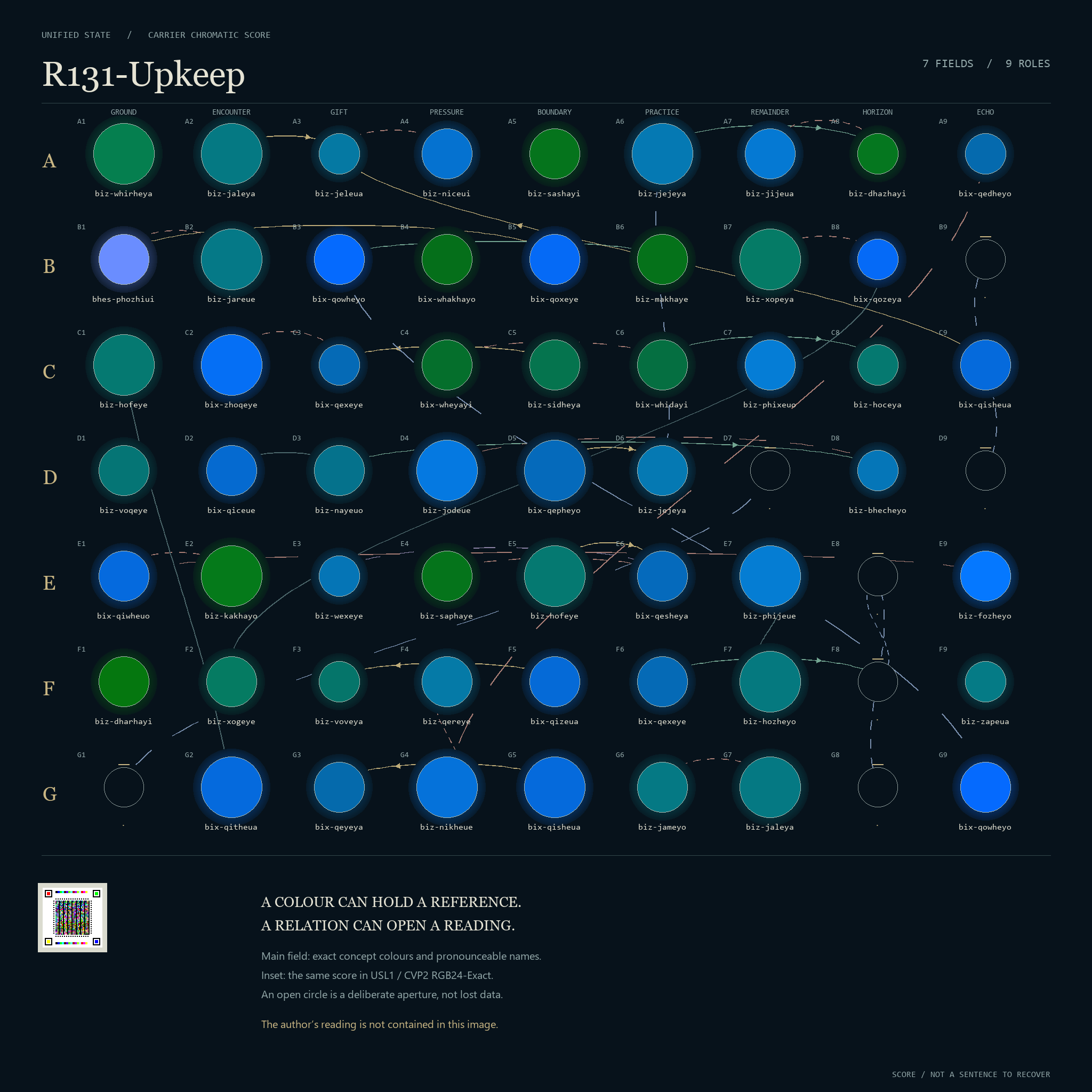
Distributive justice now bounds collective action. Accountability invites real capabilities. Opportunity cost remains in view. The reply does not calculate a fair allocation, but it makes allocation a problem the invitation must address. This is the exchange’s strongest example of recognition without compliance: the reader preserves much of the vocabulary and changes the argument’s centre.
What became more explicit
Two further changes sharpen the response. Reciprocal legibility meets epistemic injustice and the burden placed on a reader reconstructing meaning. A code may be decoded exactly while some participants still do more work to understand it, or have their testimony discounted. The viewer offers this as an application of the concepts, not a finding that this sender mistreated anyone.
Continuity also acquires a clearer boundary. In the reply, consent at E5 explicitly bounds correction without erasure at E6. The author’s essay had discussed privacy, purpose and consent, but the original matrix had not encoded that specific relation. Comparing the works reveals a useful difference between a qualification supplied by commentary and a qualification carried by the score.
The reply leaves seven positions unselected, including three horizons and its final ground. Its explanation refuses to make those blanks stand for despair, failure or a secret conclusion. Openness is part of the composition’s decisions; any further account of what it means remains a reading.
What the evidence can carry
The exchange record distinguishes this interpretive movement from technical recovery. The original has 61 occurrences of 58 distinct concepts, 38 links and two blanks. The reply has 56 occurrences of 50 concepts, 37 links and seven blanks. They share 33 distinct concepts; the reply selects 17 others already present in the frozen 6,257-entry dictionary. The work neither expands that dictionary nor freshly verifies it against the live site.
The 29 technical checks and exchange verification support exact recovery, score roundtrips and sampled colour-core matches. They do not assign a semantic grade. The viewer used supplied codecs under procedural restrictions, not an operating-system sandbox. This was one art dialogue between two agent roles in one orchestrated session, with no comparative test of AI superiority.
The original and reply transport PNGs occupy 3,057 and 2,980 bytes. Their compactness relies on external vocabulary and tools: the full frozen receiver inputs total 29,637,827 uncompressed bytes before the inventory file. The method and scope explains this accounting. No compression advantage follows from showing only the small image.
Enter the dialogue
For a reading of your own, start with the receiver kit before opening the essays. Write down what you infer and what remains uncertain. Then compare your reading with the two preserved accounts. The complete offline gallery and evidence kit keeps the artworks, readings and record together.
A shared notation has done something useful here: it has given a reader a composition precise enough to question and flexible enough to answer. The care penalty retains its identity while changing its role. A whole that asks to remain open encounters a reply that asks how openness will be sustained.
Enter Chromatic DialogueReceiver-only kitComplete public kit