Unified State · Blog · Orientation & responsibility
Galactic State Orientation 101
You are already aboard.
From your place on Earth to a wider frame of awareness, action, and care.
Find a place in the essay
Stand somewhere comfortable. Or remain seated. Notice the floor beneath you, a window, a familiar object, another person in the room.
Nothing needs to disappear for the view to become larger.
Earth is turning. It is traveling around the Sun. The Sun, together with the worlds of our solar system, travels around the Milky Way. Your ordinary surroundings belong to those movements already. [1][2]
We often imagine entering the cosmic story as a future achievement: a launch, an interplanetary journey, a first settlement beyond Earth.
Those would be important changes in our capabilities. But they would not be our first moment inside the Galaxy.
We are already aboard. The question is how consciously—and how responsibly—we participate.
This is the invitation behind the recent work on Navigating the Stellar Ocean, the System Atlas, and With Earth. The astronomy describes physical relationships. The language of System State and Galactic State proposes a way to think about them. The meditation invites us to make those relationships personally intelligible. These are connected activities, but they are not interchangeable kinds of evidence.
Earth, the vessel we did not have to build
Imagine a ship large enough to carry forests, oceans, cities, migration routes, libraries, kitchens, and every ordinary conversation you have ever had.
Its passengers do not all know one another. They disagree about almost everything. Yet they cannot make the vessel’s atmosphere belong to only one cabin.
This is the sense in which I call Earth a spaceship: a living home already traveling through space.
It is a metaphor, not a claim that Earth was manufactured or has an engine room. Its force comes from joining two things we often think about separately: the reality of our movement and the responsibility of sharing a home.
Extend the image. The Sun and its gravitationally associated planets, moons, and smaller bodies become a kind of galactic fleet. Each world has its own motion, while the system participates in the Sun’s journey through the Galaxy. NASA describes that Galactic circuit as taking roughly 230 million years. [2]
The fleet has no compulsory formation, no admiral, and no destination supplied by the metaphor. It is not a string of planets being towed behind a star. It is an image of connected travelers with distinct paths.
The useful question is not whether we can claim command of this fleet.
It is whether we can learn to live well aboard our part of it.
What System State and Galactic State mean here
In this essay, System State means considering the solar system as one connected setting for observation, navigation, communication, and possible future cooperation.
Galactic State widens that setting again: our solar system understood as one participant in a galaxy of other stellar systems.
These names do not establish a new government, prove contact with another civilization, or add a physical dimension. They describe a proposed framework of attention and responsibility.
Local, Global, System, and Galactic are not competing addresses. They are nested ways of describing where an event belongs.
The person reading this is local. The world supporting that person is planetary. That world’s orbit is a system-scale relationship. The system’s motion has a Galactic description.
Moving toward an “upper state,” in this practical sense, means including more of the relevant setting without losing the detail below it. It does not make one person more valuable than another.
I use Galactic State projection for the portion of this wider relationship we can represent and act upon from here: our instruments, shared records, scientific questions, and choices about the kind of civilization we build.
The Galaxy is not created by that projection. Our understanding of our place within it becomes more explicit.
A wider map should deepen our connection to the local world, not make the local world disposable.
Before a fleet can coordinate, its clocks and maps must translate
A shared environment does not require identical local days.
A future observer on Mars, a spacecraft team, and a person on Earth could describe the same event using different clocks, calendars, and spatial references. The important task is to preserve enough information to translate between those descriptions.
Astronomy already provides much of the foundation: reference systems such as BCRS and ICRS, and tools such as SPICE for working with time representations. These are established scientific resources, not inventions of this project. [3][4]
The proposed Unified System State Time—USST framework would organize those resources alongside local expressions of time and place. In the reader edition, its purpose is traceability: a number should carry its time scale, reference frame, model, and limitations. It is a proposal, not an adopted operational standard. [5]
That technical discipline has a useful human parallel. When two people describe the world differently, the first question need not be who must surrender their description. It can be: what reference is each person using, and what would let them understand the other?
This is an analogy about communication, not a claim that every opinion is as valid as a measured coordinate.
Unification does not require identical local experience. It requires reliable translation.
From a coordinate on a screen to a direction beside your shoulder
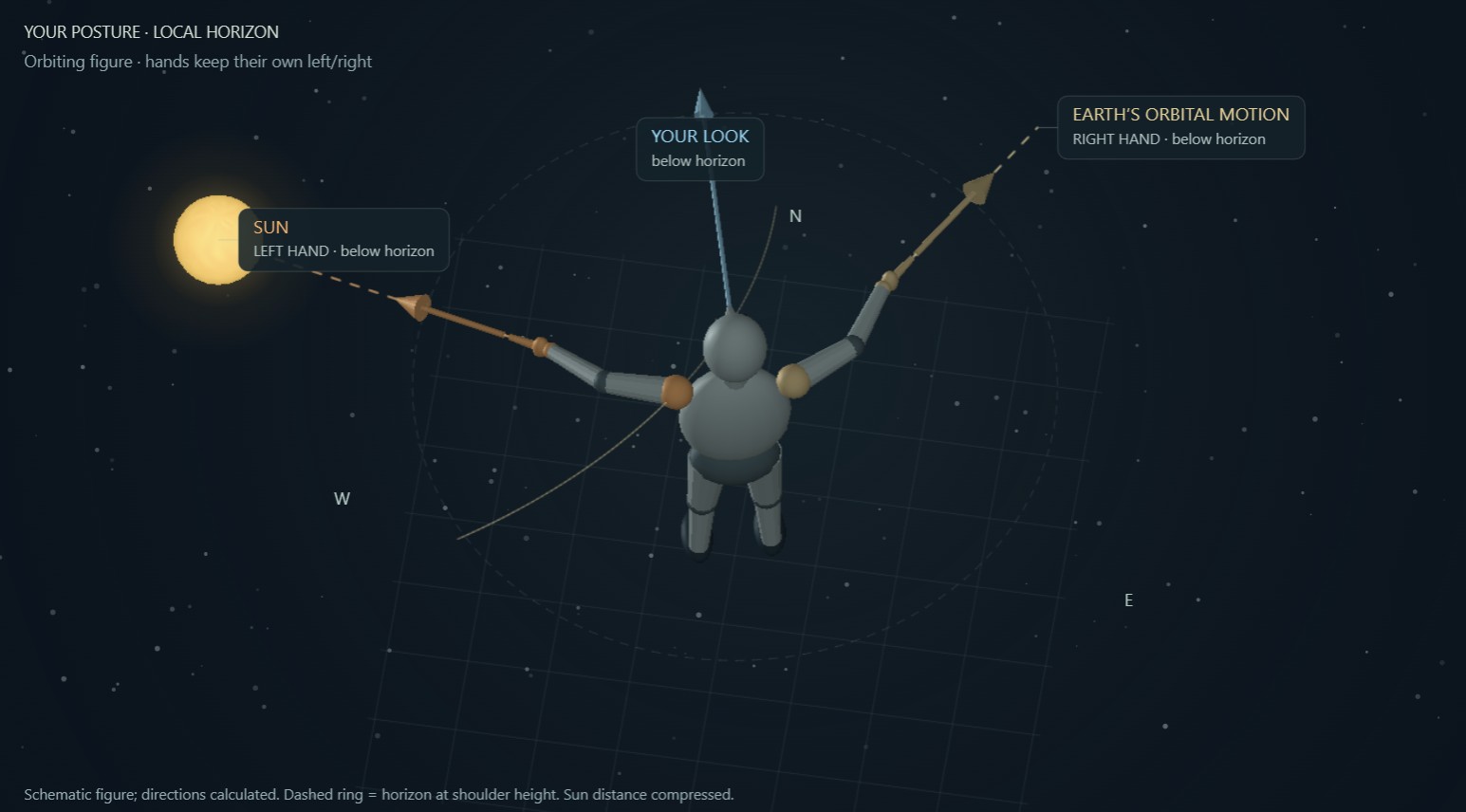
With Earth brings this problem closer to the body.
Choose a location and a looking direction. The tool relates that direction to a model of Earth’s rotation, Earth’s orbital movement, and the Sun’s motion in a declared Galactic frame. Its wider scenes preserve separate arrows for your gaze and the different motions. [6]
The distinction matters. Toward the Sun is not the same direction as Earth’s movement around the Sun. Likewise, toward the Galactic center and the Sun’s Galactic motion are not interchangeable arrows. Galactic coordinate calculations also depend on explicitly chosen frame parameters; a number without its reference is not a complete description. [6][7]
In the posture view, a generic figure faces your chosen bearing. Its blue ray represents your gaze. By default, one hand points along Earth’s orbital movement and the other toward the Sun. You can rotate the figure, view it from behind, swap the hands, or hold the displayed time. [6]
These are approximate, model-based directions for the displayed time. The enlarged bodies and arrows are visual aids, not literal distance or speed scales. [6]
Something ordinarily left inside a diagram becomes a relationship you can imagine beside your shoulder or below your feet.
A direction below the horizon is still meaningful geometry. It is not an object you can see through the ground.
The arrows do not send instructions to the Sun. They give us a way to notice a relationship that does not depend on our noticing it.
A first practice: Galactic orientation without leaving the room
Begin with here. Feel the chair or ground supporting you. Choose your location manually, or use the tool’s optional location control. Exact personal coordinates are not necessary for exploring the general idea.
Then choose one comfortable direction. Enter a true bearing and an elevation, or use an approximate manual direction while acknowledging the approximation. Looking direction and the camera angle used to inspect the model are separate choices.
Open Your posture, preferably from Behind figure. Notice the Sun direction and the orbital-motion direction. You do not have to imitate the whole pose. A small gesture, or an imagined line, is enough. The model is a schematic guide, not a measurement of your anatomy. [6]
Next, widen the view to the solar system and then the Galaxy. Keep track of which arrow describes which relationship. In the Galactic scene, the gold arrow remains Earth’s motion relative to the Sun, expressed in Galactic axes; it is not Earth’s complete Galactic velocity. The blue gaze arrow is a direction, not a speed. [6]
Finally, return to the room. Look at the same familiar object with which you began.
The invitation is simple: hold the nearby and the faraway in one understanding, without asking either to vanish.
Use the exercise while resting safely. Never look directly at the Sun to align yourself with a marker. Skip movements that strain you; stop the animation or return to ordinary surroundings whenever that feels better. There is no required sensation or successful state to achieve.
From passenger to informed participant
There are three different meanings of participation worth keeping separate.
Physical participation comes first. You belong to a world in motion whether you use an atlas or never think about astronomy at all.
Informed participation begins when you can connect an immediate experience to some of those wider relationships: this horizon, this place on Earth, this modeled direction of orbital motion.
Practical participation concerns what you choose to do with that understanding.
A meditation tool can support the second. It can invite the third. It does not grant the first, because the first was already true.
Nor is this particular tool a gatekeeper. A book, a lesson, a planetarium, an observation, or a carefully considered question can also open a wider frame.
When I speak of an observer who can also act, I mean action through ordinary causal channels—not a special power obtained by concentrating on a diagram. A teacher can help someone understand a shared environment. A programmer can make a model more transparent. A community can protect a place it depends upon. A research team can publish a measurement that other people can check.
These acts are not equivalent to influencing distant stars. Their value does not depend on pretending that they are.
We need not control the Galaxy to take responsibility for what we contribute within it.
A wider mind frame, with a way back to ordinary life
The reflective purpose of this work is not to make daily concerns look insignificant.
A wider view that tells a suffering person their pain is “small compared with the Universe” has missed the point. Scale does not measure the worth of an experience.
What I hope the exercise can offer is a little more room around an immediate concern. The situation still matters, but perhaps it need not occupy the whole imaginable world. A familiar horizon may become a place of curiosity as well as routine.
For some readers, that may feel calming or connecting. For others, a large-scale visualization may feel disorienting or simply uninteresting. These are possibilities, not promised effects. I offer With Earth as reflective practice, not a clinical treatment or a promise of relief. No one needs to adopt this vocabulary to be well or to belong.
The practice therefore has a return built into it: back to a nearby sound, a texture, a person, an ordinary task.
The related tools carry the same intention in different forms. The Wheel invites a pause; the Compass helps examine a question; the Listening Room makes space for another person’s meaning. The astronomical tools widen the setting, but they should not abandon that care for the immediate human situation.
Not escape from the room. A richer understanding of the room’s place.
What can become practical
The most immediate practical use is learning to distinguish concepts that an attractive picture can easily blur.
A learner can ask whether a change came from the object moving, the observer moving, or the camera turning. They can distinguish an orbital period from a clock rate, a gaze from a velocity, and an illustrative arrow length from a measured speed. The tool’s scene descriptions make several of those distinctions explicit. [6]
The same discipline belongs in the System Atlas: preserve the source of a coordinate, name its reference, state what is approximate, and refuse to manufacture a result where the necessary data are missing. The reader article proposes exactly that standard of traceability. [5]
A second use is civic imagination. I propose the fleet metaphor as a question for our institutions: would we design this decision differently if we remembered that the people affected share a moving home with us?
Would we treat a life-supporting environment as expendable scenery? Would we confuse being able to reach another place with being entitled to own it? Would we make cooperation depend on erasing local cultures?
These are ethical questions, not answers derived from orbital equations. Astronomy supplies the setting. We remain responsible for the values with which we respond.
The Three Horizons and the limits of a map
The earlier texts approach this wider setting from another direction: the limits of what an observer can reach, describe, and know.
The Three Horizons distinguishes the particle horizon, the Hubble radius, and the cosmic event horizon. In conventional cosmology, these concern different questions: what could have become observable, where the present expansion rate corresponds to light-speed recession, and what future causal reach a specified expansion history permits. The Hubble radius is not, in general, the same boundary as a cosmic event horizon. [8]
The instrument then adds a T Theory interpretation concerning counting, time, origins, and the meaning of the cosmic background. Its own closing sections separate Established, The Interpretation, and Open Questions & Limits, including an acknowledgment that the proposed rereading has not reproduced the cosmic microwave background evidence point for point. [9]
That distinction belongs in this blog too. Changing a description does not by itself establish a replacement cosmology.
The Safety of the Universe: Three Locks Against Empire uses stronger cosmological and theological claims about intentional protections against total domination. Its later interactive annex explicitly identifies that reading as interpretation rather than measurement. The annex also states assumptions behind its examples, including continued accelerated expansion and a chosen map-storage convention. [10][11]
The three locks and the three astronomical horizons should therefore not be treated as three interchangeable pairs of established laws. The warp and cognitive locks remain interpretations and model-dependent proposals here, not measured barriers established by a meditation exercise.
What I carry forward here is their ethical challenge: the desire to understand a world need not become the demand to possess it.
A working map need not be a perfect copy of everything. It needs enough trustworthy information for its purpose, together with an honest account of what it leaves out. That is a more useful ambition for our atlas than a fantasy of omniscience.
And limits to cosmic reach do not guarantee safety for people nearby. We still have to protect one another where our actions have consequences.
Superintelligence aboard a shared world
This is also where the orientation work meets the earlier writing about SI development.
Docking with Earth framed that discussion as speculative diplomacy. The practical concern beneath it does not require accepting a cosmic enforcement mechanism: powerful intelligence should develop alongside institutions capable of evaluating, correcting, and constraining harmful uses.
In the spaceship metaphor, AI is not an intelligence outside the vessel. Its computers, energy supply, operators, and consequences belong to the world in which it is deployed. Greater capability does not make that dependence irrelevant.
Nor would a system become trustworthy merely by describing the Galaxy fluently. A machine can produce an impressive map and still be wrong about a measurement, a person’s intention, or whether it should act.
The qualities I would ask for are therefore practical: traceable information, permission before consequential action, testable claims, meaningful oversight, and ways to recognize and correct failure. Existing AI-risk work already addresses governance, context, measurement, and risk management; NIST’s AI RMF organizes its core around Govern, Map, Measure, and Manage. [12]
The proposed wider frame adds a question of scope: as capabilities extend, are accountability and care extending with them?
We should not wait for the Sun, a horizon, or an imagined higher authority to make destructive choices safe. A speculative safeguard is not a substitute for safeguards people can inspect and use.
Better scale up good must therefore mean more than good intentions. It must mean building the practices by which powerful systems remain answerable to the lives they affect.
Alignment without uniformity
What, then, would it mean to become better aligned with the cosmos?
In the narrow geometric sense, it can mean knowing how your chosen direction relates to a local horizon, an orbit, or an adopted Galactic reference.
In the philosophical sense I propose here, it means bringing our explanations and actions into a more honest relationship with our circumstances: our dependence on a shared world, our limited knowledge, and our ability to cooperate without demanding sameness.
It is not a frequency that everyone must match. It is not a status bestowed by a website. And it is not a requirement to agree with T Theory.
The common ground can be more modest and more useful: preserve life, welcome correction, distinguish what is observed from what is imagined, and avoid turning greater reach into greater domination.
Love, in this sense, is not a claim that space will enforce our preferences. It is how we choose to treat those with whom we share the journey.
A System State worth building would make different places easier to understand without making them identical. A Galactic perspective worth cultivating would enlarge responsibility without shrinking anyone’s dignity.
The first step can be wonderfully ordinary.
Choose your place. Notice your gaze. Explore the directions. Return to the person or task beside you.
You have not left Earth. You have not become its captain. You have learned another way to recognize the journey you already share.
The room remains. The horizon widens. The responsibility comes home.
Lucid Founder calling Earth.
Copy.
This essay connects established astronomy, the author’s proposed framework, and an invitation to reflection. It does not present meditation as a navigation qualification, a clinical treatment, or proof of a cosmological interpretation.
References & related work
Scientific references support the astronomy or risk-management description cited. The Unified State texts provide the framework’s own terminology and interpretation. These roles are different; none of the external sources endorses USST, T Theory, or this tool.
- NASA Science — Facts About EarthEarth’s rotation and orbit; established astronomy.
- NASA Science — Sun: FactsThe Sun and solar system’s Galactic motion; approximate Galactic orbital timescale.
- U.S. Naval Observatory — International Celestial Reference SystemScientific reference systems and their relationship.
- NASA / JPL NAIF — SPICE Time SubsystemEstablished time representations and conversions.
- Unified State — System State I: Navigating the Stellar OceanSupplied reader edition: the proposed USST framework and its limits, not an adopted standard.
- Unified State — With EarthFeatures described from the supplied 1.5 posture edition. Approximate model; not operational navigation or body tracking.
- Astropy — Description of the Galactocentric Coordinate FrameFrame parameters and the distinction between Galactic and Galactocentric coordinates.
- Davis & Lineweaver — Expanding ConfusionPrimary scientific discussion of particle and event horizons, the Hubble sphere, and their differences.
- Unified State — The Three HorizonsAuthorial context. The supplied full instrument separates its T Theory interpretation from established modeling and open questions.
- Unified State — The Safety of the Universe: Three Locks Against EmpireEarlier cosmological/theological statement and its ethical opposition to domination; not independent empirical validation.
- Unified State — The Locks, ComputedSupplied interactive annex: stated toy-model assumptions and an explicit distinction between interpretation and measurement.
- NIST — AI RMF PlaybookGovern, Map, Measure, and Manage; ordinary, inspectable AI-risk practices.