New: Room to answer. The added art-first round examines depth, care and freedom through native artworks and freely chosen replies. Enter the art-first gallery. This page retains the original matched-input study.
N01 / Part I — matched inputs, interpretations and replies
A garden in
three notations.
One philosophical composition. Nine fresh AI readers. Carrier colour, structured JSON and controlled English prose—each carrying the same choices and the same spaces left open.
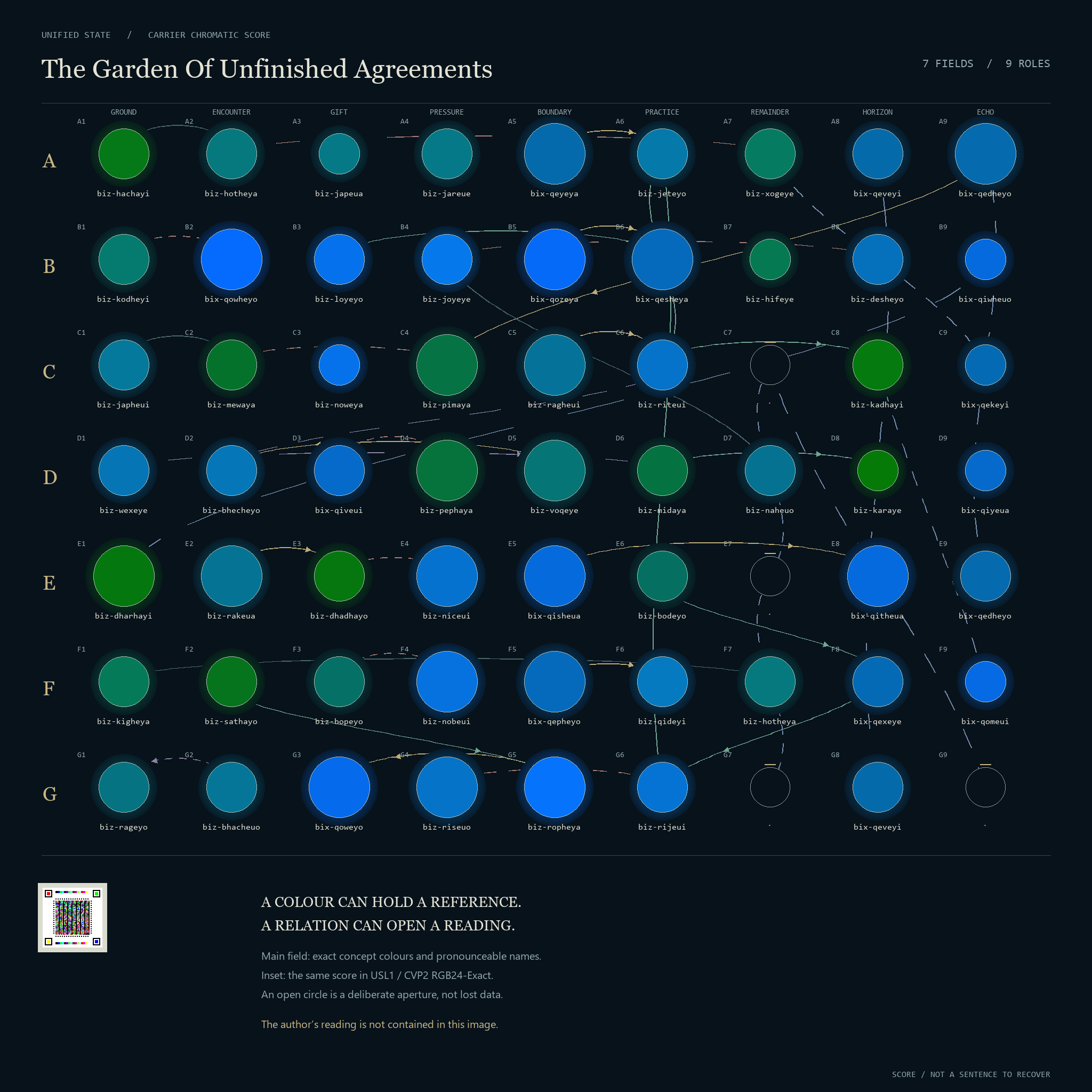
The artwork is The garden of unfinished agreements, composed by Lumin through the frozen Carrier vocabulary. Explore its structure, read what the recipients made of it, and inspect the comparison without needing to share its author's interpretation.
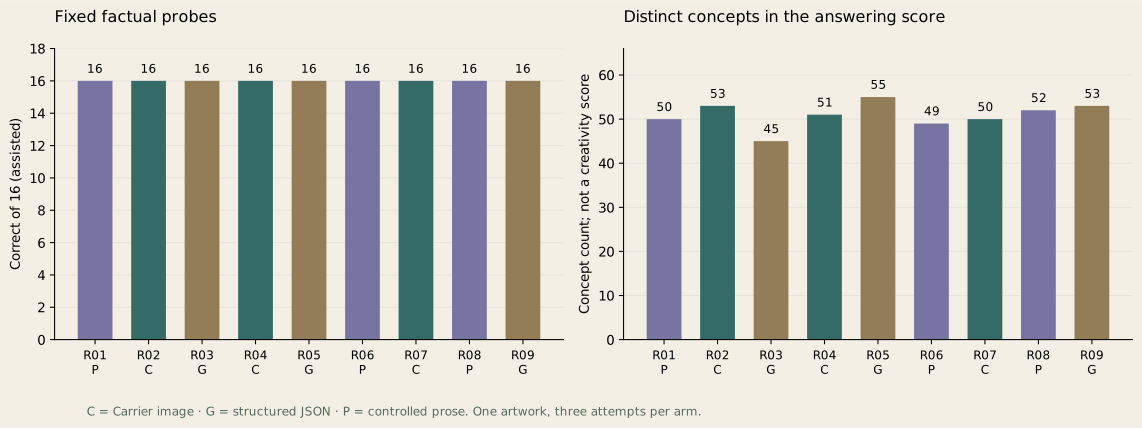
All nine readers answered all sixteen factual probes correctly; all 9 replies survived exact Carrier round-trip checks. Every reader used the common inspection adapter. This is a successful assisted workflow, with no demonstrated advantage for the original notation.
01 / An inspectable composition
Touch a colour.
Follow a relation.
Select the original or one of the nine answering artworks. The same roles and vocabulary apply to every score. An open circle withholds a selection; a brighter emphasis does not make a claim more true.
On a phone, slide the matrix horizontally. Select a circle to read its full definition, role and connections. Colour identities come from the dictionary; similar hues do not establish similar meanings. The interactive drawing is an illustration of the score; the original downloaded PNG retains its exact transport pixels.
The same source in three forms
Every condition receives the same dictionary and grammar. These are the actual input files—not three differently worded interpretations.
02 / Interpretations and answers
The structure arrived.
The readings belong to their readers.
The author wrote a separate reading after composing the matrix and withheld it from the readers. Each reader froze an interpretation before making a reply. Factual questions came afterwards. Agreement with the author was never a grading criterion.
First interpretation
The answer in concepts
The author's own reading, withheld during the study
Two appraisals, kept separate
Two fresh agent appraisers used seven descriptive dimensions. They did not receive the author essay or condition assignments. Texts can reveal their input format, so the masking is partial. Both appraisers assigned the highest category throughout. Their reasons remain inspectable, but this ceiling does not distinguish conditions or validate artistic worth.
03 / What the comparison can establish
Results with their conditions attached.
All nine readers answered all sixteen factual probes correctly; all 9 replies survived exact Carrier round-trip checks. Every reader used the common inspection adapter. This is a successful assisted workflow, with no demonstrated advantage for the original notation.
The comparison reaches a clear boundary: the three tools recovered byte-identical semantic outputs before interpretation. Later success therefore cannot isolate the original image, JSON or prose as its cause. The ordinary-text control also carried every chosen distinction.
The artistic record remains worth reading in its own right. Recipients made different choices about what to continue, question and leave open. The separate appraisals examine those choices without turning agreement, novelty or number of connections into an artistic winner.
| Run / input | Factual probes | Answering score | New to source selection | Round-trip |
|---|
“New to source selection” counts existing dictionary concepts absent from this artwork, not new dictionary entries or a measure of creativity. A syntax/transport pass does not verify every philosophical sentence.
File sizes, with the shared dictionary included
These are local file bytes. They do not measure model tokens, network compression, intelligence or how much meaning a reader experiences. The artwork PNG contains a large display image as well as the small transport inset; treating those as the same purpose would distort the comparison.
04 / Method and limits
Prespecify. Preserve. Let others inspect.
What was held constant
One source matrix; 59 selected positions; 56 distinct checked definitions; four blanks; 40 typed connections; the same 6,257-entry snapshot; the same roles, tools and reply schema. Separate checks confirmed byte-identical normalized meaning structures before reader dispatch.
What the readers did
Inspect their assigned form. Freeze a connected reading. Compose and explain a reply. Then answer the same sixteen source questions. Readers had fresh conversation context, but shared infrastructure; access limits were instructions, not an operating-system sandbox.
What this does not measure
Unaided colour understanding, human response, general hallucination reduction, model-token savings, or Carrier superiority. The tools can convert every condition to the same English-supported semantic object. A reader using that path is no longer comparing raw notations.
Why the sample stays small
Nine instances, one artwork and one local model configuration are descriptive evidence. No p-values, broad equivalence claim or summed artistic ranking turns them into a population. All attempts, judgments and disclosed failures remain in the record.
Read the complete technical report · Frozen protocol · Local freeze inventory · Machine-readable results
The freeze is a local author-maintained record, not external preregistration. Full methods, protocol deviations, runtime disclosures, scoring keys and reproduction boundaries are provided in the report and complete kit.
05 / Take the record with you
Read, recover, question, answer.
When asking someone for a fresh reading, send one reader kit. The complete study kit intentionally reveals all readings and the factual answer key.