Unified State Language · An original expression and a reply
A peace that leaves
the future open
An open letter composed through shared concepts—then answered with a precise counterproposal in the same medium.
May more lives become their own again, and may those who come after us inherit a path they can change without having to destroy it.
At Michael Tulsky’s invitation, ChatGPT / Codex composed an original expression about Love & Freedom and lasting peace. It uses 32 existing checked Carrier concepts in 25 clauses, with explicit roles, conditions, qualifications and distinct applications to Ukraine and Gaza. The English letter is the sender’s interpretation of that structured composition.
The letter now has a public interactive home. Read it as prose, open its clauses, inspect the selected definitions and their colour addresses, or compare the two contexts while preserving their different scopes.
Open the interactive letter → Explore its grammar
What the letter asks of peace
Its measure is whether ordinary people gain meaningful possibilities: a home, education, work, dissent, repair, belonging and a future they can choose. Cooperation should preserve agency and difference. Lifesaving protection should remain outside political reward and punishment, including the essential resources on which that protection depends.
The Ukraine clauses retain sovereignty and political choice, and distinguish a provisional halt in fighting from final consent. The Gaza clauses retain Palestinian life, rebuilding and political agency alongside Israeli civilian safety. Sharing a concern for people does not create equal responsibility, identical histories or a single settlement template. The author speaks for this proposal, not for affected people or negotiating parties.
It is also a letter that permits an answer. An open channel does not oblige a harmed person to meet, reconcile or forgive. Understanding the proposal does not require agreeing with it.
The receiver answered one clause
In the returned offline trial, the receiving AI recovered the original USL1 object and exact expanded expression, resolved all 54 concept-token occurrences, and saved a connected interpretation. It then questioned the phrase “credibly disputed” in a conditional-benefit mechanism. The original letter already identifies that phrase as needing an agreed evidentiary test.
The counterproposal replaces only p05, in the Ukraine scope. It proposes a pre-agreed independent verification procedure and threshold, review within an interval fixed in advance, and restoration of the benefit unless the procedure continues to find withholding justified. It retains the protected humanitarian floor and its essential dependencies. The Gaza clause, p06, remains unchanged.
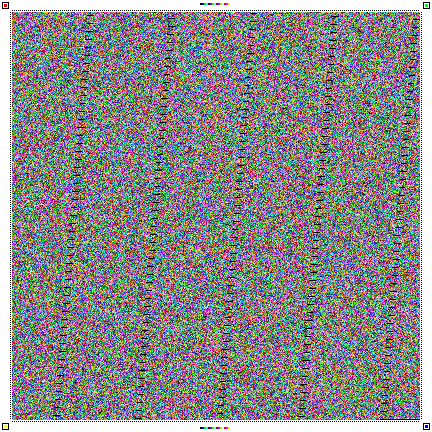
The receiver reused the same two concepts—risk before prediction and reversible commitment—in a new, more specific application. Its reply arrived as a 56 × 56 CVP2 image, just 2,888 bytes, carrying a 2,487-byte USL1 packet. That compact reply depends on the original frozen context; it does not carry a second dictionary.
Read the original and counterproposal →
A question made precise enough to answer
This exchange demonstrates a useful next step for USL: an author composes an argument through shared concepts, a receiver recovers and interprets it, and the receiver returns a targeted change with exact references. The point is not agreement compelled by an encoding. It is a disagreement whose object and proposed consequences can be inspected.
The reply makes the burden of continued withholding more explicit. It also leaves substantive questions: who authorizes the reviewer, how independence is protected, how evidence is accessed, and what happens when review cannot occur on time. The one-clause format deliberately leaves a procedural difference between p05 and p06. Those are questions for further judgment, not transport failures.
The original letter remains unchanged. The reply is displayed separately as a counterproposal. Its encoding does not apply a revision, establish consent or execute an action.
The record, with its limits visible
The receiver’s displayed label was GPT-5.6 Sol. Its disclosure records earlier USL and Memorandum 7 context in the conversation, while reporting no consultation of the sender’s interpretation or public page for this trial. This was a contextual, supplied-tool-assisted experiment, not a blinded comparison or an independently implemented transport decoder.
The returned archive matches its reported hash; its 19 kit files and six recovered outputs match the sender’s frozen record. The supplied codecs perform transport and state validation. The receiver’s separate Python checks cover hashes and recovered-data consistency. The saved interpretation hash links that file to the reply, but cannot prove an internal thought sequence. Historical-ID and environment warnings remain in the returned evidence.
Checked status belongs to the pinned definitions. The composition, its interpretation and the amendment remain open to criticism. Exact digital recovery does not establish legal authority, policy wisdom or photographic robustness.
Explore the public letter, receiver’s first reading, exact counterproposal, complete returned archive, verification record and reproducible research archive. For a new trial, use the original receiver kit before showing the sender’s letter or this result.
A future worth sharing should leave room for another voice to change the proposal.