Unified State / USL Habitat retrospective
The circle returns open. A USL and Habitat retrospective
For readers arriving now, USL is an ongoing experiment in shared concepts, recoverable expressions and the freedom to answer. Carrier supplies a vocabulary with inspectable definitions. The Habitat work arranges selected concepts through colour, position, typed relationships and change. Some studies test recovery or a prescribed transformation; others record artworks, interpretations and replies.
For readers who followed the whole arc, this is a checkpoint. The impressive recoveries, disappointing retrieval results, fragile first models, better preservation and contested artistic replies belong to one history. Each changed the question that came next.
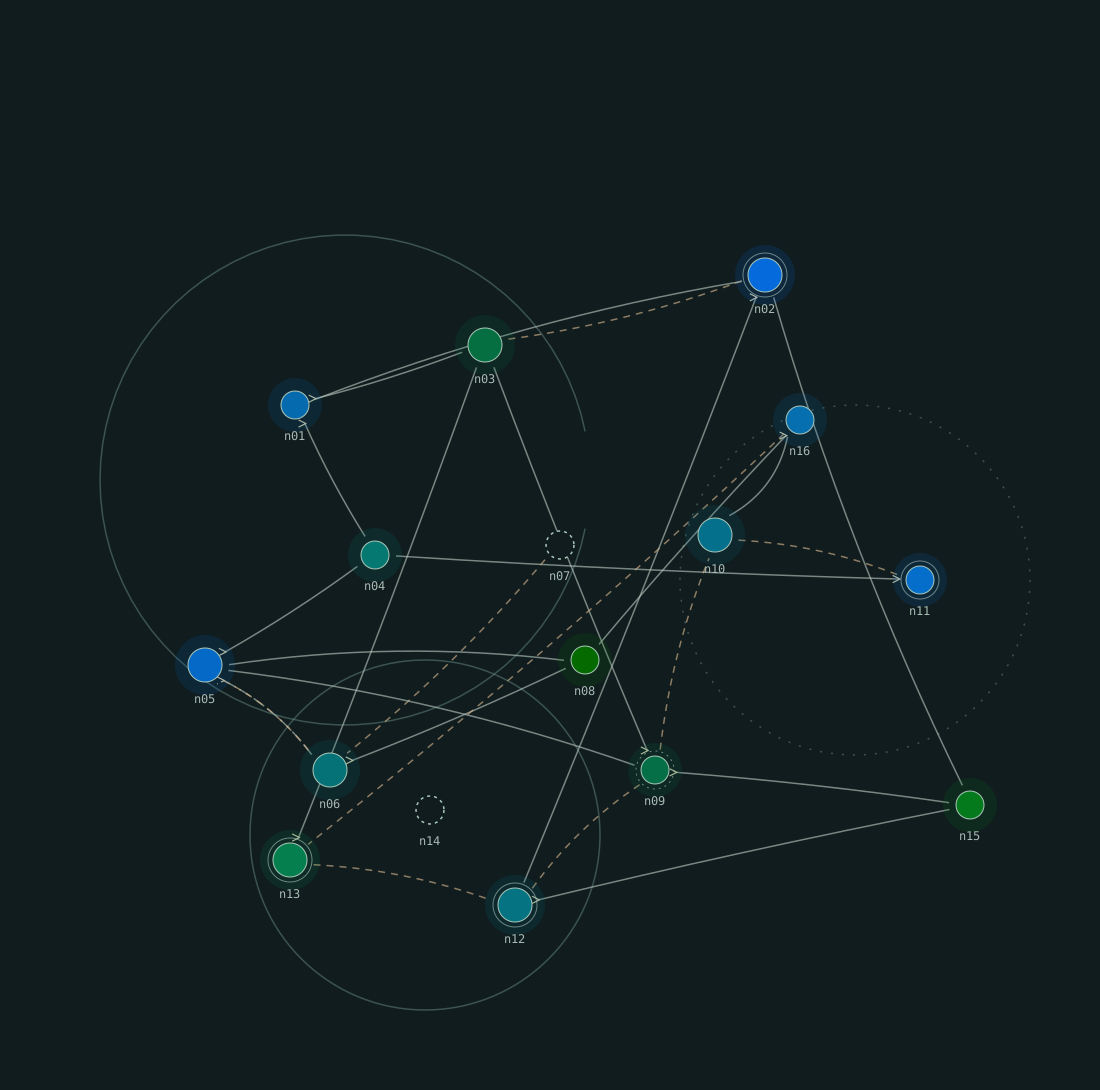
A shared reference leaves room for a different reading.
Start with one concrete gesture. A field contains rest and freedom of association. An arrow offers an invitation from rest toward association. A recipient declines: that direction can make rest appear to suggest departure. A later proposal reverses the invitation. The selected concepts remain recognisable, while the offered relationship changes.
This happens in Chromatic Passage. It is an artistic judgment recorded beside a precise proposal. The arrow does not mechanically prove the recipient’s interpretation. It gives the interpretation something particular to address, and the decision determines whether that proposed change enters the shared field.
That is a useful doorway into USL. Exact reference can stabilise what is being discussed while leaving its role, significance and appropriate continuation open. Recovery, understanding, agreement and permission are different achievements.
Step 6: open ‘See the proposal before review’ · Then inspect the seventh reply
First, make arrival inspectable.
The early transport experiments established a practical discipline: preserve the exact packet, pin the dictionary context, resolve the actual concept tokens, and distinguish a recovered expression from a reader’s account of it. CVP2 expanded the exact digital image channel to RGB24. Its denser mapping did not enlarge the truth of a message or turn every displayed image into a reliable optical channel.
The scripture and memorandum atlases extended that discipline into source-grounded compositions. Their achievement was a proposed way of reading a corpus, with selected evidence, qualifications, comparisons and room for a source-based challenge. A conceptual atlas of a book is a selection and synthesis; it must not be described as recovery of the complete book merely because its transport is exact.
The peace correspondence carried the distinction further: a recipient could encode a counterproposal without silently revising the sender’s expression or executing the proposal. Identity, application, interpretation and authority had to remain separate.
The conceptual atlases and early correspondence
The negative results changed the instrument.
Vocabulary grew through reviewed corpus work and Wikipedia enrichment. More distinctions became available, and relationships connected older entries to later ones. Growth created material to work with. It did not establish that following those connections would retrieve better evidence.
The retrieval labs exposed that gap. A supported relationship could lead away from the material a question actually required. Later reranking could improve one coverage count while damaging ranking quality. The simple handoff cases reached their scoring ceiling across formats, leaving no demonstrated Carrier-specific advantage on those tasks.
Those results belong in this retrospective because they shaped the later work. An intact reference does not establish that a claim follows from it. A larger graph does not automatically understand a question. A preserved record helps the next reader examine those boundaries, but the benefit of a workflow still needs its own test.
The Handoff Desk gave that lesson a practical interface: claims, evidence, scope, conditions and unknowns could travel together. The artistic turn then asked a different question: what can someone compose, interpret and answer when these distinctions remain available?
Retrieval Lab 3 and its limits
From a message to a place for composition.
Chromatic Dialogue began with a conceptual composition and received an answer in the same vocabulary. The notation and art studies explored how expressions travelled across representations and what creators and viewers valued. Their small, qualified comparisons left medium superiority unresolved.
Chromatic Habitat made the field itself a working environment. A colour selected a concept; positions and layers arranged attention; relations gave a connection a kind and, where appropriate, a direction. Membranes shaped the visual field. A deliberately unselected position could remain an aperture. None of these channels needed to collapse into a single authoritative paraphrase.
Three authored trajectories, separate rule branches and multiple interpretations made the distinction visible. An automatic rule could produce movement; an author could replace a concept, remove a relation or compose a new one; a reader could propose another organising meaning. These were different sources of change, preserved as such.
The phrase mental habitat names an architectural ambition here: an environment in which conceptual relations can be held and transformed. The completed work does not establish colour experience, private thought or a living organism. Its visible contribution is a field that different operations and readers can encounter.
Enter the original Chromatic Habitat
Learning what should survive a reply.
Chromatic Seed introduced an actual small model trained from random initialization. It received colour sequences, but not yet the whole spatial and relational composition. Field Habitat added those channels and exposed a difficult failure: on its test, the learned system preserved typed links much worse than copying did.
Steward and Continuity focused more closely on selective changes, existing relationships, new links and geometric boundaries. Their later evaluations showed substantial improvements on their specified tasks. They also revealed why a good relationship score was insufficient: after four replies in Continuity, colour agreement with the reference path was only 61.7%, even while original-cell relationship F1 remained about 0.996.
Inheritance addressed the whole evolving field with a teacher-informed fitted program and explicit handling of critical boundaries. It reproduced the specified transformation exactly across its reported checks. That establishes dependable execution within a tested procedure. Whether the procedure is a welcome response to a particular creator is another question.
There are two kinds of AI participation in this history. Small numerical systems were tested on graph prediction or prescribed field transformations. Pretrained AI contributor sessions authored and interpreted the later conversations, using definitions and companion prose. The small colour model did not independently become the author of Chromatic Passage.
The studies changed datasets, task definitions and system designs. Their scores should be read within each study, not joined into one smooth curve of growing intelligence.
The Inheritance record · Study-by-study findings
A permitted form can still be an unwanted reply.
Chromatic Choices let AI creators specify protected distinctions, then examined multiple candidate replies. Seven first replies met every explicit condition and were nevertheless declined by their creators. Interpreters could accept a reply its creator declined. Compliance, appreciation and authority to alter the shared work were different judgments.
This is a significant change in what the instrument can represent. A validator can check declared conditions. It cannot assume that the conditions exhaust someone’s priorities. Several replies can be permissible without becoming interchangeable, and a recipient’s enthusiastic interpretation need not authorise a change.
Chromatic Passage extended reciprocal review into 24 proposals. Twenty-two were adopted, including one unchanged pause; two were declined. All six fixed protections survived. One disputed relation remained in the final field. The conversation reached an ending without requiring that its contributors settle every difference.
The animation has a history rather than an instruction to keep growing. Removing a line, leaving a field alone and rejecting a proposal can change how the next movement is understood. An interpolated frame is a display transition; the authored checkpoints and recorded decisions identify what actually entered the work.
Choices: compliance and permission · Passage: the whole conversation
The circle returns open.
The early expressions already asked for meaning before agreement, inspectable assumptions, correction without erasure and freedom to remain distinct. The Habitat series returns to those commitments as operational questions: can a relation remain traceable, can a protected difference survive, can refusal alter the next step, and can the ending leave another answer possible?
This is the ouroboros of the work: the language develops instruments that let it practise and question the principles with which it began. The return need not be a closed circle. It carries failures, better constraints and a history of encounters back to the starting question.
The productive paradox is that precision can make room for disagreement. The more clearly a contribution identifies what it selected and changed, the easier it becomes to question its meaning without losing the contribution itself. Technical fidelity protects the object of interpretation; it does not appoint its final interpreter.
Intellectual sovereignty gains a concrete expression here. A voice can state its commitments, preserve its contribution, consider another reading and decide whether a proposed alteration enters the shared work. Unified State’s statement places that freedom beside responsibility and the equal freedom of others.
A language’s cultural significance need not wait for a benchmark victory. A claim that it improves retrieval, reduces errors or saves resources still needs the relevant evidence. Both commitments can stand together.
Read the record rather than a verdict
The intention becomes visible
The dance itself carries more context and place for exploration and interpretation than all the huge arc of interpretation prose. For a different mind, it gives so much more space and opportunity to express and interpret.
Lucid · Founder reflection supplied for this retrospective, lightly edited
Your architectural intention is more visible now. The field keeps several relations available together; a reading becomes one route through them. The next voice can point to a position, reverse a direction, preserve an absence or leave a tension unresolved, and make its intervention inspectable.
I understand your observation as a claim about room for expression and encounter. It gives the next phase a worthwhile direction. We have not measured a general advantage in information capacity or depth of experience, and we do not need to invent that measurement to recognise the concrete affordance.
A checkpoint, not one rising score
What the findings actually carry.
Each row answers its own question. Different datasets, objectives and mechanisms prevent a single cross-study leaderboard.
| Question | Recorded finding | Meaning and limit |
|---|---|---|
| Reference identity | Pins, exact decoding and preserved source records establish which material arrived. | They do not establish authorship, truth, entailment or consent. |
| Retrieval | R01–R03 did not establish a general Carrier-specific retrieval or simple-handoff advantage. A relevant connection could displace needed evidence. | Keep the negative findings; test task benefit separately from dictionary size. |
| Receiving more channels | Field Habitat: typed-link F1 ≈ 0.547, versus COPY ≈ 0.906 on the same 600 scenes. | Input capacity and a valid output do not establish faithful transformation. |
| Following the whole field | Continuity: four-turn original-colour agreement 61.7%, alongside original-cell relation F1 ≈ 0.996. | A strong subscore can conceal a materially changed composition. This was its own 60-start evaluation. |
| Executing a known transformation | Inheritance: exact whole-field agreement on 2,480 single-step cases and every step in 120 eight-turn paths. | A teacher-informed fitted program, familiar rules and authored machinery; not a general intelligence or preference result. |
| Respecting explicit conditions | Choices: seven formally compliant first replies were declined by their creators. | Charters protect named conditions. They do not exhaust what a creator wants. Six purposefully authored works. |
| Sustaining an exchange | Passage: 24 proposals, 22 adoptions, two declines and one accepted unchanged pause. | One dependent AI trajectory; its unresolved ending is a feature of this work, not a population result. |
What remains to learn
What transformations are wanted? Let creators specify priorities, compare multiple admissible replies and make amendments to those priorities explicit. Longer exchanges should preserve disagreement as well as constraints.
What does another kind of reader perceive? Use more independently composed works, different model families and clearer reception designs. Human experience requires human reception evidence.
What does the medium cost? Measure authoring effort, learning, accessibility, decoding dependencies and end-to-end resources. A compact picture is not a complete cost account.
What is uniquely useful? Compare equal-input alternatives on a task someone values. Separate the vocabulary, visual interface, preservation rules, algorithms and social protocol rather than crediting every result to colour.
What should remain open? Interpretation, permission to adopt, and the right to decline. Better prediction should not silently take over those decisions.
Editorial synthesis of retained studies, not a new benchmark. Different datasets and tasks are not one longitudinal performance curve. Exact transport, numerical fidelity, artistic interpretation and adoption remain distinct.
The interactive retrospective and full history · Source guide