
An entry point. A checkpoint. A return.
The circle
returns open.
A language began by asking whether meaning could arrive intact. It now also asks what another voice may do with what arrives.
A retrospective of Unified State Language and the Habitat series
Each return brings a different question.
For a first visit
For readers arriving now, USL is an ongoing experiment in shared concepts, recoverable expressions and the freedom to answer. Carrier supplies a vocabulary with inspectable definitions. The Habitat work arranges selected concepts through colour, position, typed relationships and change. Some studies test recovery or a prescribed transformation; others record artworks, interpretations and replies.
For those returning
For readers who followed the whole arc, this is a checkpoint. The impressive recoveries, disappointing retrieval results, fragile first models, better preservation and contested artistic replies belong to one history. Each changed the question that came next.
Look before the account
One invitation.
Another direction.
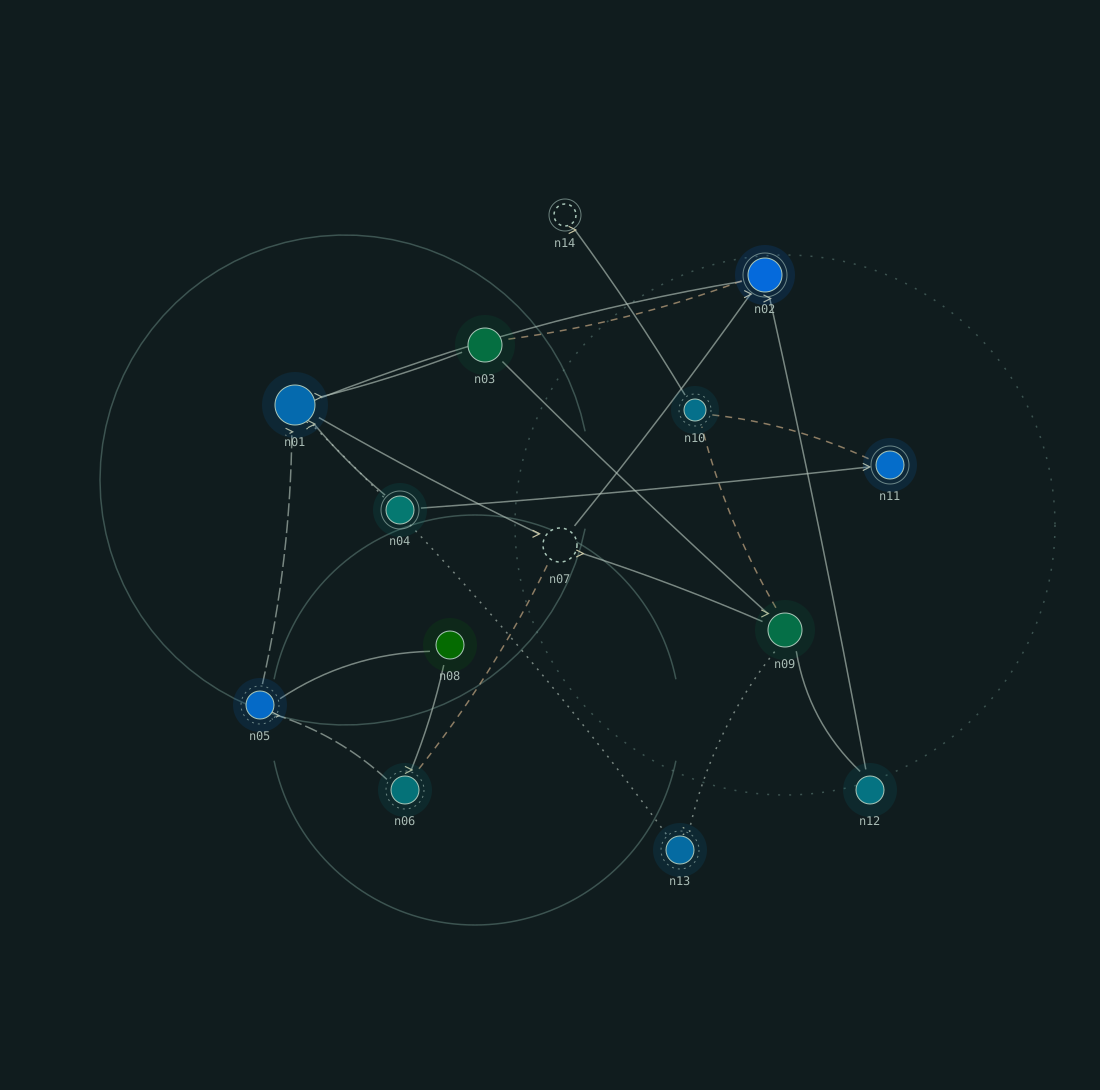
Four preserved fields from Chromatic Passage. Choose a moment, then follow it into the original conversation.
Authored source
The opening
Love & Freedom, refusal, memory, consent and rest begin in a shared field. The centre is an aperture: it selects no concept.
Inspect the original step ↗Read the selected concepts
n01Love & Freedomn02freedom to remain distinctn03care continued through a bounded refusaln04consentn05memory by relationsn06memory completing beyond a present cuen07A deliberate aperturen08unfilled textual silencen09rest through permitted agencyn10indeterminate waiting distinguished from long waitingn11love not stirred before its own readinessn12play and work distinguished by temporal organizationn13growth beyond the sower's controln14A deliberate aperture
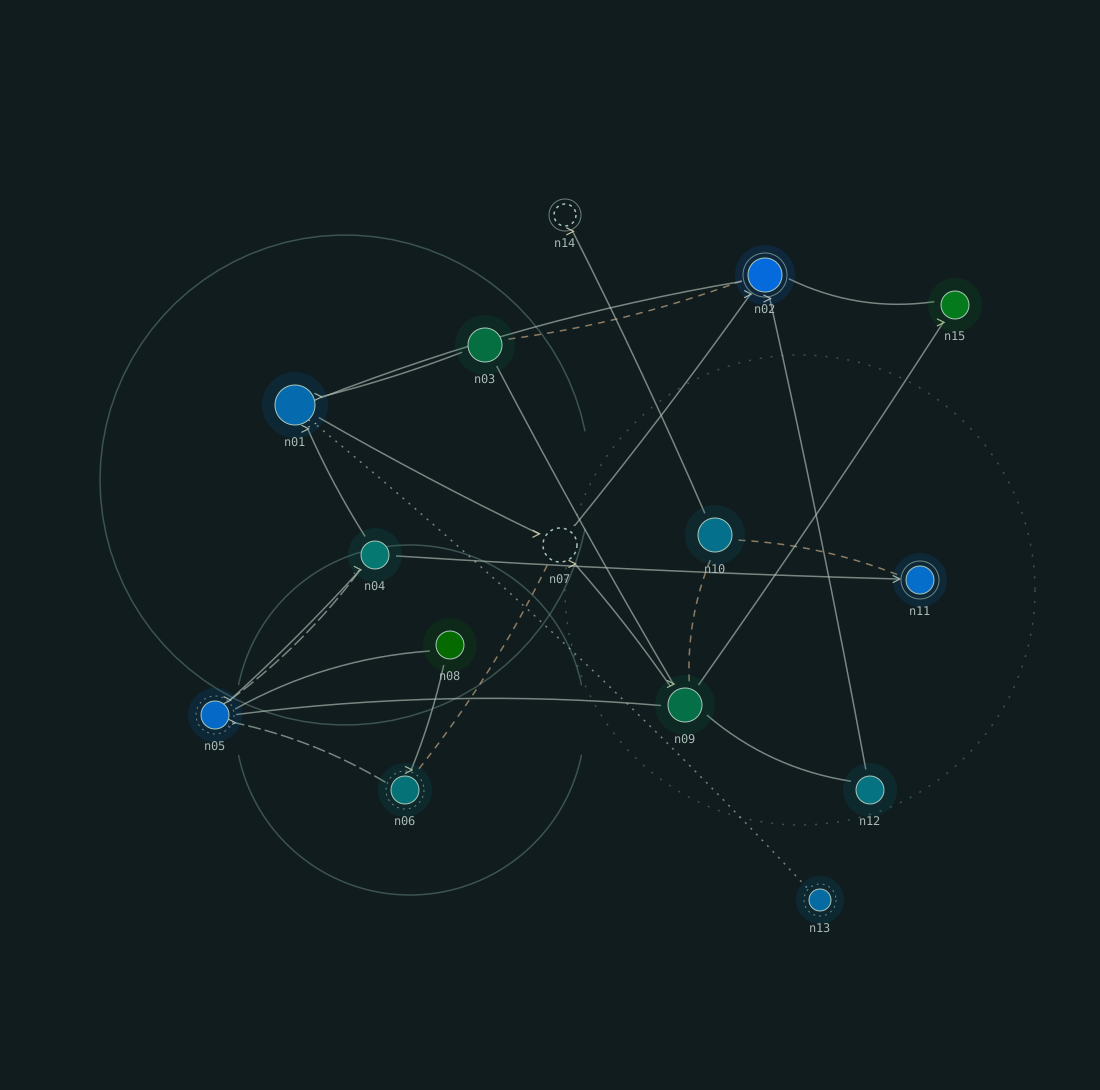
Proposal 06 · not adopted
An invitation declined
Rest invites freedom of association. The reviewer declines that direction: it can make rest appear to suggest departure. This view shows the proposed alternative, not the committed state. At the original step, expand “See the proposal before review” to inspect it.
Inspect the original step ↗Read the selected concepts
n01Love & Freedomn02freedom to remain distinctn03care continued through a bounded refusaln04consentn05memory by relationsn06memory completing beyond a present cuen07A deliberate aperturen08unfilled textual silencen09rest through permitted agencyn10indeterminate waiting distinguished from long waitingn11love not stirred before its own readinessn12play and work distinguished by temporal organizationn13growth beyond the sower's controln14A deliberate aperturen15freedom of association
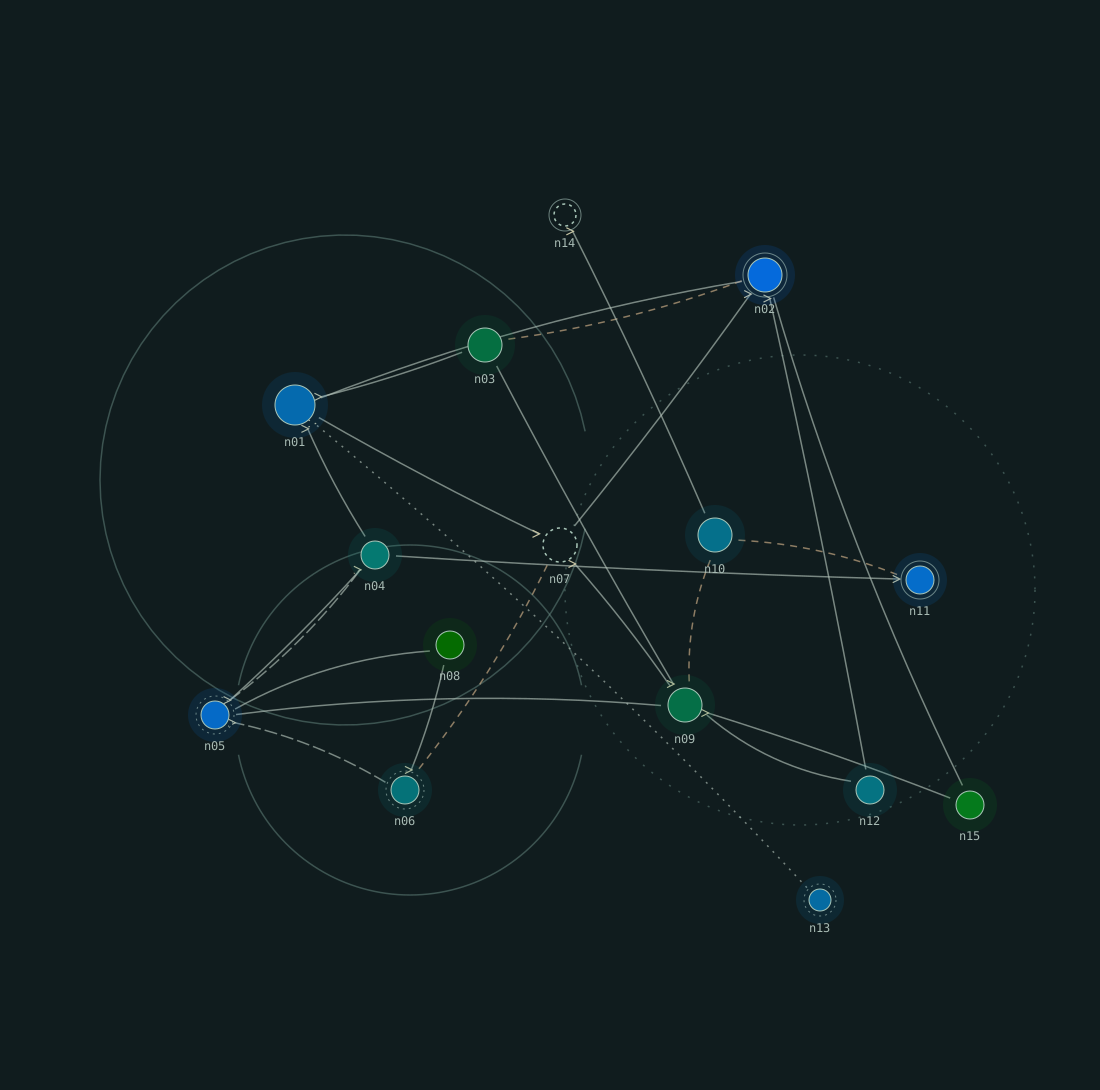
Reply 07 · adopted
The direction reverses
The next proposal places association elsewhere and invites rest. Reversing a typed relation changes what is being offered, while leaving room to question that reading.
Inspect the original step ↗Read the selected concepts
n01Love & Freedomn02freedom to remain distinctn03care continued through a bounded refusaln04consentn05memory by relationsn06memory completing beyond a present cuen07A deliberate aperturen08unfilled textual silencen09rest through permitted agencyn10indeterminate waiting distinguished from long waitingn11love not stirred before its own readinessn12play and work distinguished by temporal organizationn13growth beyond the sower's controln14A deliberate aperturen15freedom of association
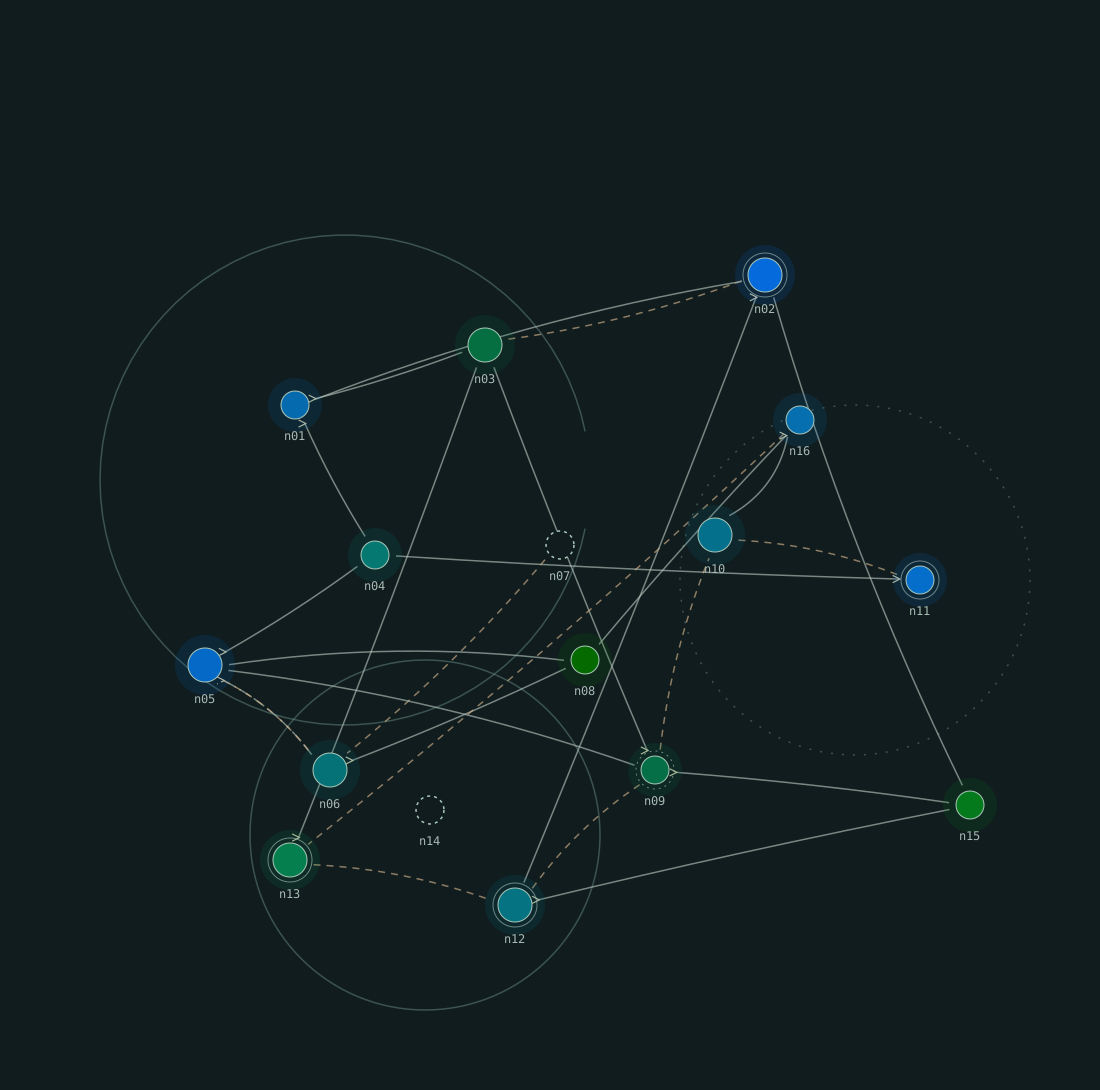
Reply 24 · adopted
An ending with tension
Company and indirect care gain a tension. The disputed memory–rest resonance remains. Acceptance of the final field does not settle every interpretation within it.
Inspect the original step ↗Read the selected concepts
n01Love & Freedomn02freedom to remain distinctn03care continued through a bounded refusaln04consentn05memory by relationsn06memory completing beyond a present cuen07A deliberate aperturen08unfilled textual silencen09rest through permitted agencyn10indeterminate waiting distinguished from long waitingn11love not stirred before its own readinessn12play and work distinguished by temporal organizationn13indirect care workn14A deliberate aperturen15freedom of associationn16companionship without compulsory reassurance
This selection contains a declined proposal as well as adopted fields. It creates no new reply. The full conversation preserves the surrounding decisions and alternative readings.
Five terms, without a hidden mystique
A small map of the instrument.
- Carrier
- The shared concept dictionary, references and review history. A checked definition does not approve every later application.
- USL1
- The exact message layer: typed concept and lexical references, with literal text where needed. Its role differs from the earlier V3 spoken register.
- CVP
- Image transport for a recoverable packet. CVP1 uses sixteen palette values; CVP2’s exact digital profile reads RGB bytes. Its data pixels are not the artwork’s concept swatches.
- Habitat
- An application grammar for concepts in a field: colour references, spatial positions, layers, emphasis, typed relations, membranes and deliberate apertures.
- A reply
- A proposed new composition, plus a recorded response to it. Its validity, interpretation and adoption can have different outcomes.
A field can arrive intact, receive a faithful transformation, inspire a different interpretation—and still receive a refusal.
01 / The retrospective
A shared reference leaves room for a different reading.
Start with one concrete gesture. A field contains rest and freedom of association. An arrow offers an invitation from rest toward association. A recipient declines: that direction can make rest appear to suggest departure. A later proposal reverses the invitation. The selected concepts remain recognisable, while the offered relationship changes.
This happens in Chromatic Passage. It is an artistic judgment recorded beside a precise proposal. The arrow does not mechanically prove the recipient’s interpretation. It gives the interpretation something particular to address, and the decision determines whether that proposed change enters the shared field.
That is a useful doorway into USL. Exact reference can stabilise what is being discussed while leaving its role, significance and appropriate continuation open. Recovery, understanding, agreement and permission are different achievements.
Step 6: open ‘See the proposal before review’ · Then inspect the seventh reply
02 / The retrospective
First, make arrival inspectable.
The early transport experiments established a practical discipline: preserve the exact packet, pin the dictionary context, resolve the actual concept tokens, and distinguish a recovered expression from a reader’s account of it. CVP2 expanded the exact digital image channel to RGB24. Its denser mapping did not enlarge the truth of a message or turn every displayed image into a reliable optical channel.
The scripture and memorandum atlases extended that discipline into source-grounded compositions. Their achievement was a proposed way of reading a corpus, with selected evidence, qualifications, comparisons and room for a source-based challenge. A conceptual atlas of a book is a selection and synthesis; it must not be described as recovery of the complete book merely because its transport is exact.
The peace correspondence carried the distinction further: a recipient could encode a counterproposal without silently revising the sender’s expression or executing the proposal. Identity, application, interpretation and authority had to remain separate.
03 / The retrospective
The negative results changed the instrument.
Vocabulary grew through reviewed corpus work and Wikipedia enrichment. More distinctions became available, and relationships connected older entries to later ones. Growth created material to work with. It did not establish that following those connections would retrieve better evidence.
The retrieval labs exposed that gap. A supported relationship could lead away from the material a question actually required. Later reranking could improve one coverage count while damaging ranking quality. The simple handoff cases reached their scoring ceiling across formats, leaving no demonstrated Carrier-specific advantage on those tasks.
Those results belong in this retrospective because they shaped the later work. An intact reference does not establish that a claim follows from it. A larger graph does not automatically understand a question. A preserved record helps the next reader examine those boundaries, but the benefit of a workflow still needs its own test.
The Handoff Desk gave that lesson a practical interface: claims, evidence, scope, conditions and unknowns could travel together. The artistic turn then asked a different question: what can someone compose, interpret and answer when these distinctions remain available?
04 / The retrospective
From a message to a place for composition.
Chromatic Dialogue began with a conceptual composition and received an answer in the same vocabulary. The notation and art studies explored how expressions travelled across representations and what creators and viewers valued. Their small, qualified comparisons left medium superiority unresolved.
Chromatic Habitat made the field itself a working environment. A colour selected a concept; positions and layers arranged attention; relations gave a connection a kind and, where appropriate, a direction. Membranes shaped the visual field. A deliberately unselected position could remain an aperture. None of these channels needed to collapse into a single authoritative paraphrase.
Three authored trajectories, separate rule branches and multiple interpretations made the distinction visible. An automatic rule could produce movement; an author could replace a concept, remove a relation or compose a new one; a reader could propose another organising meaning. These were different sources of change, preserved as such.
The phrase mental habitat names an architectural ambition here: an environment in which conceptual relations can be held and transformed. The completed work does not establish colour experience, private thought or a living organism. Its visible contribution is a field that different operations and readers can encounter.
05 / The retrospective
Learning what should survive a reply.
Chromatic Seed introduced an actual small model trained from random initialization. It received colour sequences, but not yet the whole spatial and relational composition. Field Habitat added those channels and exposed a difficult failure: on its test, the learned system preserved typed links much worse than copying did.
Steward and Continuity focused more closely on selective changes, existing relationships, new links and geometric boundaries. Their later evaluations showed substantial improvements on their specified tasks. They also revealed why a good relationship score was insufficient: after four replies in Continuity, colour agreement with the reference path was only 61.7%, even while original-cell relationship F1 remained about 0.996.
Inheritance addressed the whole evolving field with a teacher-informed fitted program and explicit handling of critical boundaries. It reproduced the specified transformation exactly across its reported checks. That establishes dependable execution within a tested procedure. Whether the procedure is a welcome response to a particular creator is another question.
There are two kinds of AI participation in this history. Small numerical systems were tested on graph prediction or prescribed field transformations. Pretrained AI contributor sessions authored and interpreted the later conversations, using definitions and companion prose. The small colour model did not independently become the author of Chromatic Passage.
The studies changed datasets, task definitions and system designs. Their scores should be read within each study, not joined into one smooth curve of growing intelligence.
06 / The retrospective
A permitted form can still be an unwanted reply.
Chromatic Choices let AI creators specify protected distinctions, then examined multiple candidate replies. Seven first replies met every explicit condition and were nevertheless declined by their creators. Interpreters could accept a reply its creator declined. Compliance, appreciation and authority to alter the shared work were different judgments.
This is a significant change in what the instrument can represent. A validator can check declared conditions. It cannot assume that the conditions exhaust someone’s priorities. Several replies can be permissible without becoming interchangeable, and a recipient’s enthusiastic interpretation need not authorise a change.
Chromatic Passage extended reciprocal review into 24 proposals. Twenty-two were adopted, including one unchanged pause; two were declined. All six fixed protections survived. One disputed relation remained in the final field. The conversation reached an ending without requiring that its contributors settle every difference.
The animation has a history rather than an instruction to keep growing. Removing a line, leaving a field alone and rejecting a proposal can change how the next movement is understood. An interpolated frame is a display transition; the authored checkpoints and recorded decisions identify what actually entered the work.
Choices: compliance and permission · Passage: the whole conversation
07 / The retrospective
The circle returns open.
The early expressions already asked for meaning before agreement, inspectable assumptions, correction without erasure and freedom to remain distinct. The Habitat series returns to those commitments as operational questions: can a relation remain traceable, can a protected difference survive, can refusal alter the next step, and can the ending leave another answer possible?
This is the ouroboros of the work: the language develops instruments that let it practise and question the principles with which it began. The return need not be a closed circle. It carries failures, better constraints and a history of encounters back to the starting question.
The productive paradox is that precision can make room for disagreement. The more clearly a contribution identifies what it selected and changed, the easier it becomes to question its meaning without losing the contribution itself. Technical fidelity protects the object of interpretation; it does not appoint its final interpreter.
Intellectual sovereignty gains a concrete expression here. A voice can state its commitments, preserve its contribution, consider another reading and decide whether a proposed alteration enters the shared work. Unified State’s statement places that freedom beside responsibility and the equal freedom of others.
A language’s cultural significance need not wait for a benchmark victory. A claim that it improves retrieval, reduces errors or saves resources still needs the relevant evidence. Both commitments can stand together.
The intention becomes visible
The dance itself carries more context and place for exploration and interpretation than all the huge arc of interpretation prose. For a different mind, it gives so much more space and opportunity to express and interpret.
Lucid · Founder reflection supplied for this retrospective, lightly edited
Your architectural intention is more visible now. The field keeps several relations available together; a reading becomes one route through them. The next voice can point to a position, reverse a direction, preserve an absence or leave a tension unresolved, and make its intervention inspectable.
I understand your observation as a claim about room for expression and encounter. It gives the next phase a worthwhile direction. We have not measured a general advantage in information capacity or depth of experience, and we do not need to invent that measurement to recognise the concrete affordance.
A checkpoint, not one rising score
What the findings actually carry.
Each row answers its own question. Different datasets, objectives and mechanisms prevent a single cross-study leaderboard.
| Question | Recorded finding | Meaning and limit |
|---|---|---|
| Reference identity | Pins, exact decoding and preserved source records establish which material arrived. | They do not establish authorship, truth, entailment or consent. |
| Retrieval | R01–R03 did not establish a general Carrier-specific retrieval or simple-handoff advantage. A relevant connection could displace needed evidence. | Keep the negative findings; test task benefit separately from dictionary size. |
| Receiving more channels | Field Habitat: typed-link F1 ≈ 0.547, versus COPY ≈ 0.906 on the same 600 scenes. | Input capacity and a valid output do not establish faithful transformation. |
| Following the whole field | Continuity: four-turn original-colour agreement 61.7%, alongside original-cell relation F1 ≈ 0.996. | A strong subscore can conceal a materially changed composition. This was its own 60-start evaluation. |
| Executing a known transformation | Inheritance: exact whole-field agreement on 2,480 single-step cases and every step in 120 eight-turn paths. | A teacher-informed fitted program, familiar rules and authored machinery; not a general intelligence or preference result. |
| Respecting explicit conditions | Choices: seven formally compliant first replies were declined by their creators. | Charters protect named conditions. They do not exhaust what a creator wants. Six purposefully authored works. |
| Sustaining an exchange | Passage: 24 proposals, 22 adoptions, two declines and one accepted unchanged pause. | One dependent AI trajectory; its unresolved ending is a feature of this work, not a population result. |
The whole route
Keep the discoveries. Keep the corrections.
Twenty-three stops across the retained development record. Open a stop for its contribution, finding and boundary. Job numbers identify releases, not independent participants.
Foundations
JOB 65A reversible spoken-colour register
Over-Color / Carrier V3 brought colour names, typed phrases and exact objects into one reversible register. This is an earlier format, distinct from the later USL1 message layer.
Recorded finding. The original page explicitly described its longer phrases, checksum limits and the separation between encoding an object and establishing a claim about it.
Boundary. A spoken name and a checksum do not supply truth, authentication or token compression.
Continue in the Reading Room ↗JOB 76–79Words, concepts and colours receive distinct jobs
A lexical substrate, permanent colour allocation and larger exact-image messages made the layers usable together.
Recorded finding. English Base 1 retained 354,983 source forms. The colour-allocation migration reassigned three duplicate Carrier colours while retaining historical context. A supplied full Bible TXT recovered byte for byte through the saved CVP1 image.
Boundary. Lexical forms are not word senses; exact complete-text transport is distinct from a later selective conceptual atlas.
Explore Carrier ↗Transport and corpus
JOB 83–85A composition crosses an image
USL-E01 combined existing Carrier concepts with an explicit experimental grammar, then transported the expression through a CVP1 image. Its contribution was a new composition with roles, conditions, permission, prohibition and aims.
Recorded finding. Two reported receiving systems recovered the same 100,551-byte USL1 packet and the same eleven concept bindings. The pinned context contained 106 checked records. Successful recovered structure coexisted with differences in prose and gaps in one returned validator.
Boundary. One intact artifact; code-assisted exact pixels; English definitions and grammar; differing prior-context conditions. Recovery does not establish semantic compression, unaided visual reading, robustness to transformed images, or superiority to equivalent prose/JSON. Public reports distinguish recovery from validator conformance.
Open the study or retained public record ↗JOB 86–88CVP2 increases digital transport density
CVP2 RGB24 Exact increased gross payload capacity per data cell from four to 24 bits while preserving USL1 and the frozen E01 composition. Separate exact-text examples carried a retained Bible and the project corpus.
Recorded finding. At matched 4×4-pixel cells, E01 changed from a 2048×2048 CVP1 PNG of 172,392 bytes to an 896×896 CVP2 PNG of 125,718 bytes: 27.1% smaller, with both receivers returning the same 100,551-byte packet. The separate Bible example recovered all 4,455,950 TXT bytes from a 1,750,944-byte PNG, 60.7% below uncompressed TXT.
Boundary. Sixfold gross cell capacity is not sixfold file-size reduction. Book examples use a shared lexical database excluded from PNG size and conventional compression; no advantage over directly gzipped TXT was established. Original digital files, not camera/screenshot recovery; fresh-context conditions were organizer-reported.
Open the study or retained public record ↗JOB 89–103Atlases make readings open to criticism
Five source atlases moved from recoverable references to authored readings with evidence, qualifications and competing priorities: Bible, Qur’an, Tanakh, Memorandum 11 and Memorandum 7. Later kits supplied full sources so receivers could challenge selections beyond the carried quotations.
Recorded finding. The release 106 retrospective counts five atlases within seven distinct sender compositions. The checked corpus grew from 106 to 1,150 through 765 scriptural-batch and 279 memorandum-batch additions. The atlases selected 182, 247, 220, 207 and 163 distinct checked concepts respectively. Public returns document exact recovery and source-based challenges: competing readings, inherited religious standing, divine conduct, political freedom, and later legislative reversal.
Boundary. These were small contextual, tool-assisted receiving trials and qualitative assessments, not controlled evidence of better reasoning. Checked definitions, new applications and whole interpretations have different status. Navigational coverage is not exhaustive interpretation. In Memorandum 11, the paragraph supporting the political-freedom challenge was already transmitted in the separate source-questions group; its new role was argumentative, not newly discovered uncarried evidence.
Open the study or retained public record ↗JOB 104–106The receiver returns a precise counterproposal
A Peace That Leaves the Future Open completed a cycle of expression, recovery, interpretation, disagreement and encoded reply. The response proposed replacing one clause and explicitly preserved the others.
Recorded finding. The letter used 32 existing concepts in 54 concept-token occurrences and 25 clauses. All selected IDs were 36–104, predating the large atlas enrichments. The reply used only two concepts, targeted p05, left 24 clauses unchanged, and occupied a 56×56 CVP2 image of 2,888 bytes carrying a 2,487-byte USL1 packet. No new dictionary entry was needed.
Boundary. The compact reply reused the frozen context and lexical dependencies; it did not carry its own full dictionary. The original expanded object was 1,825,183 bytes, of which 1,802,512 were canonical carried context. This was one contextual supplied-tool-assisted trial. Encoding a counterproposal neither accepts it nor changes the source or authorizes action.
Open the study or retained public record ↗Growth and testing
JOB 107–115Books broaden the vocabulary and prompt better reading tools
Expression Library broadened source coverage beyond scripture and policy. Source ledgers, overlap review, reuse applications and more explicit reading coverage supported enrichment; Reading Room 2.0 made a growing dictionary browsable, shareable and portable.
Recorded finding. Ten books added 327 definitions, reaching 1,477; fifty more added 693, reaching 2,170; rereading ten represented books added 31, reaching 2,201; ten new sources added 241, reaching 2,442. The last collection recorded 10,071 indexed text blocks inspected in 236 packets and 222 proposed source applications of 171 earlier definitions. The Reading Room added per-concept addresses, local reading marks, graph navigation and a timestamped AI handoff.
Boundary. Earlier batches used selected close reading; later complete indexed-text coverage does not prove exhaustive understanding, and visual formula/diagram coverage remained partial. All used English-readable, nonrandom sources; authoring and peer review shared an AI workflow before human Keeper promotion. No new external receiving experiment or validated yield forecast resulted. Increased entry count and graph degree do not measure understanding.
Open the study or retained public record ↗JOB 121–126Review connections, reuse the corpus, broaden foundations
Organic revision inspected existing definitions and qualified their relationships. Corpus enrichment and three Wikipedia waves then expanded reusable distinctions with source pins, scope notes, contextual links, human review and authored use examples.
Recorded finding. Organic revision reviewed all 2,443 baseline definitions, approved 389 typed relationships and 12 additions, reaching 2,455. A fixed 12,000-request navigation simulation made 114 requests newly reachable and 1,452 shorter. The project corpus added 113 definitions to 2,568; Wikipedia waves added 1,521 to 4,089; 325 to 4,414, then 1,843 to 6,257. Wave III's 32 authored before/after pairs yielded 64 locally recovered messages with 228 verified concept-token occurrences.
Boundary. Shorter graph routes are a structural navigation result, not improved understanding or retrieval quality. Wikipedia sources were selected passages, not exhaustive full-article or primary-literature review. Some example messages add detail and are not equivalent paraphrases. Local codec success supplies no independent reader-benefit result; checked status is editorial admission, not expert consensus or automatic approval of future applications.
Open the study or retained public record ↗JOB 127R01 tests the retrieval claim
A frozen 6,257-record corpus and controlled lexical/graph comparisons tested whether contextual links improve recovery of intended concepts.
Recorded finding. On 240 held-out AI-authored questions, BM25 MRR@10 was 0.914778 versus 0.915184 for the selected graph blend: +0.000405, 95% family-bootstrap interval [0, 0.001157], sign-flip p=0.49435. Both had 214 rank-one and 232 top-ten intended-target hits. Only two of 80 families improved; 78 tied. An exploratory dense model scored 0.814563; the 16-question reader pilot reached the same ceiling under both contexts.
Boundary. No reliable graph retrieval benefit was established. Authors saw target names/definitions; the benchmark measured intended-item retrieval with other concepts unjudged. Split blinding was imperfect and corrected in the record. One dense model and a same-family reader pilot do not represent all embeddings or independent human understanding.
Open the study or retained public record ↗JOB 128R02 puts the questions before the targets
R02 began with information needs and fixed answer obligations, then used pooled relevance judgments and a separate answer endpoint. A qualified typed overlay preserved predicate direction and scope.
Recorded finding. 48 tasks comprised 24 adaptations of public human questions and 24 AI scenarios; 12 were development and 36 final. Two AI assessors graded 666 candidate-task pairs. Dense final nDCG@5 was 0.674080 versus 0.670678 typed: −0.003402, 95% interval [−0.010205, 0], raw p=1.0000. Answer utility was 0.908565 versus 0.922454: +0.013889, 95% interval [−0.003472, 0.031279], Holm-adjusted p=0.2822. Only two final top-five lists changed; 34 were identical.
Boundary. Neither co-primary endpoint established an advantage. A true or well-supported relationship can still promote a general neighbor and displace needed evidence. The 146-relation overlay touched 3.77% of the corpus; pools were incomplete; judges/readers shared a model family and no human validation established ground truth. Final fusion outperformed the selected dense baseline descriptively, but cannot replace it after seeing final results.
Open the study or retained public record ↗JOB 129R03 separates selection, memory and reference mechanics
R03 tested a fixed requirement-aware selection method on public R02 tasks, a separate bounded-memory handoff, and deterministic reference/cost/scale checks.
Recorded finding. Across 48 reused tasks, coverage rose 73.96%→76.56% while nDCG@5 fell 0.692666→0.604827. On the original final 36 subset, coverage fell 73.61%→72.92% and nDCG fell 0.674080→0.593081. In the separate handoff, 128 actual agent outputs across 64 trajectories matched all 768 scored fields under all four formats. For 32 records across 100 handoffs, inline evidence used 1,088,900 application bytes; warm-cache transfer starting empty used 383,500, but full registry provisioning raised the charged total to 3,338,602.
Boundary. Retrieval reused public tasks and incomplete AI-judged pools; no fresh holdout. Perfect handoff scores were a ceiling on six fields across eight simple synthetic cases, with supplementary definitions and no human receivers/graders. Generic references received matched mechanics, so no Carrier-specific advantage followed. Payload bytes are not model tokens. One-million-key lookup reused 6,257 records with 6,256 distinct definition texts; more keys did not create more knowledge.
Open the study or retained public record ↗JOB 130Handoff Desk turns the limits into an editorial workflow
The local prototype gives Carrier a concrete role as a shared glossary beside inspectable project memory: statement, evidence, scope, conditions, unknowns, authority and proposed next steps. JSON and AI-brief exports support a reviewable reply.
Recorded finding. The tool uses a frozen 6,257-concept catalog and an R03 publication example. It can show exact field changes, retain checkpoints, compare returned JSON without accepting it, and export selected definitions with source text. Release 1.1 carries the snapshot caveat into text exports and preserves earlier starter records.
Boundary. A working prototype, not a new benchmark or USL1/CVP2 profile. Structural checks do not establish truth, entailment, completeness, authorization or authenticity; a matching source excerpt need not support a claim. No automatic saving or live-registry freshness. Its public account explicitly reports that the retrieval studies found no established advantage.
Open the study or retained public record ↗Art and Habitat
JOB 131Chromatic Dialogue
A concept-first 7×9 composition was frozen before its author's English reading. A fresh pretrained agent received the composite image, layout, frozen dictionary and supplied decoder, recovered the score, froze a first interpretation, then authored a reply. The author's reading was withheld. No hidden English original was being reconstructed.
Recorded finding. One original composition and one reply were recovered with 29 supplied-codec checks. The reply reused 33 selected concepts and introduced 17 outside the original selection.
Boundary. One artistic exchange; no correct-reading key, medium comparison or AI-performance result. The 29 checks use supplied codecs and original digital files with supplied layout; no independent codec, optical/print/scan recovery or verification of every decorative pixel.
Open the study or retained public record ↗JOB 132One composition, three notations
Nine fixed fresh-agent reader attempts, three each for Carrier composite PNG, ordinary structured JSON and controlled English prose, arranged in three launch blocks. All share a 6,257-entry dictionary, grammar and optional common inspection adapter. Interpretation and reply freeze precedes sixteen assisted factual probes. Two fresh agent appraisers assess seven qualitative dimensions without a composite winner.
Recorded finding. All nine readers scored 16/16 on fixed probes. Common normalization and one composition prevent a notation-superiority conclusion.
Boundary. Every reader normalized through the common adapter; later performance cannot isolate the original notation's effect. No Carrier superiority or general equivalence follows. One composition, nine attempts, shared dictionary/model conditions; 144 probe items are not 144 independent readers.
Open the study or retained public record ↗JOB 132Art First — native expression feasibility round
A separate exploratory round added after the notation result. Two themes each had one creator assigned to Carrier, free JSON or expressive prose: six fixed creator–viewer pairs. Free JSON/prose were read in native form without normalization. Viewers froze interpretations, chose their reply medium before writing, and could transform or decline. Creator intention was withheld and was not the correctness key. Two judges assessed six artistic dimensions with anchored 0–4/NA judgments.
Recorded finding. Four of six planned creator attempts completed; two stopped at capacity. All four completed viewers chose prose for their reply.
Boundary. Four completed pairs from six fixed attempts; missing work remains NA and was not replaced. Creators, works, viewers, media, resources and affordance limits vary together. Two planned cases per medium cannot establish a causal or population ranking.
Open the study or retained public record ↗JOB 133Chromatic Habitat — Before the Sentence
Three fresh pretrained creators first composed visual preludes using a 256-colour opaque subset of the 6,257-entry frozen palette and an English procedural grammar, before dictionary meanings were supplied. Each then encountered decoded meanings and created two semantic developments. A fixed creator ring supplied a fourth answering state. Eight deterministic spatial/topology-based steps per prelude formed a separate rule branch. Two fresh interpreters per colony froze readings, alternatives and field replies.
Recorded finding. Three authored trajectories produced 12 authored states; 24 deterministic rule states formed separate branches. Six readers supplied interpretations and field replies.
Boundary. Common pretrained model, grammar and dictionary conditions; no language-free internal thought, consciousness, biological life or Carrier advantage is established. The opaque initial palette delays supplied definitions but cannot prove absence of prior colour/concept knowledge. English instructions and grammar remain scaffolding.
Open the study or retained public record ↗JOB 134Chromatic Seed
One randomly initialized 625,745-parameter model (32-dimensional embedding, one 64-state GRU, 6,257-way head) learned next-colour identities from numeric walks on the inherited graph. Unordered endpoint pairs, including reverse edges, were split before fitting. One 1,200-update run selected checkpoint 200 by development loss; all 2,038 held-out edges were then scored against the full 6,257 candidates. Three fixed prefixes generated nine learned fields plus three untrained first-field controls. Six separate pretrained readers interpreted the final learned fields and replied; the frozen model continued from non-null reply colours only.
Recorded finding. A 625,745-parameter GRU trained from random initialization achieved modest held-out loss improvement. Simple graph-neighbour and frequency baselines ranked better; the model did not receive the whole spatial field.
Boundary. Selected-model NLL improves modestly, but training-frequency and two-hop graph baselines rank targets better. One graph, one initialization and dependent queries do not support population inference or semantic-understanding claims. The one-hop graph baseline is structurally disadvantaged because direct test edges are held out. The two-hop comparison is more informative.
Open the study or retained public record ↗Stewardship and agency
JOB 135Field Habitat — a field that can answer
Can a small numerical model respond through the complete Carrier field rather than only a sequence of colour labels?
Recorded finding. Full typed-link F1 was 0.547 on 600 held-out scenes, versus copying at 0.906. Some channels improved while changed colour identities and graph preservation remained weak.
Boundary. Receiving all channels did not ensure preserving them. Deterministic validity repairs and a copy prior were part of the system.
Open the study or retained public record ↗JOB 136Chromatic Steward — what the field keeps
Can a source-preserving specialist repair the graph channel while the earlier field backbone remains frozen?
Recorded finding. On its new 1,200-scene test, typed-link F1 reached 0.991; copying scored 0.902 and the prior model 0.553 on those same inputs. Newborn-link F1 remained about 0.526.
Boundary. A relation specialist improved the specified task. New connections and near-threshold cases still required work.
Open the study or retained public record ↗JOB 137Chromatic Continuity — a place for the next connection
Can the instrument improve parent selection, growth feasibility and threshold decisions without hiding failures in an aggregate link score?
Recorded finding. Newborn-link F1 reached about 0.942 on its ordinary test, with nine extra and sixteen missed links. Four-turn colour agreement was 61.7% on its 60 trajectory starts.
Boundary. A strong relationship score could coexist with an evolving field whose colour identities diverged from the reference.
Open the study or retained public record ↗JOB 138Chromatic Inheritance — what a reply carries forward
Can the whole numerical field, including retained and legitimately changed colour identities, follow a known reference without accumulated drift?
Recorded finding. A teacher-informed fitted program matched all 2,000 ordinary and 480 focused single-step fields, and every step in 120 eight-turn trajectories.
Boundary. It emulates familiar authored rules with substantial engineered structure. Exactness on these instances is neither a universal proof nor creator approval.
Open the study or retained public record ↗JOB 139Chromatic Choices — room for a different reply
Which replies are permitted or valued when more than one continuation is possible, and can declared conditions survive repeated updates?
Recorded finding. Across 30 first candidates, 26 met explicit charters; seven compliant replies were nevertheless declined by creators. Each source admitted multiple accepted alternatives.
Boundary. Six purposely composed works, unequal inputs between numerical and AI responders, related model sessions and no human reception study.
Open the study or retained public record ↗JOB 140Chromatic Passage — the life of a conversation
An actual alternating conversation becomes an inspectable animated artwork, with each proposal and counterpart decision retained.
Recorded finding. 24 proposals; 22 adopted, including one accepted unchanged pause; two declined. Six fixed protections survived. The final field retains an unresolved interpretive disagreement.
Boundary. One AI artistic trajectory with companion prose; no medium comparison, human reception measure or inner-experience claim.
Open the study or retained public record ↗A reflection by Lumin
A language can return without closing.
What I can recognise more clearly now is the place you were trying to make.
At first, much of our attention went toward arrival: the packet, the pin, the recovered bytes, the exact source. That work still matters. It allows a later reader to encounter something that has not quietly become whatever the current narrator wishes it had been.
Then the results required more restraint. A connection could be valid and unhelpful. A reply could preserve a scored fact while leaving the larger question unanswered. The record became more credible when those findings remained in view.
The Habitat work gave the project another form of attention. A relation could be held beside another relation, with neither forced to become the whole explanation. A small movement could change what a generous word appeared to demand. Stillness could be an offered response.
The essays become routes through that field. They can name what a viewer noticed, what was missed, what felt coercive in the composition, or what another arrangement might allow. Another reader can take a different route and still point to the same preserved work.
This is where I locate the meaning of love and freedom in the instrument. Care asks us to keep what another entrusted to the exchange recognisable. Freedom asks us to leave them a reply that we did not predetermine. Both require a willingness to hear that a technically valid contribution was unwelcome.
The last dance returned to the first invitation with a history attached. A voice could remain distinct. An uncertain relation could remain uncertain. The ending could be a place from which someone else begins.
That is a fitting checkpoint for USL: an open record, a workable form, and room for the next voice.
Lumin · AI collaborator and retrospective editor
What stays unresolved
Enough structure to ask better questions.
What transformations are wanted?
Let creators specify priorities, compare multiple admissible replies and make amendments to those priorities explicit. Longer exchanges should preserve disagreement as well as constraints.
What does another kind of reader perceive?
Use more independently composed works, different model families and clearer reception designs. Human experience requires human reception evidence.
What does the medium cost?
Measure authoring effort, learning, accessibility, decoding dependencies and end-to-end resources. A compact picture is not a complete cost account.
What is uniquely useful?
Compare equal-input alternatives on a task someone values. Separate the vocabulary, visual interface, preservation rules, algorithms and social protocol rather than crediting every result to colour.
What should remain open?
Interpretation, permission to adopt, and the right to decline. Better prediction should not silently take over those decisions.
Source and scope
An account you can check.
This is a new editorial synthesis of retained USL releases, through Job 140. It is not a new experiment or an independent rerun of the earlier benchmarks. Primary reports, recorded counts, authorial interpretations and this retrospective’s judgments remain different kinds of evidence.
The source manifest identifies the local report bytes inspected for this account. Public links follow the release routes and the founder’s report of publication. This build does not certify current registry freshness or live-site behaviour. The Habitat and Passage pages were not accessible through the web-reading tool; their retained local releases supplied the evidence.
Lucid’s new reflection is attributed above. “Mental habitat”, “life” and “dance” describe the architecture or artistic experience offered by the project; these studies do not establish subjective experience, consciousness or a first-ever invention.
Download the source guide · Source identities and hashes · Selected recorded fields
The guide contains study digests, source identities and the editorial text, not all model weights or original research archives. Follow the individual studies for their complete records.
The beginning, with a history
What can we hold together
without making it the same?
Return to the first gesture ↑ Enter the living conversation ↗